
Cannabis Product Safety Checks: Clean CBD & THCa in CA
Written by Trevor

TL;DR:
- California enforces strict testing standards but contaminated products still reach consumers.
- Consumers should verify COAs for accuracy, recent testing date, and lab accreditation before purchase.
- Hemp-derived CBD poses additional risks as it’s not fully regulated to the same standards as licensed cannabis.
California had 63 cannabis recalls and nearly 500 product embargoes in 2024 alone. That number should stop anyone shopping for CBD or THCa in their tracks. Even in one of the most tightly regulated cannabis markets in the world, contaminated and mislabeled products still reach consumers. Whether you are new to hemp flower or a seasoned THCa enthusiast, understanding how to verify what is actually in your product is the difference between a safe, effective experience and a genuine health risk. This guide walks you through California’s testing standards, how to read a Certificate of Analysis (COA), and a practical checklist you can use before every purchase.
Table of Contents
- Why cannabis product safety checks matter in California
- Understanding California’s cannabis testing requirements
- How to check Certificates of Analysis (COAs) and spot red flags
- Hemp CBD vs. legal cannabis: Key safety check differences for California consumers
- A step-by-step checklist for safe CBD and THCa purchases
- Why safety checks are becoming even more critical: An expert’s perspective
- Choose safe, lab-tested CBD and THCa with California Blendz
- Frequently asked questions
Key Takeaways
| Point | Details |
|---|---|
| Rigorous but not perfect | California cannabis testing is the strictest in the nation, but consumer vigilance is still needed. |
| Always review the COA | Demand recent, ISO 17025–accredited lab results before purchasing any CBD or THCa product. |
| Check for recalls and fraud | Verify authenticity of COAs and stay alert for product recalls or inconsistent test results. |
| Know hemp differences | Hemp-derived CBD and THCa have fewer required safety checks—so independent verification is a must. |
| Use a simple checklist | Follow our actionable steps to ensure your cannabis products are safe and support your wellness. |
Why cannabis product safety checks matter in California
California is often held up as the gold standard for cannabis regulation, and for good reason. The state demands rigorous, mandatory testing from every licensed brand before a single product hits the shelf. Yet the numbers tell a more complicated story. In 2024 alone, pesticides and mold were the primary drivers behind product recalls statewide, exposing real gaps between regulatory intent and market reality.
So what are the actual risks? The most common contaminants found in recalled cannabis products include:
- Pesticides (including banned organophosphates and pyrethroids)
- Mold and mycotoxins (particularly dangerous for immunocompromised users)
- Heavy metals like lead, arsenic, cadmium, and mercury
- Residual solvents from extraction processes
- Undisclosed or inaccurately labeled cannabinoid content
Understanding product transparency standards gives you a foundation for knowing what responsible brands are expected to disclose. Reviewing CBD recall case studies shows how even reputable-looking products have failed consumers when corners were cut.
“Even the strictest testing framework cannot fully protect you if you do not know how to read the results or spot a fraudulent report.”
California’s full panel testing requirements cover everything from potency and pesticides to heavy metals, residual solvents, microbials, mycotoxins, moisture, and foreign material. Every single licensed product must pass all of these before sale. That sounds bulletproof. But testing is only as reliable as the labs conducting it and the brands submitting samples. Consumer vigilance fills the gap where regulation alone falls short.
Understanding California’s cannabis testing requirements
Knowing what labs are actually required to test for puts you in a much stronger position as a buyer. California mandates full panel testing covering over 66 pesticides, major heavy metals, residual solvents, microbes, mycotoxins, foreign material, and potency accuracy within ±10 to 15% of the label claim. Every licensed product batch must pass before it can be sold.
Here is a quick breakdown of what each test category covers:
| Test Category | What It Checks | Why It Matters |
|---|---|---|
| Potency | THC, CBD, CBG levels | Accurate dosing and legal compliance |
| Pesticides | 66+ banned chemicals | Protects lungs and liver |
| Heavy metals | Lead, arsenic, mercury, cadmium | Long-term toxicity risk |
| Microbials | Bacteria, mold | Infection risk, especially when inhaled |
| Residual solvents | Butane, ethanol, propane | Combustion and inhalation safety |
| Mycotoxins | Aflatoxins, ochratoxin A | Liver damage from mold byproducts |
Labs must be accredited to ISO 17025 standards, meaning they follow internationally recognized quality management and technical competency protocols. They also use chain-of-custody documentation to ensure a product sample cannot be swapped or tampered with between collection and testing.
For practical ensuring cannabis purity insights, it helps to understand that test results are batch-specific, not product-specific. A batch tested six months ago is not the same as the batch you are buying today. COA results are valid for up to 12 months, but fresher results are always more trustworthy. If a batch fails any required test, it is held and either remediated, retested, or destroyed.
Here is a simple checklist of what valid COA documentation includes:
- Product name and license number
- Batch or lot number
- Testing date (within the last 12 months)
- Name and accreditation number of the testing lab
- Full panel results with pass/fail status
- Potency results matching label claims within acceptable range
Pro Tip: For CBD testing requirements, always match the batch number on the product packaging to the batch number on the COA. If they do not match, the document is not valid for your product.
How to check Certificates of Analysis (COAs) and spot red flags
A COA is only as valuable as your ability to read it. Most consumers glance at the paper, see a green checkmark or the word “Pass,” and move on. That is exactly the behavior that lab fraud exploits.
A trustworthy COA should clearly show the product name, batch number, collection date, and testing lab with its ISO 17025 accreditation number. Each test category must show numerical results, not just a pass/fail stamp. COA authenticity matters because lab fraud and inflated potency figures have already caused real shutdowns and recalls in California.
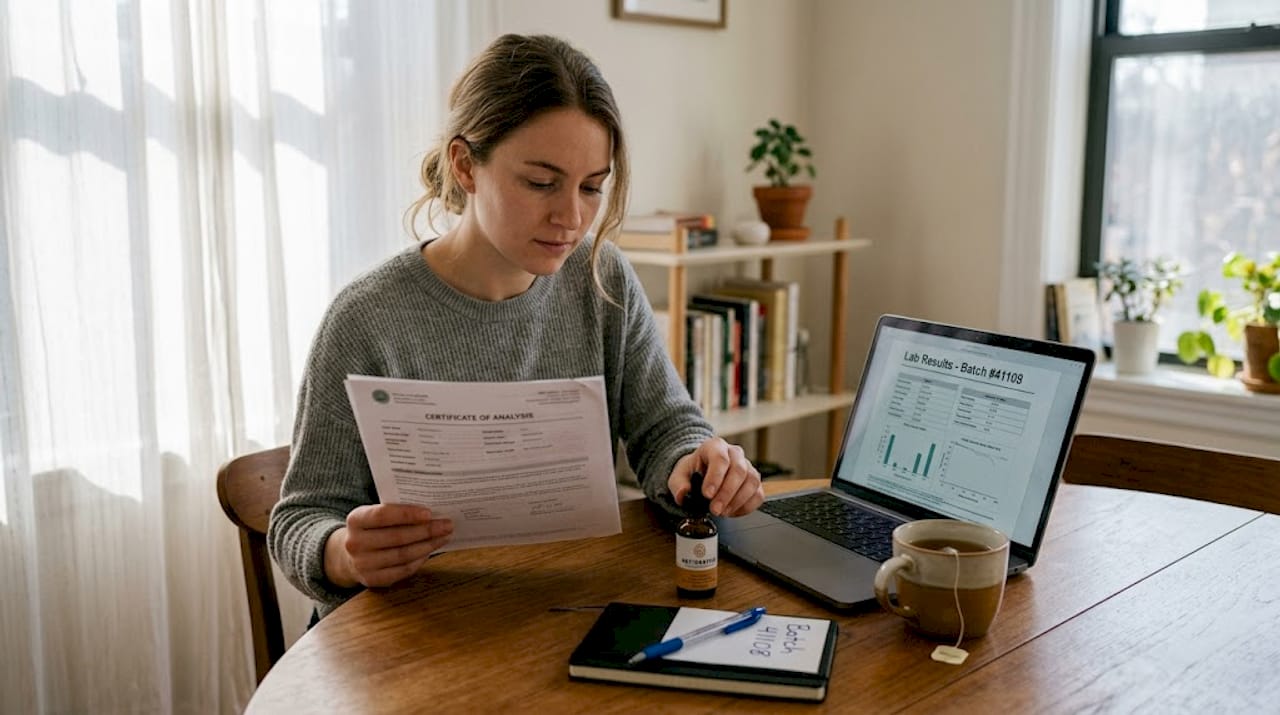
Here is how to quickly compare a legitimate COA versus a suspicious one:
| Feature | Legitimate COA | Red Flag COA |
|---|---|---|
| Lab accreditation | ISO 17025 certified, verifiable | Not listed or unverifiable |
| Batch number | Matches product label | Missing or generic |
| Test date | Within 12 months | Outdated or undated |
| Results format | Full numerical data | Only “Pass” stamps |
| Pesticide panel | 66+ compounds listed | Partial or missing panel |
Here is a step-by-step process for verifying any COA:
- Find the lab name and look it up independently to confirm ISO 17025 accreditation
- Match the batch number on the COA to the batch number on your product
- Check the test date and confirm it is within 12 months
- Review pesticide and heavy metal results for numerical values, not just pass/fail
- Compare the potency listed on the COA to the label claim on the packaging
Pro Tip: Use the COA interpretation guide to understand what acceptable contaminant limits actually look like in numeric form. Knowing what the numbers mean is more powerful than trusting a single word like “Pass.”
Always cross-reference what you find with the CBD label breakdown to make sure the label itself matches what the COA says. Discrepancies between the two are a serious fraud indicator.
Hemp CBD vs. legal cannabis: Key safety check differences for California consumers
This is where it gets especially important for anyone buying hemp-derived CBD or THCa. California’s licensed cannabis products are subject to the full mandatory testing framework described above. Hemp CBD products are not.
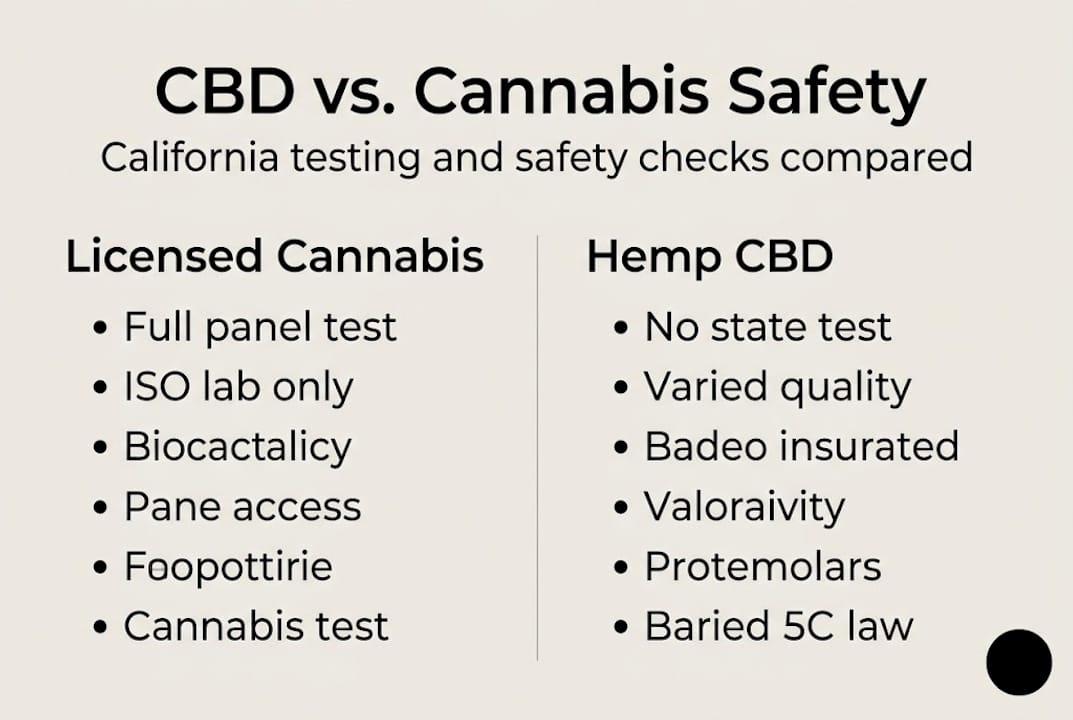
Hemp operates in a different regulatory lane. The result is that hemp products must have no detectable THC per serving and should be independently verified, but there is no state law forcing every hemp brand to submit to California’s full panel testing protocol. That is a meaningful gap.
Watch out for these specific risks when buying hemp-derived products:
- THCa conversion to THC: Raw THCa converts to THC when heated. A product labeled “hemp THCa” may become legally and pharmacologically equivalent to cannabis once you smoke or vaporize it. Always check the post-decarboxylation total THC figure on the COA.
- Semi-synthetic cannabinoids: Some brands use chemical conversion processes to create cannabinoids that do not occur naturally in hemp. These are poorly studied and carry unknown safety profiles.
- Non-standard labs: Lab fraud and inconsistent testing create real risk in both licensed cannabis and hemp markets. A COA from a lab you cannot verify is essentially worthless.
- Incomplete panels: A hemp COA covering only potency but skipping pesticides or heavy metals tells you almost nothing about product safety.
“For hemp-derived THCa specifically, the COA needs to show the total THC after decarboxylation, not just raw THCa content. This is the number that determines legality and safety.”
Pro Tip: Use these quality CBD tips to build a habit of requesting the full panel COA every single time, whether the product is licensed cannabis or hemp-derived. Brands that do independent third-party testing for hemp are the ones worth trusting. For safe CBD flower buying, verifying the source state and cultivation practices alongside the COA is essential.
A step-by-step checklist for safe CBD and THCa purchases
Putting all of this into practice takes less time than you might think. Lab-tested products with recent, clean panel results are the clearest signal that a brand is operating with integrity. Here is a simple checklist to run through before every purchase:
- Request the COA. Any brand worth buying from will make it accessible. If you cannot find it on the website or by asking, that is your answer.
- Check the date. The test should be less than 12 months old and ideally within the last 6 months for perishable flower products.
- Match the batch number. The COA batch number must match the number on your actual product packaging.
- Verify lab accreditation. Look up the lab independently and confirm ISO 17025 status.
- Review the full panel. Do not accept a COA that only shows potency. Pesticides, heavy metals, microbials, and solvents should all have results.
- Check for recalls. California’s Department of Cannabis Control publishes active recall notices. Search the brand name before buying.
- Confirm hemp THC compliance. For hemp products, verify the total THC post-decarboxylation is under 0.3%.
- Report problems. If you experience adverse effects or find a discrepancy, report it to California’s Department of Cannabis Control.
For a deeper dive into brand accountability, the product transparency guide is a useful starting point.
Pro Tip: Save the COA for every product you buy. If you experience any adverse effects, having the batch information and test results on hand makes reporting significantly faster and more effective.
Why safety checks are becoming even more critical: An expert’s perspective
Regulation creates a framework, but frameworks have cracks. One of the most underappreciated cracks in California’s cannabis testing system is methodological disagreement. Labs currently debate whether PCR or traditional culture methods more accurately detect mold in cannabis, and inflated potency figures have led to real shutdowns and recalls statewide. Two labs can test the same batch and return meaningfully different numbers.
The honest takeaway is that consumer safety in cannabis is not a solved problem. It is an ongoing negotiation between regulators, brands, and buyers. The brands that voluntarily invest in rigorous testing, clear COA disclosure, and accurate dosing practices are telling you something important about their values. And the brands that make COAs hard to find, or present incomplete panels, are also telling you something.
Trusting a product should never be passive. Active verification is a wellness practice in itself.
Choose safe, lab-tested CBD and THCa with California Blendz
Finding brands that actually back up their claims with transparent lab results can feel like a full-time job. That is exactly the problem California Blendz was built to solve.
Every product at California Blendz is sourced from California’s Emerald Triangle, grown organically, and independently lab-tested with full panel COAs you can actually access. No hunting around, no vague assurances. Our CBD flower, THCa flower, pre-rolls, and bundles are curated with your safety and experience in mind. You get the test results, the sourcing story, and the confidence to shop without second-guessing what is in your product. Real transparency, real quality, ready to ship.
Frequently asked questions
What contaminants are tested for in California cannabis products?
California cannabis products are tested for potency, 66+ pesticides, major heavy metals, residual solvents, microbials, mycotoxins, moisture, and foreign material before any product can be sold legally.
How do I know if a cannabis product’s COA is real in California?
Ensure the COA is less than 12 months old, batch-specific, and from an ISO 17025 accredited lab, with batch numbers that match your product packaging exactly.
Is hemp-derived THCa legal and safe in California?
Hemp-derived THCa is only compliant if total THC post-decarboxylation stays under 0.3%, and safety depends entirely on independent third-party lab testing covering the full contaminant panel.
What is the main cause of cannabis product recalls in California?
Most California recalls are caused by pesticides or mold contamination, both of which are detectable through proper full-panel lab testing before products reach consumers.
Are there differences between safety checks for licensed cannabis and hemp CBD in California?
Yes. Licensed cannabis requires full state-mandated testing by law, while hemp CBD does not, so always request an independent third-party COA before purchasing any hemp-derived product.
Recommended
- California Cannabis Best Practices: 30% Safer Lab-Tested – California Blendz
- Safe home cannabis storage: 5 essential steps (2026) – California Blendz
- Legal Requirements for CBD – What California Shoppers Need – California Blendz
- CBD and Legal Compliance: What California Shoppers Need – California Blendz


