
Master cannabis dosing accuracy for better wellness results
Written by Trevor

Many consumers struggle with cannabis dosing because product labels often don’t match actual potency, especially with flower products. Understanding how label accuracy, testing methods, and bioavailability affect your dose helps you achieve consistent wellness benefits safely. This guide breaks down the science behind dosing accuracy and shows you how to verify potency, choose reliable products, and personalize your dose for hemp-derived CBD and THCa products.
Table of Contents
- Key takeaways
- Understanding cannabis product labeling and potency accuracy
- Laboratory testing challenges and how they impact dosing accuracy
- Bioavailability and formulation: why your dose might differ from the label
- Practical tips for accurate and safe cannabis dosing
- Explore trusted hemp-derived products for accurate dosing
- FAQ
Key Takeaways
| Point | Details |
|---|---|
| Potency labeling gaps | Flower labels often overestimate potency compared to concentrates, leading to less predictable dosing. |
| Concentrates provide consistency | Concentrates offer more consistent potency than flower but still require verification. |
| COA verification importance | Always check a recent COA from an ISO accredited lab within the past six months to ensure accurate potency. |
| Start low go slow | Begin with a small dose and adjust based on how your body responds to personalize dosing safely. |
Understanding cannabis product labeling and potency accuracy
The cannabis industry faces significant challenges with cannabinoid potency labeling accuracy, and these discrepancies directly impact your ability to dose precisely. Research reveals stark differences between product types. Label accuracy for concentrates reaches 96% within acceptable ranges, while flower products achieve only 56.7% accuracy, with systematic over-labeling averaging 4.3% above actual THC content.
This means when you purchase flower labeled at 20% THC, the actual potency might be closer to 15.7%. For consumers seeking specific effects or managing tolerance, this variability creates unpredictable experiences. You might find yourself consuming more product than intended to achieve desired results, or experiencing unexpectedly mild effects despite high label claims.
Concentrates offer more reliable dosing precision because extraction and processing create homogeneous products with consistent cannabinoid distribution. The manufacturing process for concentrates involves quality controls that flower products can’t match. However, even with concentrates, verification remains essential.
Pro Tip: Prioritize lab-tested concentrates over flower when precise dosing matters most for your wellness routine. The improved accuracy helps you dial in your ideal dose faster and maintain consistent effects.
Choosing products with recent Certificates of Analysis from ISO-accredited laboratories gives you the best chance at accurate dosing. Look for testing dates within the past six months, as cannabis flower potency can degrade over time through exposure to light, heat, and oxygen.
Key factors affecting label accuracy:
- Sample variability within the same batch or harvest
- Testing methodology differences between laboratories
- Intentional or unintentional mislabeling practices
- Degradation between testing and consumption
- Lack of standardized industry regulations
Understanding these labeling challenges empowers you to make informed purchasing decisions and adjust your expectations accordingly. When you know flower labels tend toward overestimation, you can start with slightly higher amounts than calculated and adjust based on actual effects rather than label claims alone.
With an understanding of labeling accuracy differences, let’s examine how testing methods can affect these potency results.
Laboratory testing challenges and how they impact dosing accuracy
Even when laboratories test cannabis products with good intentions, analytical methods face significant technical challenges that compromise dosing accuracy. The chemistry of hemp-derived products creates unique measurement problems that standard testing protocols struggle to resolve.
Chromatographic interferences in hemp concentrates limit accurate Δ9-THC determination because similar compounds like Δ8-THC and manufacturing by-products co-elute during analysis. This means the detector can’t distinguish between target cannabinoids and interfering substances, potentially inflating reported potency.
Liquid chromatography with photodiode array detection, a common testing method, excels at measuring CBD with high accuracy but struggles with THC variants in complex hemp matrices. The problem intensifies with products derived from hemp biomass conversion processes, where chemical transformations create dozens of structurally similar compounds.
Common testing interferences:
- Δ8-THC overlapping with Δ9-THC peaks
- CBD degradation products mimicking other cannabinoids
- Terpenes affecting detector response
- Extraction solvent residues interfering with measurements
- Matrix effects from plant lipids and waxes
Pro Tip: Request COAs that specify the analytical method used and show chromatograms when possible. Laboratories using advanced techniques like mass spectrometry provide more reliable cannabinoid identification than basic UV detection alone.
CBD measurements generally achieve higher accuracy than THC because CBD exists in higher concentrations and faces fewer interfering compounds. This explains why CBD products often deliver more predictable effects than THC-dominant options. When reading THC percentages, remember that small percentage differences might reflect testing variability rather than actual potency changes.
“Understanding the limitations of cannabis testing helps set realistic expectations. No single test provides perfect accuracy, but consistent testing from reputable labs offers the best available guidance for informed dosing.”
Laboratory accreditation matters significantly. ISO/IEC 17025 accredited labs follow standardized protocols, maintain equipment calibration, and participate in proficiency testing programs. These quality measures don’t eliminate all measurement challenges but substantially improve reliability compared to unaccredited facilities.
The recency of testing also impacts accuracy. Cannabinoids degrade through decarboxylation, oxidation, and isomerization over time. A COA from six months ago might not reflect current potency, especially for products stored in suboptimal conditions. Always verify testing dates before making dosing decisions based on reported values.
Building on testing challenges, we’ll next explore how bioavailability affects effective dosing beyond labeling.
Bioavailability and formulation: why your dose might differ from the label
Even with perfectly accurate labels, the amount of cannabinoid entering your bloodstream depends heavily on product formulation and consumption method. This concept, called bioavailability, explains why identical doses of different products produce vastly different effects.

Oral CBD suffers from notoriously poor bioavailability, typically below 10-20% for standard capsules or edibles. Your digestive system and liver metabolism destroy most cannabinoids before they reach systemic circulation. However, enhanced CBD formulations improve maximum concentration 3-6 times and overall exposure 2-4 times compared to basic products.
These advanced formulations use techniques like nanoemulsion, liposomal encapsulation, or self-emulsifying delivery systems to protect cannabinoids during digestion and enhance absorption. A 25mg dose of enhanced CBD might deliver blood levels equivalent to 100mg of standard CBD, dramatically affecting your effective dose.
| Consumption method | Typical bioavailability | Onset time | Duration |
|---|---|---|---|
| Inhalation (smoking/vaping) | 20-30% | 2-5 minutes | 2-4 hours |
| Sublingual (tinctures) | 15-25% | 15-30 minutes | 4-6 hours |
| Oral standard (edibles/capsules) | 4-12% | 60-120 minutes | 6-8 hours |
| Oral enhanced (nanoemulsion) | 15-40% | 30-60 minutes | 6-10 hours |
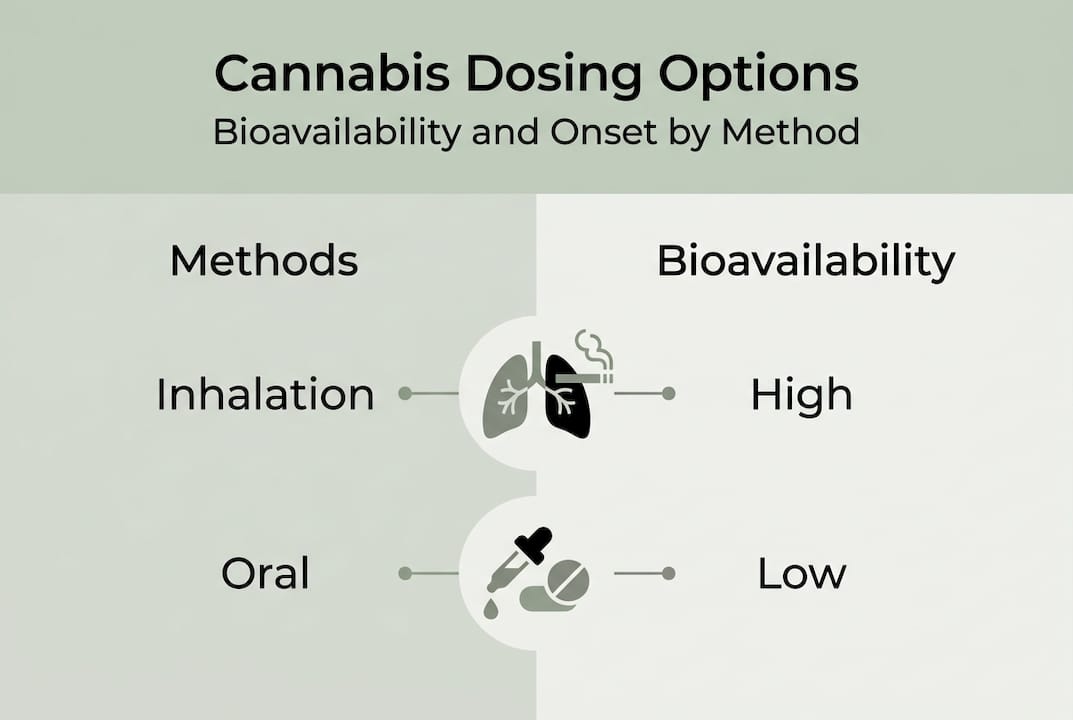
Inhalation provides the highest bioavailability and fastest onset, making it easier to titrate doses in real time. You feel effects quickly and can decide whether to consume more within minutes. This immediacy supports the “start low, go slow” approach better than methods with delayed onset.
Oral consumption creates unpredictable absorption because food intake, digestive health, and individual metabolism vary significantly between people and occasions. The same edible might produce strong effects on an empty stomach but barely noticeable results after a large meal. This variability makes determining CBD dosage more challenging with oral products.
Factors affecting bioavailability:
- Carrier oils and emulsifiers in the formulation
- Particle size of cannabinoid molecules
- Presence of food in your digestive system
- Individual differences in metabolism and absorption
- Product quality and manufacturing processes
Pro Tip: When switching between consumption methods or product formulations, reduce your dose by 50% initially and adjust upward based on observed effects. Different bioavailability profiles mean your usual dose might be too strong or too weak with a new product type.
Understanding formulation impacts helps you choose products matching your dosing preferences. If you need rapid relief with precise control, inhalation offers advantages despite lower total duration. For sustained effects throughout the day, enhanced oral formulations provide longer-lasting benefits once you establish your effective dose.
The first-pass metabolism through your liver also converts THC into 11-hydroxy-THC, a more potent metabolite that contributes to the stronger, more sedating effects many people experience with edibles compared to smoking. This metabolic transformation represents another layer of complexity in predicting your actual dose from label claims.
Having grasped bioavailability’s role, let’s discuss practical dosing strategies to apply this knowledge safely.
Practical tips for accurate and safe cannabis dosing
Applying dosing science to your personal wellness routine requires systematic experimentation within safe boundaries. The foundational principle remains consistent across all cannabis products: start with minimal amounts and increase gradually while monitoring effects.
For inhalation methods, begin with a single small puff and wait 15-20 minutes before considering additional consumption. This waiting period lets you assess the full onset of effects and prevents overconsumption. Many users make the mistake of taking multiple hits in quick succession, then experiencing stronger effects than intended once full absorption occurs.
Oral products demand even more patience. Wait a full 2 hours after consuming edibles or capsules before taking more. The delayed onset creates a temptation to redose prematurely, leading to uncomfortable experiences when both doses hit simultaneously. Mark your consumption time and set a timer to avoid this common pitfall.
Step-by-step dosing protocol:
- Start with the lowest available dose, typically 2.5-5mg for THC or 10-15mg for CBD
- Document your consumption time, amount, product details, and any food intake
- Wait the appropriate onset period without additional consumption
- Record your experience including effects, intensity, and duration
- Maintain the same dose for 3-5 sessions before increasing
- Increase by small increments, typically 2.5mg for THC or 5-10mg for CBD
- Repeat the evaluation process at each new dose level
Your individual factors significantly influence optimal dosing. Body weight affects cannabinoid distribution, with larger individuals generally requiring higher doses for equivalent effects. However, metabolism speed, tolerance level, and endocannabinoid system sensitivity matter more than weight alone.
Regular cannabis users develop tolerance, requiring progressively higher doses for the same effects. If you find your usual dose becoming less effective, consider a tolerance break rather than continuously escalating consumption. A few days to two weeks without cannabis can reset your sensitivity substantially.
Pro Tip: Keep a dosing journal tracking product, amount, timing, effects, and any variables like food intake or stress levels. Patterns emerge over time that help you predict optimal doses for different situations and desired outcomes.
Verifying potency through Certificates of Analysis remains critical for accurate dosing calculations. Look for COAs showing testing within the past six months from ISO/IEC 17025 accredited laboratories. The certificate should display individual cannabinoid percentages, testing date, batch number matching your product, and laboratory contact information.
Cross-reference the batch number on your product packaging with the COA batch number. Some companies display outdated or generic COAs that don’t match actual product batches. This practice undermines dosing accuracy and suggests questionable quality control.
Selecting CBD dosage for therapeutic purposes often requires higher amounts than recreational THC use. While 2.5-10mg THC might produce noticeable psychoactive effects, effective CBD doses for wellness applications typically range from 20-100mg or higher. Don’t assume equivalent dosing between cannabinoids.
Re-evaluate your dosing regularly as your needs and tolerance evolve. What works perfectly for three months might become too strong or too weak as your endocannabinoid system adapts. Periodic dose adjustments keep your cannabis use aligned with your wellness goals.
Equipped with practical dosing methods, let’s explore how to ensure you’re getting what the label promises before you dose.
Explore trusted hemp-derived products for accurate dosing
Accurate dosing starts with reliable products backed by transparent testing and quality standards. Finding trustworthy sources eliminates guesswork and helps you achieve consistent wellness results.
California Blendz offers a curated selection of hemp-derived CBD and THCa products with verified potency through comprehensive lab testing. Every product includes accessible Certificates of Analysis so you can confirm cannabinoid content before making dosing decisions. The selection focuses on organic, sustainably grown flower and concentrates from California’s Emerald Triangle, emphasizing quality and legal compliance. Whether you’re new to cannabis wellness or refining your personal dosing protocol, explore trusted hemp products designed for accuracy and natural effectiveness.
FAQ
What causes discrepancies between labeled and actual THC potency?
Testing interferences from similar compounds, sample variability within batches, and systematic over-labeling practices create discrepancies between labels and actual potency. Laboratory methodology limitations and product degradation over time also contribute to inaccurate potency claims.
How can I verify that my CBD or THCa product’s potency is accurate?
Check that the Certificate of Analysis is recent, ideally under six months old, and comes from an ISO/IEC 17025 accredited laboratory. Cross-reference the batch number on your product with the COA batch number to ensure they match. Review THC percentage reading techniques to interpret results correctly.
What factors should I consider when adjusting my cannabis dose?
Tolerance level, metabolism speed, body weight, consumption method, and product formulation all affect your optimal dose. Monitor how these variables influence your experience and adjust gradually based on observed effects. Consult the cannabis dosing basics guide for detailed adjustment strategies.
Why do edibles feel stronger than smoking the same THC amount?
Your liver converts THC into 11-hydroxy-THC when you consume edibles, creating a more potent metabolite with stronger sedating effects. Combined with different bioavailability profiles and slower onset, oral consumption produces distinctly different experiences than inhalation despite equivalent doses.


