
Cannabinoid safety overview: What consumers must know
Written by Trevor

TL;DR:
- Hemp-derived cannabinoids vary widely in quality and safety due to minimal federal regulation.
- Most mild side effects occur at low doses; vulnerable groups should avoid use without medical advice.
- Always verify products with third-party lab testing reports to ensure potency and safety.
Hemp-derived cannabinoids like CBD and Delta-8 THC are everywhere, from gas station shelves to wellness boutiques, but the safety picture is far murkier than the marketing suggests. The U.S. market operates with minimal federal oversight, leaving consumers to navigate an unregulated landscape where product quality, potency, and purity can vary wildly from brand to brand. While not FDA-approved for most wellness uses, cannabinoids generally show mild adverse effects in studies. The real danger often comes not from the compounds themselves, but from what else might be in the product. Here is what the evidence actually says, and how to protect yourself.
Table of Contents
- Understanding cannabinoids: Types, uses, and what’s in your products
- Known risks and side effects: What clinical evidence tells us
- Special safety concerns: Interactions, at-risk groups, and consumption methods
- How to verify cannabinoid product safety: Lab testing and quality signals
- The hidden risks: Why product testing is the real safety game-changer
- Explore more: Trustworthy CBD and cannabinoid safety resources
- Frequently asked questions
Key Takeaways
| Point | Details |
|---|---|
| Choose lab-tested products | Only buy cannabinoids with clear Certificates of Analysis for purity and potency. |
| Know your risks | Most side effects are mild, but certain groups should avoid cannabinoid use entirely. |
| Understand interactions | Always check for drug interactions and underlying medical conditions before use. |
| Federal oversight is lacking | CBD and most hemp-derived cannabinoids are not FDA-regulated for safety or content. |
Understanding cannabinoids: Types, uses, and what’s in your products
When people say “cannabinoids,” they usually picture CBD. But the hemp-derived market has exploded with options including Delta-8 THC, Delta-10 THC, HHC (hexahydrocannabinol), CBG, CBN, and THC-O. Each compound interacts differently with your body’s endocannabinoid system, and each carries a distinct risk and legality profile.
CBD (cannabidiol) is the most studied, widely used for calming effects, sleep, and discomfort relief. Delta-8 THC delivers mild psychoactive effects and comes from hemp, making it federally ambiguous but popular. What is HHC? It is a hydrogenated form of THC with a longer shelf life and a similar, though less potent, high. THC-O is a synthetic derivative that is significantly more potent and carries unique risks discussed later in this article.
| Cannabinoid | Common uses | Legal status (federal) | Key notes |
|---|---|---|---|
| CBD | Calm, sleep, relief | Legal (Farm Bill) | Most studied; minimal intoxication |
| Delta-8 THC | Mild euphoria, relaxation | Gray area | Derived from hemp; state laws vary |
| HHC | Relaxation, mood | Gray area | Semi-synthetic; less researched |
| CBG | Focus, gut health | Legal | Emerging research only |
| THC-O | Strong euphoria | Federally illegal | Synthetic; higher risk profile |
The problem is not just which compound you are using. It is what is actually in the product. CBD products lack federal standards for content, purity, or potency, and may contain impurities or inaccurate labeling. Third-party testing fills this gap, but not every brand prioritizes it.
Consumers should also keep in mind that CBD regulations by state differ significantly. A product legal in California may be restricted in Idaho. Always verify your state’s rules before purchasing.
“Natural” does not mean regulated. Hemp plants can absorb heavy metals and pesticides from soil, and without rigorous lab screening, those toxins end up in finished products.
Signs that a product discloses its content honestly include batch-specific COA links, clear cannabinoid concentrations listed on the label, and third-party testing by ISO-accredited labs. More on how to read those reports later.
Known risks and side effects: What clinical evidence tells us
Here is the honest truth about cannabinoid side effects: they are real but, for most healthy adults at low doses, manageable. The research does show a clear pattern.
Common side effects of CBD and cannabinoids include dizziness, dry mouth, drowsiness, nausea, diarrhea, fatigue, and decreased appetite. These effects are generally mild to moderate. Delta-8 THC and HHC can add psychoactive effects like anxiety or confusion, especially at higher doses.
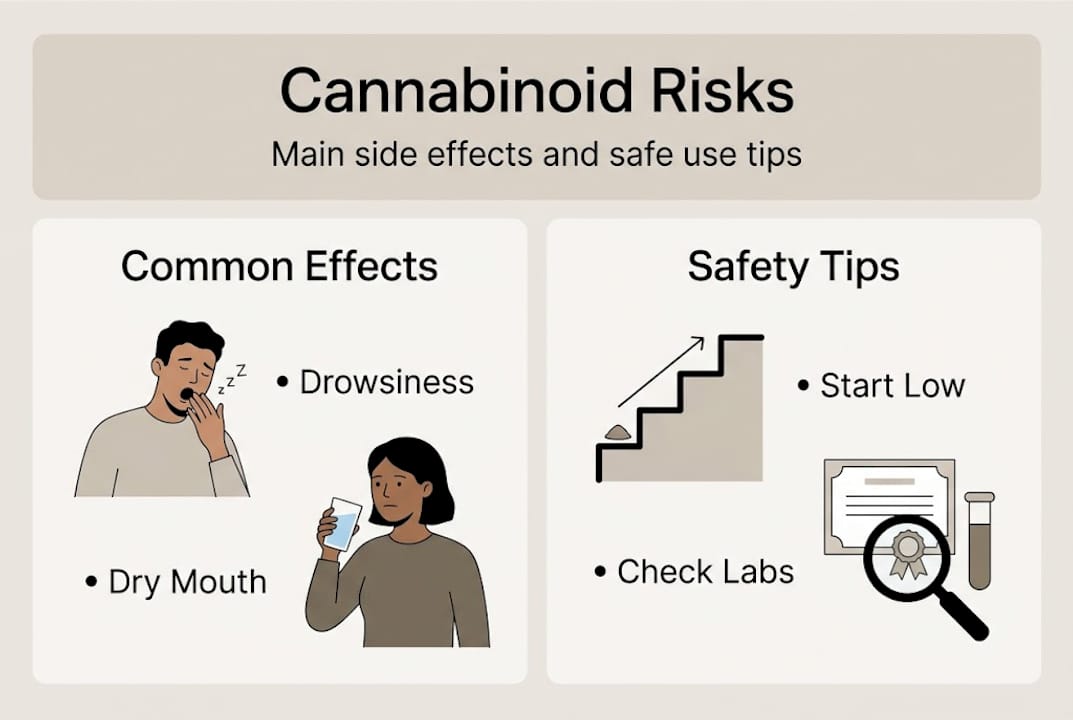
| Side effect | CBD | Delta-8 THC | HHC |
|---|---|---|---|
| Dry mouth | Common | Common | Common |
| Dizziness | Mild | Moderate | Moderate |
| Anxiety/paranoia | Rare | Possible | Possible |
| Liver enzyme elevation | With high doses | Unlikely | Unknown |
| Drowsiness | Common | Moderate | Moderate |
Who faces the most risk? Pay attention to this list:
- People taking prescription medications (especially blood thinners or anti-epileptics)
- Individuals with liver disease or compromised liver function
- Those with a personal or family history of psychosis or schizophrenia
- Anyone currently pregnant or breastfeeding
- Children and teenagers, whose developing brains are more sensitive
- Older adults managing multiple health conditions
One important perspective: limited high-quality evidence exists for pain relief from cannabinoids, and while they appear safer than opioids, they remain insufficient evidence for most broad wellness claims. The science is promising but incomplete. That gap matters when you are making decisions about your health.
For practical guidance on reducing your exposure to risk while using these products, exploring smart cannabinoid safety tips can help you build a safer routine from the start.
Special safety concerns: Interactions, at-risk groups, and consumption methods
This is where it gets personal. The cannabinoid that works well for your neighbor might be genuinely risky for you, depending on your health status and the medications you take.
CBD is metabolized by liver enzymes known as CYP3A4 and CYP2C19. CBD interacts with common medications processed by those same pathways, including warfarin, clobazam, and some antidepressants. This interaction can raise drug levels in your bloodstream dangerously, or lower their effectiveness. If you take any prescription medication, talk to your doctor before adding cannabinoids.
The following groups should exercise strong caution or avoid cannabinoids altogether:
- Pregnant or breastfeeding women
- Children and adolescents
- Older adults, particularly those with cardiovascular disease
- People with a history of psychosis or severe anxiety disorders
- Anyone with liver disease or elevated liver enzymes
Vulnerable groups like older adults and those with heart or psychiatric conditions face elevated risks that make even mild cannabinoids potentially harmful without medical supervision.
How you consume cannabinoids also changes the risk equation significantly. Edibles take longer to kick in, leading many users to take too much too soon. Inhaled forms, including smoked and vaped products, carry their own dangers. HHC and Delta-8 THC-O vaping products in particular carry higher risks including pulmonary toxicity, with THC-O vaping linked to EVALI, a serious lung injury condition.
For a deeper look at how different delivery methods compare in terms of safety and effectiveness, the guide on safe CBD consumption methods walks through each option clearly. Getting accurate cannabis dosing right also dramatically reduces the likelihood of a negative experience.
Pro Tip: Always start with the lowest possible dose of any new cannabinoid product, and wait at least two hours before redosing. This is especially important with edibles, where the onset is delayed and the temptation to take more is high.
How to verify cannabinoid product safety: Lab testing and quality signals
You cannot tell if a product is safe by looking at the packaging. You need the data behind it. That is where Certificates of Analysis (COAs) come in. A COA is a third-party lab report that shows exactly what is in a product, including cannabinoid potency, residual solvents, pesticides, heavy metals, and microbial contamination.
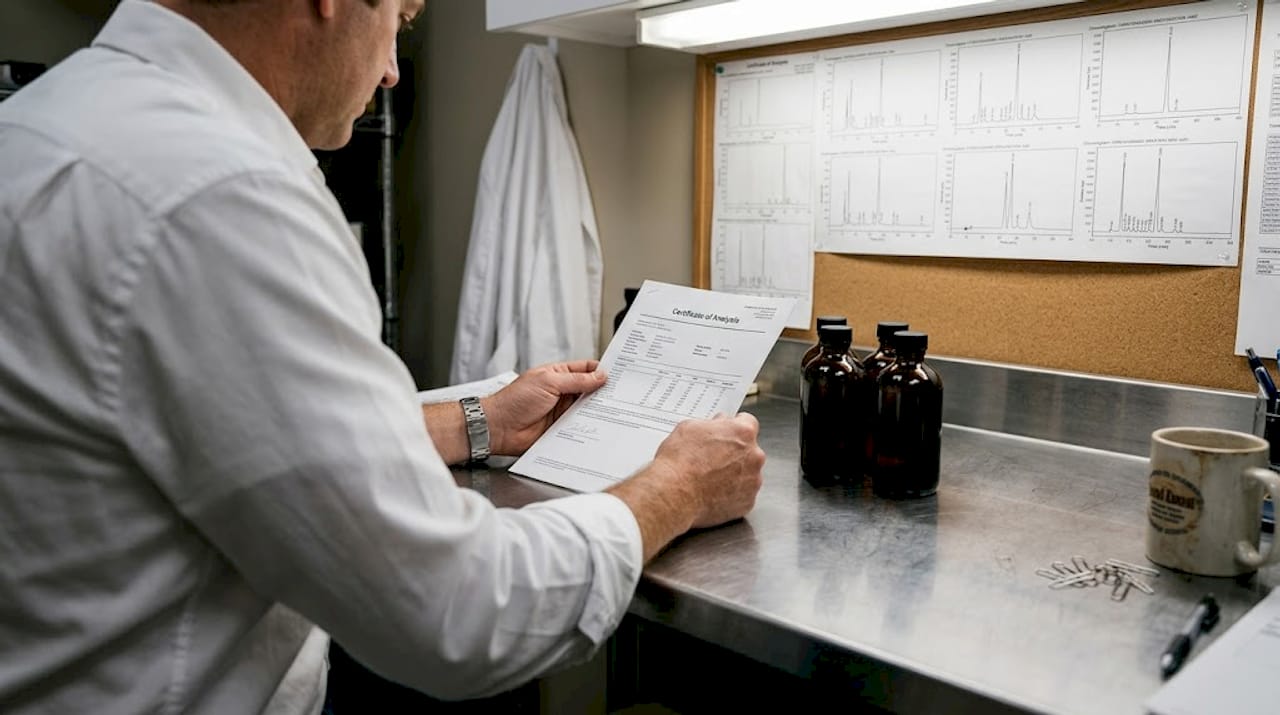
To verify lab-tested products for purity, potency, and contaminant levels, always request or locate the COA before purchasing. Reputable brands make these documents publicly accessible, typically via QR code or product page.
Here is what to look for when reviewing a COA:
- Batch number match: The COA batch number should match the one printed on your product
- Testing date: Look for recent tests, ideally within the last 12 months
- Cannabinoid profile: Verify the product contains what the label claims
- Contaminant panels: Confirm tests for pesticides, heavy metals, and microbials
- Accredited lab: The testing facility should be ISO 17025 certified or state-licensed
- Delta-9 THC level: Must be below 0.3% for legal hemp classification
For more context on what these documents actually mean in practice, understanding lab-tested cannabis breaks down the terminology in plain language.
Pro Tip: Most people only check cannabinoid potency on a COA. The real red flags are in the contaminant panels. Failing results for pesticides or heavy metals mean the product is unsafe, regardless of how good the CBD percentage looks.
Look beyond the potency numbers. A COA that only lists cannabinoid content but skips pesticides, solvents, and heavy metals is incomplete and not worth trusting.
Learning how to identify quality CBD takes practice, but once you know what to look for, it becomes second nature. You can also read about how cannabis is tested to understand the science behind the numbers. And if you want a quick summary of why this matters for your routine, lab-tested flower for wellness lays it out clearly.
The hidden risks: Why product testing is the real safety game-changer
Most safety conversations focus on cannabinoids themselves. Is CBD risky? Is Delta-8 too strong? Those are fair questions, but they miss a bigger point: the compound is rarely the problem. The product is.
Clinical trials use pure, precisely dosed compounds. The bottle you pick up at a wellness shop might contain a fraction of the labeled CBD, or it might have residual solvents from a rushed extraction process. Methodologies from RCTs show good tolerability in controlled settings, but real-world risks come from variability and mislabeling, and chronic use warrants liver enzyme monitoring.
The “natural” label is one of the most misleading in consumer wellness. Hemlock is natural. Arsenic occurs naturally in soil. A hemp plant grown without proper agricultural controls can concentrate toxins, and no amount of “organic” branding changes that without verified lab results to back it up.
Smart consumers treat product skepticism as a habit, not a one-time check. Brands that invest in transparent testing have nothing to hide and everything to prove. Those that make it hard to find lab results usually have a reason. Reviewing cannabis safety considerations regularly keeps your knowledge current as new products and cannabinoids enter the market.
Explore more: Trustworthy CBD and cannabinoid safety resources
If this overview has clarified some of the confusion around cannabinoid safety, the next step is making sure the products you choose actually meet the standards we have discussed. At California Blendz, every product comes with third-party lab results, clear sourcing from California’s Emerald Triangle, and a commitment to transparency that goes beyond the label.
Browse our selection of safe, lab-tested CBD products and filter by effect, experience, or cannabinoid type to find what fits your wellness goals. If you want to go deeper on the science behind what makes a product trustworthy, our resource on learn about lab testing gives you the full picture. Knowledge and quality belong together, and we are here to support both.
Frequently asked questions
Are hemp-derived cannabinoids like CBD and Delta-8 safe to use?
Most carry a mild side effect profile at low doses for healthy adults, but products may be mislabeled or contaminated, and risks increase significantly in vulnerable populations or without lab-tested sourcing.
Who should avoid using cannabinoids?
Pregnant or breastfeeding women, children, older adults, and people with heart disease or psychiatric conditions should avoid cannabinoids, as vulnerable groups face elevated risks even at low doses.
How can I check if a cannabinoid product is safe?
Look for third-party lab reports showing potency, purity, and contaminant screening. Lab-tested products with an accessible Certificate of Analysis minimize the risk of exposure to mislabeled or contaminated goods.
Do cannabinoids interact with medications?
Yes. CBD in particular can raise or lower the blood levels of several common drugs because CBD interacts with CYP3A4 and CYP2C19 pathways, affecting medications like warfarin and clobazam, so medical consultation is essential.
Recommended
- Cannabinoid Safety Tips: Smart Choices for CBD & THCa – California Blendz
- Essential cannabis safety considerations for consumers – California Blendz
- Top cannabis flower safety tips for healthy use – California Blendz
- Cannabis dosing fundamentals: A clear guide for California users 2026 – California Blendz


