
CBD and Legal Compliance: What California Shoppers Need
Written by Trevor

Finding truly legal and transparent hemp-derived CBD can feel challenging if you live in California. Federal rules permit hemp-derived CBD with less than 0.3% THC, but California now requires zero detectable THC in food and beverage products, setting stricter standards than federal law. Shopping with confidence in this evolving market means knowing how to spot compliant labels, trust credible sourcing, and understand the difference between hemp-derived and cannabis-derived CBD for your wellness journey.
Table of Contents
- CBD And Legal Status Explained
- Types Of CBD And THC Distinctions
- Key California And Federal Regulations
- Labeling, Age Restrictions, And Sourcing Standards
- Risks, Penalties, And Consumer Responsibilities
Key Takeaways
| Point | Details |
|---|---|
| CBD Legalities | CBD is federally legal if derived from hemp with less than 0.3% THC, but state regulations, especially in California, may impose stricter standards. |
| Types of CBD | California allows both hemp-derived and cannabis-derived CBD, with distinct legal requirements and sources for purchase. |
| Labeling and Compliance | Consumers should verify product labels for compliance, including batch numbers and lab testing documentation to ensure safety and legality. |
| Consumer Responsibilities | Shoppers must confirm the compliance of their purchases to avoid health risks and penalties, especially when buying from unlicensed retailers. |
CBD and Legal Status Explained
Cannabidiol, or CBD, occupies a unique position in American law. It’s legal federally under specific conditions, yet state regulations vary significantly. Understanding this distinction is crucial for California shoppers.
The 2018 Farm Bill changed everything for hemp-derived CBD. It federally legalized CBD products containing less than 0.3% THC by dry weight. This threshold became the legal standard across the United States. However, individual states maintain authority to set their own rules.
California’s approach differs from many states. The state allows hemp-derived CBD under federal guidelines but also permits cannabis-derived CBD through its legal cannabis market. This dual pathway creates options California residents don’t find elsewhere. Some states ban CBD entirely or classify it differently.
CBD has gained medical recognition in recent years. The FDA approved Epidiolex® for treating specific seizure disorders, confirming CBD’s therapeutic potential for certain conditions. This approval validated CBD’s medicinal properties at the federal level.
However, legal status varies globally in ways that affect imports and research. International CBD regulatory frameworks lack harmonization, meaning products legal in California may be prohibited elsewhere. This creates complications for manufacturers and consumers alike.
Here’s what the current California legal landscape actually allows:
- Hemp-derived CBD products with under 0.3% THC
- Cannabis-derived CBD from licensed dispensaries
- CBD in foods, beverages, and cosmetics under specific conditions
- Third-party lab testing verification
- Products from California’s legal cannabis supply chain
California permits both hemp-derived and cannabis-derived CBD, making it one of the most permissive states for legal access.
The distinction between hemp and cannabis matters legally. Hemp is cannabis with less than 0.3% THC; anything above that threshold is classified as marijuana. This seemingly small percentage difference determines whether products fall under federal hemp regulations or state cannabis regulations.
Product transparency is your protection in this complex system. California requires third-party lab testing results showing THC and CBD content. These results verify products actually contain what sellers claim. They also confirm the absence of contaminants.
Federal legality doesn’t equal complete freedom. Banks often refuse CBD businesses despite federal legality. Insurance companies may decline coverage. This creates financial friction even for compliant businesses.
For California shoppers, federal legality means you can legally purchase and possess hemp-derived CBD. State regulations support this further. But always verify products come from compliant sources with available lab testing.
Pro tip: Verify lab test results match the product you’re buying by checking the batch number or lot code on the label against the third-party testing documentation provided by the retailer.
Types of CBD and THC Distinctions
CBD and THC are both cannabinoids, but they work completely differently in your body. Understanding these differences is essential for making informed purchasing decisions in California.
The most obvious distinction is the “high.” THC produces intoxication and euphoria, while CBD does not. This fundamental difference shapes everything about how these compounds are regulated, sold, and used. THC binds directly to cannabinoid receptors in your brain, creating psychoactive effects. CBD operates through different molecular pathways, offering therapeutic benefits without the high.
Structurally, both molecules share the same atoms but arrange them differently. This seemingly small chemical variation creates vastly different effects on human behavior and health. Think of it like two buildings made from identical materials but with completely different designs.
California’s legal framework treats these compounds distinctly. Hemp-derived CBD remains federally legal regardless of THC limits in hemp. Cannabis-derived THC falls under state cannabis regulations. The legal threshold of 0.3% THC separates hemp from marijuana.
Here’s how they actually differ:
- Psychoactive effects: THC creates a “high”; CBD does not
- Receptor binding: THC directly activates CB1 receptors; CBD modulates other pathways
- Legal status: CBD is federally legal; THC remains federally restricted
- Medical applications: CBD shows therapeutic potential; THC has approved medical uses
- Intoxication: THC impairs cognition; CBD does not affect mental clarity
CBD counteracts THC’s psychoactive effects, meaning products with both compounds may feel different than THC alone.
There’s an important detail about CBD and heat. When heated above certain temperatures, CBD can convert into THC. This means smoking or vaping CBD at high temperatures might produce unexpected psychoactive effects. Storage and preparation method matter significantly.
California shoppers encounter both types in the market. Hemp-derived CBD products come from federally compliant hemp. Cannabis-derived CBD comes from licensed dispensaries and may contain trace THC. Understanding which you’re purchasing helps you select the right product for your needs.
For a quick reference, here’s how hemp-derived and cannabis-derived CBD products differ for shoppers:
| CBD Source | Purchase Location | Legal Status | Typical Uses |
|---|---|---|---|
| Hemp-derived CBD | Retailers, online | Federally legal, state regulated | Wellness, non-intoxicating |
| Cannabis-derived CBD | Licensed dispensaries | State legal, federally restricted | Medical, may contain THC |
THC potency varies widely among cannabis products. A high-THC flower might contain 20-30% THC, while hemp-derived CBD products contain virtually no THC. This potency difference affects both effects and legal classification.
CBD’s non-intoxicating nature makes it suitable for daytime use without affecting your ability to work or drive. THC products require different considerations due to impairment risks. Your lifestyle and responsibilities should guide your choice between these compounds.
Pro tip: If you’re new to cannabinoids, start with hemp-derived CBD since it won’t produce psychoactive effects, allowing you to assess how your body responds before exploring THC products.
Key California and Federal Regulations
Federal and California regulations create a layered compliance framework for CBD shoppers. These rules interact in ways that can seem contradictory if you’re not paying attention. Knowing both levels is essential for making legal purchases.
The federal 2018 Farm Bill legalized hemp-derived CBD containing less than 0.3% THC. This federal baseline applies nationwide. However, California has added its own stricter requirements on top of federal rules. The state doesn’t simply accept federal compliance—it demands additional protections.
California’s emergency regulations effective September 2024 changed the game significantly. The state banned hemp-derived food and beverage products containing detectable THC. This means CBD-infused drinks, edibles, and dietary supplements must be completely THC-free. Retailers had to remove non-compliant products from shelves immediately.
This regulation protects children and enforces stricter controls than federal law permits. Federal rules allow up to 0.3% THC; California now requires zero detectable THC in hemp-derived foods and beverages. That’s a meaningful difference for consumers.
Here’s what California actually allows:
- Hemp-derived CBD products with zero detectable THC in foods and beverages
- Hemp-derived CBD in non-food products (topicals, tinctures, capsules)
- Cannabis-derived CBD exclusively from licensed dispensaries
- Strict testing and labeling requirements for all products
- No CBD in foods without FDA approval
California requires zero detectable THC in hemp-derived foods and beverages, which is stricter than the federal 0.3% threshold.
California differentiates between hemp-derived and cannabis-derived CBD. Hemp-derived products fall under Assembly Bill 45, requiring proper testing and labeling if they comply. Cannabis-derived CBD requires state cannabis licenses, excise taxes, and advertising restrictions. The source matters legally and financially.
Another critical detail: California prohibits hemp-derived CBD in foods without FDA approval. This creates a practical problem—the FDA hasn’t approved CBD for food use. So technically, hemp-derived CBD cannot legally be added to foods in California, despite federal hemp legalization.
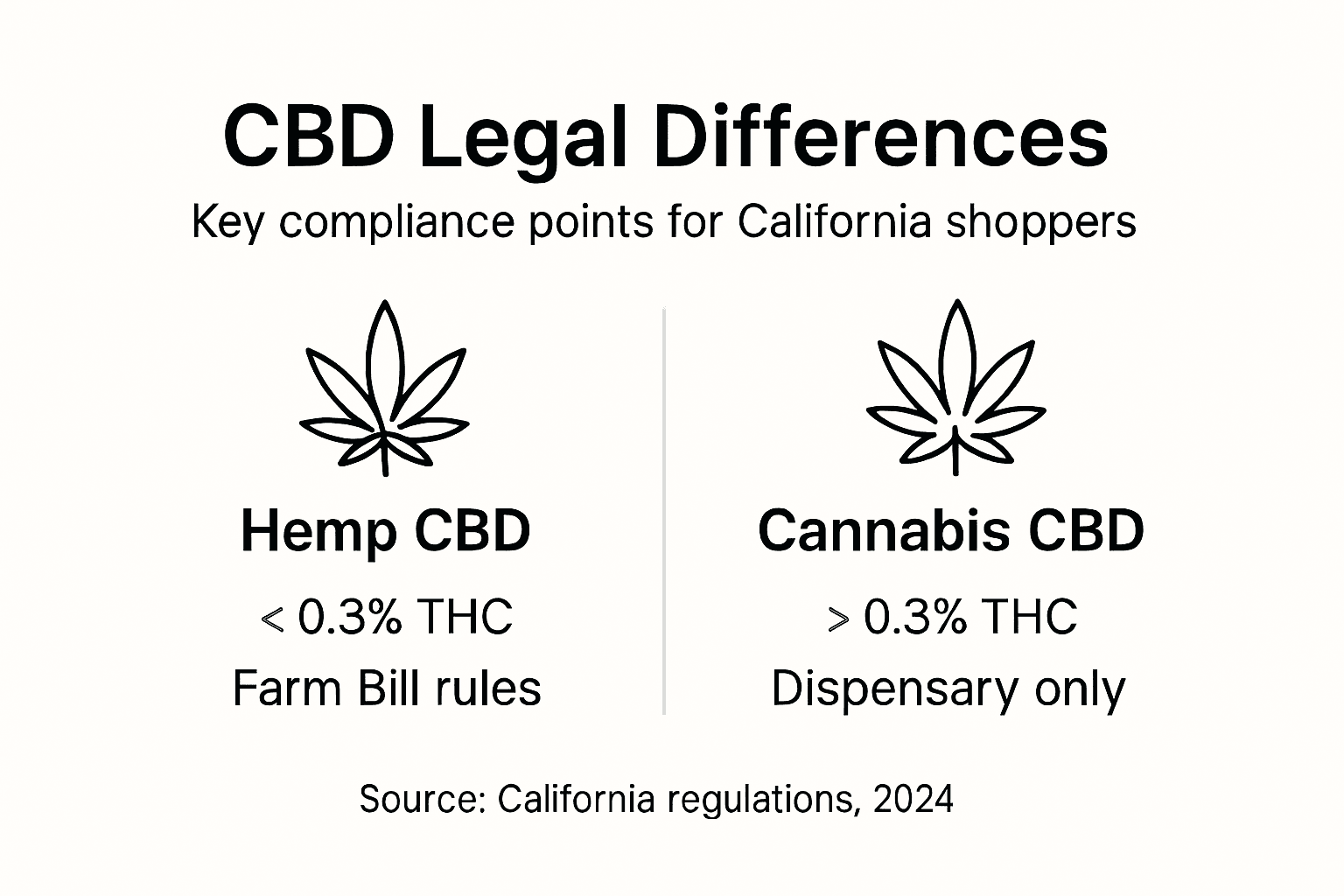
Products combining both CBD and THC remain available exclusively through licensed cannabis dispensaries. You cannot purchase mixed products from hemp retailers. This separation exists to prevent accidental intoxication from unregulated sources.
Licensed dispensaries follow different rules than hemp retailers. They must track products through the state cannabis track-and-trace system. Prices include excise taxes. Potency and labeling follow cannabis regulations, not hemp regulations.
For California shoppers, the practical takeaway is simple: Buy from compliant sources with lab testing documentation. Verify products meet California’s zero-detectable-THC requirement for foods and beverages. Licensed dispensaries and reputable hemp retailers know these rules.
Here’s a concise comparison of federal versus California CBD regulations for consumer clarity:
| Regulation Area | Federal (2018 Farm Bill) | California (2024 Emergency Rules) |
|---|---|---|
| THC Limit | Up to 0.3% THC in hemp products | Zero detectable THC in foods/beverages |
| Food/Beverage Use | Allowed if under 0.3% THC | Only if THC is undetectable; FDA approval required |
| Labeling Standards | Basic batch and potency info | Comprehensive: batch, warnings, explicit cannabis/hemp symbols |
| Enforcement | Relies on state compliance | Active inspections, swift product removals, license penalties |
Pro tip: Always request and review third-party lab test results showing THC content before purchasing, especially for food and beverage products, since California’s zero-detectable-THC standard is stricter than the federal 0.3% allowance.
Labeling, Age Restrictions, and Sourcing Standards
Proper labeling is your first line of defense as a California CBD shopper. Labels tell you exactly what you’re buying and whether it’s legally compliant. Understanding what to look for prevents costly mistakes.
California requires comprehensive labeling on all cannabis and hemp-derived CBD products. Legal labels must include product identifiers, net weight, and batch numbers. Every package displays California’s universal cannabis symbol. This standardization makes compliance visible and verifiable.
The information panel contains critical safety details. Manufacturers must list their contact information, packaging date, and complete ingredient lists including allergens. Government warning statements appear prominently on packaging. Storage instructions help you preserve product quality and safety.
For edible products specifically, labels must state “cannabis-infused” or “hemp-derived” depending on the source. This distinction matters legally and helps you understand regulatory framework. Potency information showing CBD and THC content appears in milligrams per serving.
Here’s what a compliant label actually shows:
- Product identifier with unique batch or lot number
- California universal cannabis symbol (hexagon with cannabis leaf)
- Net weight in metric and standard measurements
- Manufacturer details with address and contact information
- Packaging and manufacturing dates
- Complete ingredient list with allergen warnings
- Government warning statement about health risks
- Potency information showing CBD and THC percentages
- Storage instructions for proper preservation
Compliant labels include batch numbers, potency testing results, and government warnings—all visible before purchase.
Age restrictions vary depending on product type and source. Hemp-derived CBD has minimal age restrictions in most cases. Cannabis-derived products require purchasers to be 21 or older with valid identification. Licensed dispensaries verify age at purchase.
Sourced from California’s Emerald Triangle or licensed farms? The origin matters for sustainability and quality. Reputable retailers provide information about cultivation practices and sourcing locations. Organic, sustainably grown products command premium prices because they demand higher standards.
Third-party lab testing proves what’s in the bottle. Professional laboratories test for potency, contaminants, and pesticides. Results should match label claims within acceptable ranges. Test reports indicate testing date and expiration date for result validity.
Sourcing standards protect your health and support ethical businesses. California’s legal market requires traceability from seed to sale. This track-and-trace system prevents black market products from entering licensed retailers.
Red flags indicate non-compliant products. Missing batch numbers, absent warning labels, or potency information that seems exaggerated suggest problems. Illegally sourced products often have vague or missing manufacturer information.
Transparency builds trust between retailers and consumers. Reputable sources display lab results publicly and answer sourcing questions readily. They document cultivation practices and explain why their products cost more.
Pro tip: Photograph or write down the batch number from your product label and verify it matches the third-party lab test results provided by the retailer—this simple step confirms you’re receiving exactly what the label claims.
Risks, Penalties, and Consumer Responsibilities
Buying CBD comes with real responsibilities. Choosing non-compliant products exposes you to health risks and legal consequences. Understanding these risks helps you shop safely and legally.
The primary risk involves unexpected THC exposure. Non-compliant hemp products may contain detectable THC despite federal limits. This creates cognitive impairment and intoxication risks, especially for consumers expecting zero THC. California’s emergency regulations specifically address this danger to protect vulnerable populations.
Children face particular vulnerability to intoxicating hemp products. Products marketed as “hemp-derived” or “CBD-only” sometimes contain harmful THC levels. Unaware parents may unknowingly give intoxicating products to their children. This risk motivated California’s strict zero-detectable-THC requirement for foods and beverages.
Buying from unlicensed retailers carries serious risks. Unlicensed sellers don’t follow testing protocols, labeling standards, or sourcing verification. Their products may contain contaminants, pesticides, or heavy metals. You have no recourse if purchased products cause harm.
Here are the major risks you should avoid:
- Unexpected intoxication from mislabeled or non-compliant THC content
- Contaminant exposure including pesticides and heavy metals
- Product mislabeling showing false potency information
- Unlicensed retailers with no accountability or oversight
- Black market products with no quality verification or traceability
Retailers selling non-compliant hemp products face license suspensions, fines, and potential criminal liability.
As a consumer, you bear responsibility for verifying compliance. This means checking labels, requesting lab test results, and purchasing from established retailers. Ignorance doesn’t protect you from the consequences of buying illegal products.
Retailers face serious penalties for violations. California can suspend or revoke retail licenses entirely. Fines accumulate quickly for selling non-compliant products. Business owners can face criminal liability depending on violation severity.
Product removal represents one enforcement action. Retailers must immediately pull non-compliant inventory from shelves when authorities discover violations. This disrupts business operations and represents financial loss. Repeated violations result in escalating penalties.
Your due diligence prevents problems. Always request third-party lab results before purchasing. Verify batch numbers match documentation. Ask retailers about sourcing and cultivation practices. Legitimate businesses readily answer these questions.
Understanding legal distinctions protects your wallet. Hemp-derived and cannabis-derived products follow different regulatory paths. Knowing which type you need prevents purchasing wrong products. Price differences often indicate sourcing and compliance standards.
Stay informed about evolving regulations. California’s rules changed significantly in 2024 and continue evolving. Subscribe to retailer newsletters or follow official California Department of Public Health updates. Awareness prevents accidental violations.
Pro tip: Keep photographs or copies of lab test results and labeling information from every purchase—this documentation protects you if questions arise about product legality or safety later.
Navigate California’s Complex CBD Landscape with Confidence
Understanding the intricate legal landscape around CBD and THC in California can be overwhelming. With strict regulations on THC content, lab testing requirements, and evolving compliance standards, finding trustworthy hemp-derived products that meet legal criteria and deliver desired effects is a major challenge. If you want relief, relaxation, or a natural wellness boost without risking non-compliance or unexpected intoxication, you need a reliable source that prioritizes transparency, quality, and California-specific laws.
California Blendz offers a curated selection of organic, lab-tested hemp-derived CBD and THCa flower from California’s Emerald Triangle, fully compliant with state and federal regulations. Explore our range of products with verified third-party lab results that ensure zero detectable THC in foods and beverages as required by California law. Whether you are new to cannabinoids or experienced, find your ideal product filtered by effect and potency with clear educational resources at California Blendz. Shop now to enjoy fast shipping and a premium, legally compliant cannabis experience delivered right to your door.
Frequently Asked Questions
What is the legal distinction between hemp-derived CBD and cannabis-derived CBD?
Hemp-derived CBD is derived from hemp plants containing less than 0.3% THC and is federally legal. Cannabis-derived CBD comes from marijuana plants and is subject to state cannabis regulations, which includes restrictions on THC content.
Can I use hemp-derived CBD in food products in California?
No, California’s regulations require that hemp-derived CBD products in foods and beverages must contain zero detectable THC. Additionally, CBD is not legally permitted in foods without FDA approval, creating strict limitations on its use.
How can I verify the THC and CBD content in CBD products?
You can verify THC and CBD content by checking third-party lab testing results. These results should be available from the retailer and must match the batch number on the product label, ensuring transparency and compliance with legal standards.
What are the risks of buying non-compliant CBD products?
Buying non-compliant CBD products can expose you to unknown THC levels, leading to intoxication, as well as potential exposure to contaminants. Non-compliant products may also lack proper labeling and potency information, putting your health at risk.
Recommended
- Legal Requirements for CBD – What California Shoppers Need – California Blendz
- California Cannabis Laws 2025: Everything You Need to Know – California Blendz
- Legal Updates for Hemp 2025 – CBD and THCa Regulation Impact – California Blendz
- California Cannabis Culture: Wellness, Laws, and Trends – California Blendz


