
Achieve legal compliance for CBD and THCa in California
Written by Trevor

TL;DR:
- California cannabis compliance requires ongoing licensing, rigorous testing, and precise labeling.
- Violations such as misleading labels and unapproved products lead to significant fines and license suspension.
- Staying proactive with regulatory updates and partnering with compliance experts strengthens market credibility.
Legal compliance in California’s cannabis market is not a form you file once and forget. The rules shift, enforcement tightens, and what was acceptable last year may trigger a fine or license suspension today. For hemp-derived CBD and THCa businesses, this reality is especially sharp. California operates one of the most complex regulatory environments in the country, and staying current is not optional. This guide cuts through the noise, giving you a clear picture of what compliance actually demands in 2026 and how to build it into your daily operations before a regulator shows up at your door.
Table of Contents
- Understanding California’s cannabis regulatory landscape
- The essentials: Licensing, testing, and labeling for CBD and THCa
- Avoiding compliance pitfalls: Common risks and real consequences
- Winning strategies for staying compliant in a changing market
- The future of cannabis compliance: Trends and advocacy debates
- Our take: Compliance is a competitive edge, not a burden
- Partner with experts to secure your compliance
- Frequently asked questions
Key Takeaways
| Point | Details |
|---|---|
| Evolving regulations | California cannabis compliance rules for CBD and THCa change frequently, demanding proactive attention. |
| Mandatory testing and labeling | Licensing, thorough product testing, and accurate labeling are musts for legal operation. |
| Real consequences | Non-compliance risks hefty fines, product loss, and business license suspension. |
| Stay informed and proactive | Regularly monitor legal updates and integrate compliance into daily business operations. |
Understanding California’s cannabis regulatory landscape
Two agencies sit at the center of California’s cannabis compliance world. The California Department of Cannabis Control (DCC) oversees licensing, enforcement, and business operations for cannabis retailers, distributors, and manufacturers. The California Department of Public Health (CDPH) handles hemp-derived CBD products, particularly those entering the food and supplement supply chain. If your business touches both THCa flower and CBD edibles or tinctures, you are answering to both agencies simultaneously.
The passage of AB 8 introduced significant changes to how California treats hemp-derived cannabinoids, including THCa. It created new definitions, tightened testing thresholds, and established clearer lines between licensed cannabis and hemp-derived products. Understanding California cannabis laws as they stand today means understanding how AB 8 reshaped the entire playing field.
| Regulatory milestone | Impact on businesses |
|---|---|
| AB 8 passage | New definitions for hemp and THCa products |
| DCC testing updates | Stricter potency and contaminant thresholds |
| CDPH hemp CBD rules | Limits on CBD in food and beverages |
| 2026 enforcement wave | Increased inspections and penalty enforcement |
Common compliance misconceptions that trip up operators include:
- Believing a federal hemp license covers California state requirements
- Assuming THCa flower is automatically treated the same as CBD flower
- Thinking lab testing from another state satisfies California’s standards
- Overlooking packaging rules because the product was compliant in a different category
The tension in this space is real. As one policy analyst familiar with cannabis culture and trends in California noted:
“The intent of AB 8 was consumer protection, but the implementation has created friction for small operators who lack the legal infrastructure to keep pace with rapid rule changes.”
With this context established, let’s break down how compliance impacts CBD and THCa operations.
The essentials: Licensing, testing, and labeling for CBD and THCa
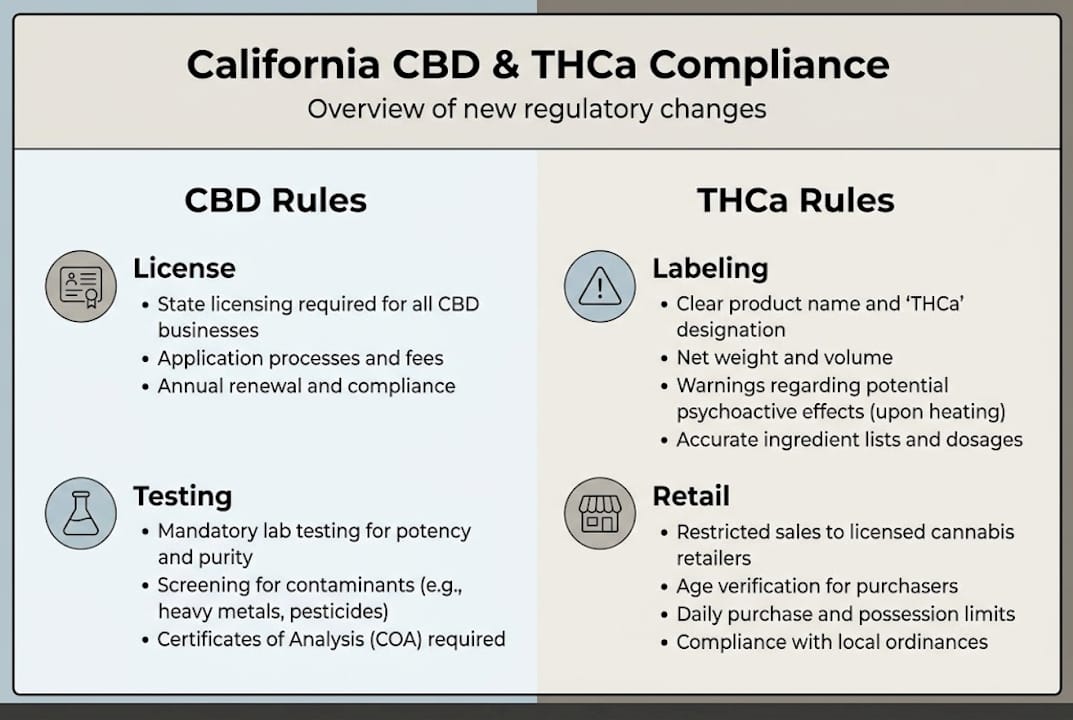
Getting licensed is step one, but it is rarely as simple as submitting one application. Depending on your business model, you may need a cultivation license, a manufacturing license, a retail license, or some combination. THCa flower sold as hemp requires a different pathway than licensed cannabis flower, and the CBD legal requirements for retail sales add another layer on top.

The state requires rigorous lab testing and accurate labeling for every product that reaches a consumer. This is not a suggestion. Testing must cover potency, residual solvents, pesticides, heavy metals, and microbial contaminants. Only California-accredited labs can produce results that satisfy state regulators. Following lab testing best practices means building a relationship with a reliable accredited lab and scheduling tests at every production batch, not just occasionally.
Here is the labeling workflow every compliant operator should follow:
- Confirm all cannabinoid content from a certified lab report before printing any label
- Include the batch number, harvest date, and lab report QR code on the primary label
- List all ingredients, net weight, and a clear statement of THC content
- Add required warnings for youth access, pregnancy, and health risks
- Submit label artwork for review if your product falls under CDPH jurisdiction
| Compliance element | Hemp-derived CBD | THCa flower |
|---|---|---|
| License type | CDPH registration or DCC retail | DCC cultivation or retail |
| Testing standard | Potency, contaminants, CBD content | Potency, total THC, contaminants |
| Labeling requirement | Ingredient list, health warnings | Cannabinoid panel, batch ID |
| Retail channel | Licensed retailer or direct-to-consumer (where allowed) | Licensed cannabis retailer only |
Pro Tip: Keep a physical compliance binder at your facility with current licenses, the most recent lab reports for every active SKU, and your labeling approval records. Inspectors often arrive without notice, and having everything organized in one place can be the difference between a warning and a citation.
Now that you know the compliance pillars, see how to actively avoid the most common pitfalls.
Avoiding compliance pitfalls: Common risks and real consequences
Violations in California’s cannabis market are not abstract. They carry real financial weight. Enforcement actions and fines have increased significantly since AB 8 took effect, and regulators are not issuing many second chances. The most common violations operators face include:
- False or misleading labeling, such as overstating CBD content or omitting required warnings
- Selling unapproved product formats, like CBD-infused beverages that have not cleared CDPH review
- Youth access failures, including inadequate child-resistant packaging or marketing that appeals to minors
- Using out-of-state or non-accredited lab results to satisfy California testing requirements
- Operating with an expired or incorrect license category for the products being sold
The financial consequences scale quickly. First-time violations can run into thousands of dollars per infraction. Repeat violations or serious offenses can result in license suspension or permanent revocation. Understanding CBD legal compliance details in full before you launch a product is far cheaper than resolving an enforcement action after the fact.
Statistic callout: California cannabis regulators issued over 800 enforcement actions in a single recent fiscal year, with labeling and testing violations accounting for the majority of citations.
Transparency is not just a marketing value. It is a legal shield. Businesses that invest in product transparency by making lab results publicly available and clearly communicating product contents tend to fare better during inspections because the documentation trail is already in order.
Pro Tip: Retain all compliance records, including lab reports, licensing correspondence, and inspection reports, for a minimum of seven years. California regulators can audit back several years, and missing records are treated as a red flag even when the underlying products were compliant.
Having understood the risks, you can now leverage up-to-date strategies to stay compliant and competitive.
Winning strategies for staying compliant in a changing market
The best compliance programs are not reactive. They are built to absorb change before it becomes a crisis. The most reliable resources for staying current include:
- The DCC’s official website and email alert system for rule updates
- CDPH hemp program newsletters for CBD-specific regulatory changes
- Industry associations like the California Cannabis Industry Association (CCIA)
- Legal counsel who specializes in California cannabis and hemp law
- Platforms tracking CBD and THCa legal updates in real time
Continuous regulatory updates are crucial for cannabis business adaptation, and building a system to capture those updates is as important as the compliance actions themselves. A simple compliance calendar, reviewed monthly, can catch upcoming deadlines before they become violations.
When a new rule drops, here is how to respond effectively:
- Read the full regulatory text, not just the summary, to understand scope and effective dates
- Assess which products, licenses, or processes are directly affected
- Consult your legal or compliance advisor within the first week of the announcement
- Update internal SOPs (standard operating procedures) and retrain relevant staff
- Document every change made in response to the new rule, with dates and signatures
Reviewing the CBD legal guide for 2026 updates is a smart starting point for any operator reassessing their current standing.
Pro Tip: Designate a compliance officer inside your business, even if it is a part-time role. Having one person responsible for tracking regulatory changes, maintaining records, and coordinating with legal counsel prevents the common failure mode where compliance tasks fall through the cracks because everyone assumes someone else is handling them.
While these strategies will maximize your compliance, let’s look at how the landscape shapes business opportunities going forward.
The future of cannabis compliance: Trends and advocacy debates
California’s cannabis compliance environment is not standing still. Several developments are shaping what the next few years will look like for CBD and THCa operators:
- Potential standardization of cannabinoid testing methods across all product categories
- Expanding rules around product innovation, including novel cannabinoids like THCP and HHC
- Possible federal hemp legislation that could override or complement California’s state framework
- Growing pressure for cross-industry standards that align cannabis with food safety regulations
- Increased scrutiny of online hemp sales and direct-to-consumer shipping compliance
The industry and advocacy groups have different takes on AB 8’s long-term impact, and that tension shapes every rulemaking process:
“Consumer advocates push for tighter controls to prevent youth access and mislabeling, while industry groups argue that excessive regulation drives compliant businesses out and leaves the market to bad actors who ignore the rules entirely.”
Both sides have valid points. The real risk is that over-regulation without enforcement resources simply punishes operators who are trying to do things right while doing nothing to stop those who are not. Watching how advocacy groups influence cannabis law impact debates gives you a window into where the rules are likely to move next.
Given these shifts, it is essential to form your own approach grounded in experience and current realities.
Our take: Compliance is a competitive edge, not a burden
Here is something most compliance guides will not tell you: the operators who treat compliance as a minimum bar to clear are the ones who get caught off guard when the rules tighten. The ones who treat it as a brand standard are the ones who grow.
When you make rigorous testing, transparent labeling, and proactive licensing part of your public identity, you are not just avoiding fines. You are building trust with retailers, consumers, and regulators simultaneously. In a market where skepticism about product quality is still high, documented compliance is a genuine differentiator.
We have seen businesses in the Emerald Triangle use their compliance record as a sales tool, sharing lab results openly and highlighting their licensing status in marketing materials. That approach to product transparency strategies converts cautious buyers into loyal customers. Compliance done well is not overhead. It is your most credible marketing asset.
Partner with experts to secure your compliance
Navigating California’s shifting cannabis regulations is easier when you have the right partners in your corner. At California Blendz, we have built our entire operation around the compliance standards outlined in this guide, from sourcing organically grown THCa flower in the Emerald Triangle to publishing third-party lab results for every product we carry.
If you are looking for a benchmark of what compliant, transparent cannabis retail looks like in practice, California Blendz compliance solutions offer a clear model. Browse our lab-tested CBD and THCa flower selection, review our sourcing practices, and see how compliance and quality work together to deliver a product line you can trust and build on.
Frequently asked questions
What are the key compliance requirements for selling CBD in California?
CBD sellers must hold the appropriate state licenses, submit products to California-accredited labs for testing, and follow strict labeling rules covering cannabinoid content, health warnings, and batch identification for every SKU they sell.
How often do California cannabis compliance laws change?
California cannabis compliance laws are revised frequently, sometimes multiple times per year, as new legislation passes and state agencies issue updated regulations in response to market conditions.
What happens if I fail a compliance inspection in California?
Failing an inspection can result in steep fines, mandatory product recalls, and suspension or permanent revocation of your cannabis business license depending on the severity and frequency of the violations found.
Is THCa regulated differently from CBD in California?
Yes, California applies distinct licensing categories, testing standards, and retail channel requirements to THCa flower versus hemp-derived CBD, making it critical to verify compliance separately for each product type you carry.
How can I keep up with cannabis legal compliance updates?
Subscribe directly to DCC and CDPH alert systems, join industry associations like the CCIA, and work with a cannabis-specialized attorney to ensure you catch every regulatory change before it affects your operations.
Recommended
- Legal Requirements for CBD – What California Shoppers Need – California Blendz
- California Cannabis Laws 2025: Everything You Need to Know – California Blendz
- Legal status of THCA in 2026: What U.S. consumers need to know – California Blendz
- California Cannabis Best Practices: 30% Safer Lab-Tested – California Blendz
- Decarboxylation of THCA to THC Under Vacuum – Viking Lab Supply


