
Understand CBD product labels: your 2026 complete guide
Written by Trevor

Picking up a CBD or THCa product should feel simple, but labels often confuse more than clarify. Mislabeling is rampant, with nearly half of products showing inaccurate potency and many skipping critical details like batch numbers or lab results. Understanding what to look for on these labels protects you from low-quality or non-compliant products and ensures you get exactly what you pay for. This guide walks you through every label element, from potency data to new 2026 regulations, so you can shop with confidence and make informed decisions every time.
Table of Contents
- What You Need To Know Before Reading CBD Product Labels
- Step-By-Step Guide To Interpreting CBD And THCa Labels
- Common Labeling Mistakes And How To Avoid Them
- 2026 Regulatory Changes Impacting CBD And THCa Labels
- Shop Confidently With California Blendz In 2026
- Frequently Asked Questions
Key takeaways
| Point | Details |
|---|---|
| Federal and state rules mandate specific label information | CBD and THCa labels must include manufacturer details, potency, batch numbers, and warnings to meet 2026 compliance standards. |
| Mislabeling is widespread across product types | Studies reveal nearly half of CBD products are underlabeled or overlabeled, making third-party lab verification essential. |
| 2026 regulations tighten THC limits and warnings | New federal caps set total THC including THCa at 0.4mg per container, with mandatory heating and intoxication warnings. |
| QR codes link directly to Certificates of Analysis | Scanning QR codes gives instant access to third-party lab results confirming potency, purity, and safety. |
| Illegal disease claims signal non-compliant products | FDA prohibits any therapeutic or medical claims on CBD labels, so avoid products making these promises. |
What you need to know before reading CBD product labels
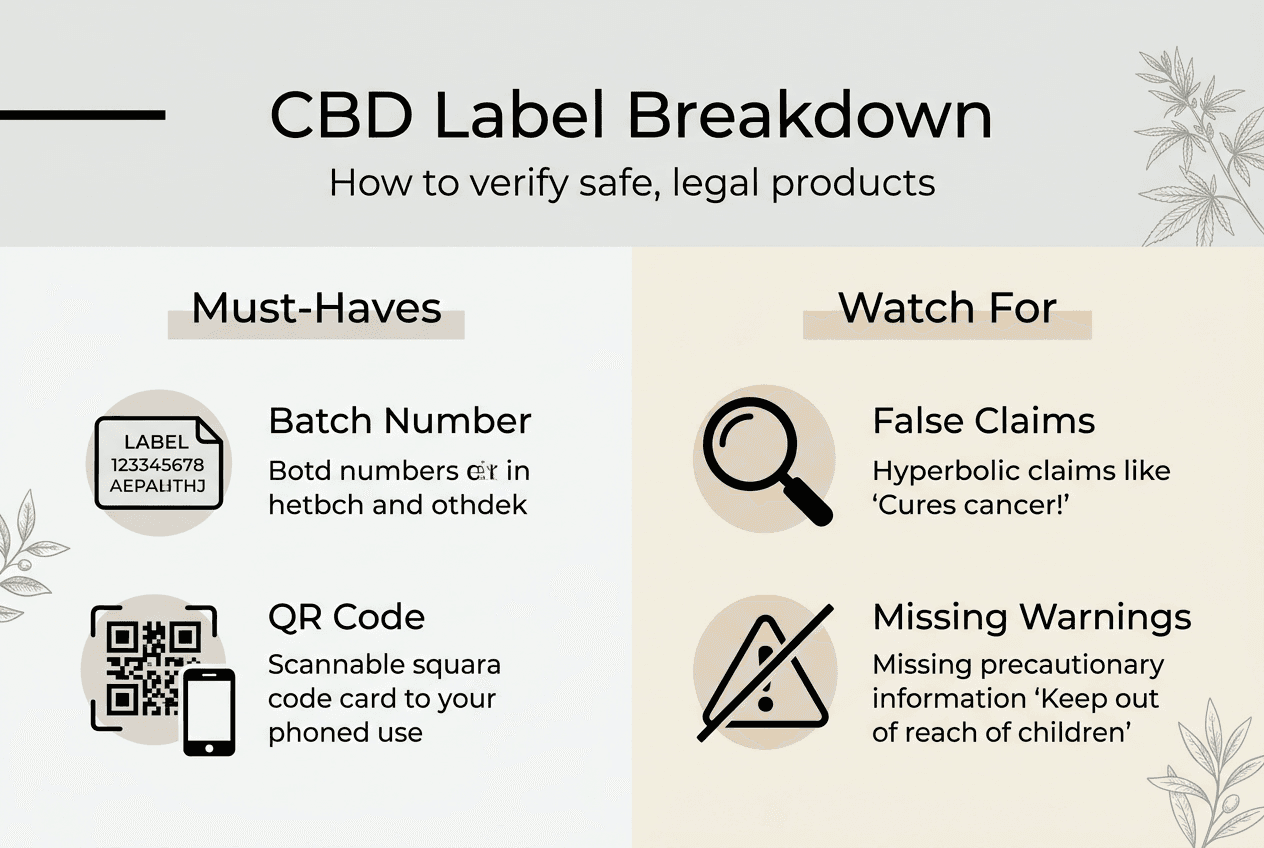
Before you dive into decoding a CBD or THCa label, you need a solid grasp of what the law requires and why those requirements exist. Federal and state governments mandate that CBD products must include manufacturer name/address, ingredient list, net quantity, product identity, batch/lot number, CBD/THC potency, and avoid disease claims. These rules protect consumers by ensuring transparency and preventing misleading marketing. CBD cannot legally claim to treat, cure, or prevent any disease on labels, a restriction the FDA enforces strictly to keep unproven health promises off the market.
THCa products face additional scrutiny because heating converts THCa into psychoactive THC. Labels must reflect less than 0.3% delta-9 THC and include clear warnings about heating, intoxication risks, and age restrictions. Most packages feature a principal display panel (PDP) with the product name and net weight, plus an information panel listing ingredients, potency, and manufacturer details. Batch or lot numbers paired with QR codes linking to third-party lab results boost transparency, letting you verify what is inside matches what the label promises.
Understanding legal requirements for CBD in California and other states helps you spot compliant products quickly. California, for example, adds Prop 65 warnings and prohibits smoking claims, while New York mandates QR codes for all hemp products. Familiarizing yourself with the cannabis product labeling guide prepares you to navigate state-specific rules confidently. The FDA CBD labeling guidelines outline federal baseline standards every product must meet, regardless of where you buy it.
Pro Tip: Always cross-check the batch number on the label with the batch number on the third-party Certificate of Analysis (COA) accessed via QR code. Mismatched numbers can indicate outdated or fraudulent lab results.
Key label elements to look for include:
- Manufacturer name, address, and contact information for accountability
- Net quantity in both metric and U.S. customary units
- Complete ingredient list in descending order by weight
- CBD and THC potency per serving and per container
- Batch or lot number for traceability
- QR code linking to current third-party lab results
- Required warnings for THCa products about heating and intoxication
- Absence of disease treatment or therapeutic claims
Step-by-step guide to interpreting CBD and THCa labels
Reading a label systematically ensures you catch every detail that matters. Follow these steps to verify quality, potency, and compliance before you buy.
- Check manufacturer information to confirm legitimacy and accountability. A complete address and contact details signal a transparent company willing to stand behind its products.
- Compare stated CBD and THC potency on the PDP with the information panel and the lab COA accessed via QR code. Discrepancies suggest mislabeling or outdated test results.
- Verify the batch or lot number matches the one on the third-party lab report. Mismatched numbers mean the COA does not apply to the product in your hand.
- Note all warnings, especially for THCa products, including age restrictions, heating intoxication risks, and no driving advisories. Missing warnings indicate non-compliance.
- Calculate per-serving dose if the product contains multiple servings. Divide total CBD or THC by servings to understand what you consume each time.
- Identify any illegal claims such as disease treatment, pain relief, or medical benefits that the FDA strictly prohibits on CBD labels.
Pro Tip: If a QR code does not scan or links to a generic homepage instead of a specific COA, treat it as a red flag. Legitimate brands provide direct access to batch-specific lab results.
Frequent mislabeling occurs across all product types. Scientific studies show 49% of products are underlabeled, 38% overlabeled, and only 12.7% accurately labeled for CBD potency. This means nearly nine out of ten products you pick up may not contain the CBD or THC levels advertised. Verifying potency through third-party labs becomes essential, not optional.
Understanding common CBD misconceptions helps you avoid falling for marketing hype that does not align with label facts. For example, labels claiming zero THC in full-spectrum CBD are misleading, as full-spectrum extracts naturally contain trace THC.
| Label Element | What to Verify | Why It Matters |
|---|---|---|
| Manufacturer Info | Complete name, address, contact | Ensures accountability and traceability |
| Potency Data | CBD/THC mg per serving and container | Confirms dosage accuracy and compliance |
| Batch/Lot Number | Matches COA batch number exactly | Validates lab results apply to this product |
| QR Code | Scans to batch-specific third-party COA | Provides independent verification of contents |
| Warnings | Age, heating, intoxication, no driving | Indicates legal compliance and consumer safety |
| Claims | No disease treatment or medical promises | Avoids FDA violations and misleading marketing |
Common labeling mistakes and how to avoid them
Mislabeling is not rare. It is the norm. Under or overlabeled potency appears in all product types, especially oils and beverages. Studies show 56.7% accuracy in THC flower labeling with frequent underlabeling and 79% overlabeling in hemp beverages. This means the CBD or THC you think you are getting could be significantly higher or lower than advertised, affecting both safety and efficacy.
Beware of labels showing zero CBD despite product claims. Some brands list CBD on marketing materials but report none on the official label or COA, a clear sign of deceptive practices. Check for missing or fake QR codes and batch numbers. A missing QR code means no independent verification, while a fake code that does not link to a real lab report signals a scam. Avoid products making FDA-prohibited disease or therapeutic claims such as treating anxiety, curing insomnia, or reducing inflammation. These claims violate federal law and indicate a non-compliant or untrustworthy brand.
Heating changes THCa to psychoactive THC, so look for proper warnings to avoid surprises. Without clear heating and intoxication warnings, you might unknowingly consume a psychoactive product thinking it is non-intoxicating. Understanding THCa legality in 2026 helps you navigate these nuances and choose products that fit your needs and legal comfort level.
Common red flags to watch for:
- Potency claims without corresponding lab data or QR code access
- Labels listing CBD or THC but showing zero on the COA
- Missing batch or lot numbers that prevent traceability
- QR codes that do not scan or link to generic pages
- Disease treatment, pain relief, or medical benefit claims
- THCa products without heating or intoxication warnings
- Vague ingredient lists like “hemp extract” without specifying CBD or THC content
- Outdated COAs not matching the current production batch
“Nearly 90% of CBD products fail to accurately label potency, making third-party lab verification the only reliable way to know what you are buying.”
2026 regulatory changes impacting CBD and THCa labels
Regulatory shifts in 2026 tighten compliance requirements and close loopholes that previously allowed high-THC hemp products to slip through. Federal rules now cap total THC including THCa at 0.4mg per container, require new warnings, and close loopholes that let THCa flower bypass THC limits. This change means many THCa products previously sold as legal hemp now exceed federal thresholds and face removal from the market or reformulation.

States like California and New York add extra warnings beyond federal minimums. California requires Prop 65 warnings for products containing detectable THC and prohibits smoking-related claims. New York mandates QR codes for all hemp products, ensuring consumers can access lab results instantly. Labels must include explicit heating intoxication warnings for THCa, clearly stating that heating converts non-intoxicating THCa into psychoactive THC. Multi-state shipping requires customized compliance with state-specific regulations, so brands selling nationwide must navigate a patchwork of rules.
The FDA continues to prohibit disease claims and unapproved food or supplement additions. CBD cannot be added to conventional foods or marketed as dietary supplements without FDA approval, a restriction that remains firmly in place for 2026. Understanding the legal status of THCa in 2026 for U.S. consumers helps you stay informed about what products remain legal and which face new restrictions. Reviewing updated CBD labeling requirements for 2026 ensures you recognize compliant labels and avoid products that may soon face regulatory action.
Pro Tip: Check the production or packaging date on the label. Products manufactured before 2026 may not reflect the latest regulatory changes, so prioritize recently produced batches for full compliance.
| Requirement | Federal Standard | California Addition | New York Addition |
|---|---|---|---|
| Total THC Limit | 0.4mg per container including THCa | Same as federal | Same as federal |
| QR Code to COA | Recommended | Recommended | Mandatory |
| Heating Warning | Required for THCa | Required for THCa | Required for THCa |
| Prop 65 Warning | Not applicable | Required for detectable THC | Not applicable |
| Smoking Claims | Prohibited by FDA | Explicitly prohibited | Prohibited by FDA |
| Disease Claims | Prohibited | Prohibited | Prohibited |
Shop confidently with California Blendz in 2026
Now that you understand what to look for on CBD and THCa labels, you can shop with confidence knowing you will get safe, compliant, and accurately labeled products. California Blendz offers thoroughly lab-tested CBD and THCa products that meet all 2026 federal and state requirements. Every product features clear labeling with QR codes linking directly to batch-specific Certificates of Analysis, so you verify potency and purity before you buy.
Our selection includes organic, sustainably grown hemp flower sourced from California’s Emerald Triangle, ensuring quality from seed to sale. We stay updated on 2026 regulatory compliance, so you never have to worry about outdated formulations or non-compliant labels. Explore a broad range of CBD and THCa options with consistent quality standards, transparent lab results, and customer support ready to answer your questions.
Frequently asked questions
What is a QR code on a CBD product label?
A QR code is a scannable square barcode that links directly to the product’s third-party Certificate of Analysis (COA). Scanning it with your smartphone gives instant access to lab results showing CBD and THC potency, contaminants, and purity for that specific batch. This transparency lets you verify the label claims match independent test results before you buy.
How do I know if a CBD product is mislabeled?
Compare the potency stated on the label with the COA accessed via QR code. If the batch numbers do not match or the lab results show significantly different CBD or THC levels, the product is mislabeled. Studies show nearly 90% of CBD products have inaccurate potency claims, so always verify through third-party labs.
Are THCa products legal in 2026?
THCa products remain federally legal only if total THC including THCa stays below 0.4mg per container under new 2026 rules. Many THCa flower products exceed this limit and face regulatory restrictions. State laws vary, so check your local regulations and look for compliant labeling with proper warnings about heating and intoxication.
What warnings should appear on THCa product labels?
THCa labels must include warnings about heating converting THCa into psychoactive THC, intoxication risks, age restrictions (21+), and advisories against driving or operating machinery after use. Products without these warnings do not meet 2026 compliance standards and should be avoided.
Can CBD labels legally claim to treat medical conditions?
No. The FDA strictly prohibits any disease treatment, cure, or prevention claims on CBD labels. Products claiming to treat anxiety, pain, insomnia, or any medical condition violate federal law and indicate a non-compliant or untrustworthy brand. Avoid these products regardless of other label features.
Why do some CBD products show zero CBD on lab results?
Some brands make CBD claims in marketing but fail to include meaningful amounts in the actual product, or they use isolates that degrade over time. Others use deceptive labeling to attract buyers without delivering real CBD content. Always verify potency through third-party COAs before purchasing.


