
Top cannabis flower safety tips for healthy use
Written by Trevor

Choosing cannabis flower sounds simple until you realize how much can go wrong between the farm and your hands. Mold, pesticide residue, mislabeled potency, and poor storage can turn a wellness purchase into a health risk. The good news is that a few smart habits dramatically reduce those risks. Third-party lab results covering potency, pesticides, heavy metals, and microbials are your single most powerful tool before you ever open a bag.
Table of Contents
- What makes cannabis flower safe? Key criteria explained
- 1. Buy only from licensed dispensaries
- 2. Always check lab results and COAs
- 3. Inspect for mold, pests, and off odors
- 4. Store flower properly to maintain safety and quality
- 5. Dose responsibly and consider your health
- Important cautions: Who should avoid or use extra care?
- Quick reference: Cannabis flower safety tips checklist
- Discover safe, quality cannabis flower options
- Frequently asked questions
Key Takeaways
| Point | Details |
|---|---|
| Buy tested flower | Purchase only from licensed dispensaries for guaranteed safety and accurate labeling. |
| Check lab results | Always review the product’s COA for potency and contamination data before using. |
| Monitor storage and handling | Keep flower in airtight jars under ideal temperature and humidity to prevent mold and potency loss. |
| Dose with care | Start with low doses, consulting a healthcare professional as needed, especially if you’re new or have health conditions. |
| Know the risks | Avoid use if pregnant, underage, or at higher risk for psychosis or addiction. |
What makes cannabis flower safe? Key criteria explained
Safety in cannabis flower comes down to a handful of non-negotiable checkpoints. Think of it as a filter system: each layer catches a different type of risk before it reaches you.
Here are the core criteria every buyer should evaluate:
- Regulated source: Purchased from a licensed seller in a legal state
- Certificate of Analysis (COA): Third-party lab results confirming purity and potency
- Visual and aroma check: No mold, pests, or chemical smells
- Appropriate use: Avoided by high-risk groups (more on that below)
- Responsible dosing: Starting low, going slow
A Certificate of Analysis, or COA, is a document issued by an independent laboratory that confirms what is actually in your flower. It covers cannabinoid percentages, pesticide screening, heavy metal levels, and microbial contamination. Without one, you are essentially guessing.
“Buying from licensed dispensaries in legal states ensures regulated testing and reduces risks of contaminants or mislabeling.”
The regulatory landscape varies widely by state. Some states require comprehensive testing panels; others have minimal oversight. That gap is exactly why understanding lab-tested flower benefits matters so much, especially if you shop online or across state lines. Unregulated flower carries real potential marijuana risks that tested products largely eliminate.
1. Buy only from licensed dispensaries
Your buying source is your first and perhaps most important safeguard. A licensed dispensary operates under state law, which means its products must pass required safety testing before hitting the shelf.
Illicit or unlicensed cannabis skips that process entirely. Products from unregulated sellers frequently contain pesticide residue, mold, or wildly inaccurate potency labels. State regulations require testing; unlicensed products often exceed legal THC limits or carry pesticides that would fail any regulated panel.
Pro Tip: Every licensed dispensary in a legal state has a publicly searchable license number. Look it up on your state’s cannabis regulatory website before you buy, or ask to see it in person.
Watch for these red flags that suggest an unregulated seller:
- No COA available or offered
- Prices dramatically below market rate
- No physical address or verifiable business info
- Packaging with no batch number or lab stamp
- Seller unable to name the cultivar or source farm
Transparency is the hallmark of a trustworthy seller. When a dispensary freely shares benefits of lab testing and walks you through the cannabis testing process, that is a strong signal you are in the right place.
2. Always check lab results and COAs
Once you choose a reputable seller, your next move is to demand proof. The COA is the test result that reveals a product’s true safety profile, and reading one is easier than it sounds.
Every COA worth trusting should include these testing categories:
- Cannabinoid profile: THC, CBD, CBG, and other active compounds with percentages
- Pesticide screening: Pass or fail for dozens of regulated chemicals
- Heavy metals: Lead, arsenic, cadmium, and mercury levels
- Microbial contamination: Mold, yeast, E. coli, and Salmonella counts
- Residual solvents: Relevant for extracts but sometimes tested on flower too
Here is a sample of what a trustworthy COA result looks like:
| Test category | Example result | Status |
|---|---|---|
| Total THC | 22.4% | Pass |
| Total CBD | 0.8% | Pass |
| Pesticides | Not detected | Pass |
| Heavy metals | Below action level | Pass |
| Microbials | Below action level | Pass |
Potency accuracy is a bigger issue than most buyers realize. Flower labels often understate potency by more than 15%, and potency inflation is common in some markets. That means you could be getting far more or far less than you expect.
Always check COAs from third-party labs for potency, pesticides, heavy metals, microbials, and residual solvents before you purchase.
Most reputable sellers post COAs on their website by batch number. If you cannot find one, ask directly. Understanding the importance of COAs and how cannabis is tested puts you firmly in control of what you consume.
3. Inspect for mold, pests, and off odors
Testing is critical, but your senses are your last line of defense before consuming cannabis flower. Even a COA-verified product can develop problems after packaging if stored poorly.
Follow this step-by-step inspection before every use:
- Look at the color. Healthy flower ranges from deep green to purple with visible orange or red hairs. Yellowing or brown patches are warning signs.
- Check for white fuzz or powder. Powdery mildew looks like fine white dust on the surface. Fuzzy gray or white growth is mold. Discard immediately.
- Smell it. Quality flower smells earthy, floral, citrusy, or piney depending on the strain. A musty, ammonia-like, or chemical smell means something is wrong.
- Feel the texture. Flower should be slightly springy, not bone dry or wet and spongy. Wet flower is a mold risk; overly dry flower has lost potency.
- Look for pests. Tiny dark specks, webbing, or visible insects are signs of infestation.
Relative humidity above 65% accelerates mold growth rapidly. Even one or two days in a humid environment can compromise an otherwise clean product. Inspect flower for mold, mildew, pests, or off odors and discard anything suspicious to avoid serious respiratory risks.
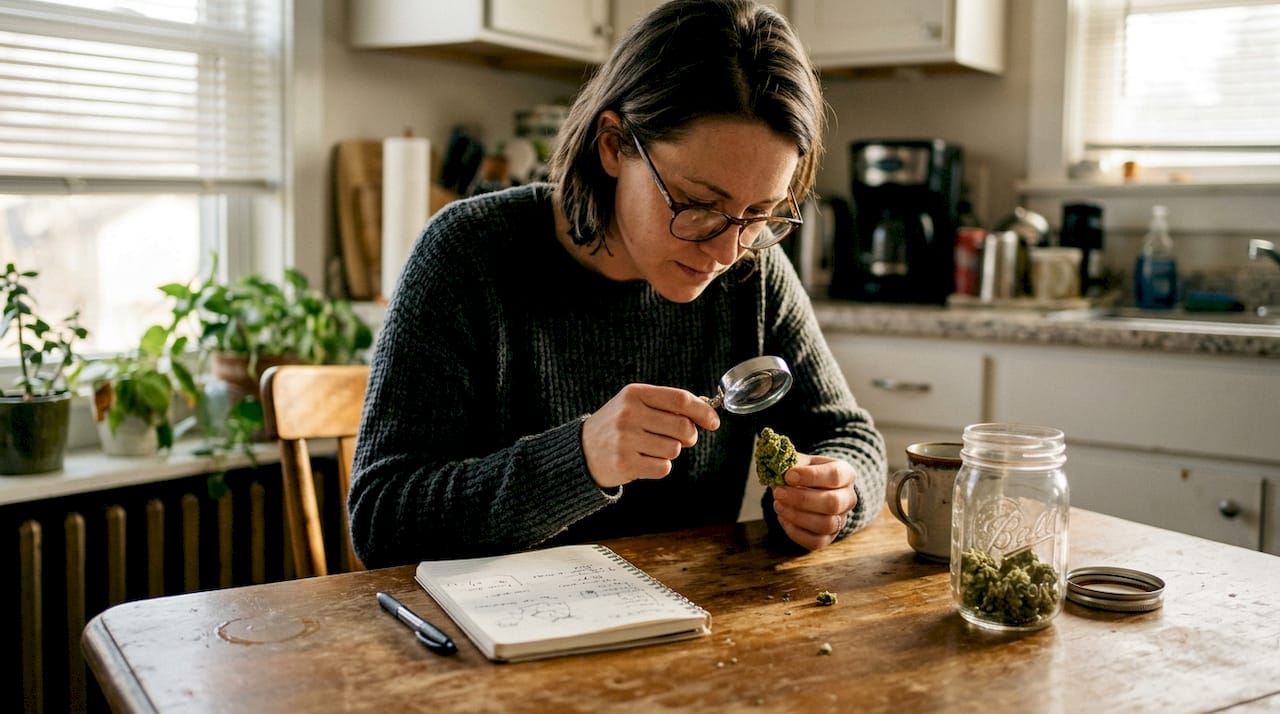
Pro Tip: A jeweler’s loupe (a small magnifying lens) lets you examine trichomes up close. Healthy trichomes look like tiny clear or amber mushrooms. Anything that looks like webbing or dark debris deserves a closer look before you use it. Learning how to spot good cannabis flower takes just a few minutes and pays off every time.
4. Store flower properly to maintain safety and quality
Safe flower is not just about buying and inspecting. It is about keeping your stash safe between sessions. Poor storage can ruin even the highest-quality, lab-tested flower within days.
The gold standard for cannabis flower storage is an airtight glass jar kept at 60 to 70 degrees Fahrenheit, with 58 to 62% relative humidity, in a dark location away from direct light and heat.
Here is how common storage methods compare:
| Storage method | Humidity control | Light protection | Potency preservation | Risk level |
|---|---|---|---|---|
| Airtight glass jar | Excellent | Good (in dark) | High | Low |
| Mylar bag (sealed) | Good | Excellent | Medium-High | Low-Medium |
| Plastic zip bag | Poor | None | Low | High |
| Paper bag | Very poor | None | Very low | Very high |
| Original dispensary bag | Varies | Varies | Medium | Medium |
The biggest storage mistakes people make:
- Storing near a window or heat source
- Using plastic bags that create static and strip trichomes
- Leaving the container open between uses
- Mixing strains in the same jar, which transfers moisture and odors
- Storing in the freezer, which makes trichomes brittle and causes them to break off
For more detail, check out how to store cannabis flower and these cannabis storage tips. If you use Mylar bags, make sure they are heat-sealed for the best results.
5. Dose responsibly and consider your health
With flower safely stored, making informed choices about how much and who should use it is your next priority. Dosing is where many people run into trouble, especially with today’s much more potent products.
Follow this stepwise approach to safe dosing:
- Start with a single small inhalation. Wait 10 to 15 minutes before taking more.
- Note how you feel. Mild relaxation or relief is the target. Anxiety or racing heart means you have had enough.
- Increase gradually over multiple sessions. Never jump to large doses based on a friend’s tolerance.
- Track your sessions. Note the strain, amount, and effect so you can repeat what works.
- Avoid mixing with alcohol or other substances until you know how cannabis affects you alone.
Too-large doses can trigger anxiety, panic attacks, and impaired coordination. Start with low doses, especially if you are a medical user or new to cannabis, because potency and effects vary significantly between products.
Here is a sobering fact: THC potency has tripled compared to past decades, and between 9 and 30% of regular users develop dependency. Erring on the side of caution is not timid; it is smart.
Pro Tip: If you take prescription medications or have a chronic health condition, talk to your doctor before using cannabis flower. Cannabinoids interact with several common drug classes. Our guide on how to dose cannabis safely is a solid starting point for understanding your options.
Important cautions: Who should avoid or use extra care?
No safety checklist is complete without knowing who should simply not use cannabis flower, or who needs to take extra precautions.
These groups face significantly elevated risk:
- Adolescents and young adults under 25: Regular use is linked to up to 8-point IQ loss and disrupted brain development
- Pregnant or breastfeeding individuals: Cannabis crosses the placenta and enters breast milk, posing real harm to fetal and infant brain development
- People with a personal or family history of psychosis or schizophrenia: THC can trigger or worsen psychotic episodes
- Those with a history of substance use disorder: Cannabis carries real addiction potential, especially at high potencies
- Anyone about to drive or operate heavy machinery: Cannabis impairs reaction time, depth perception, and judgment, even when you feel fine
Avoid use entirely if you are pregnant, breastfeeding, adolescent, or have a mental health history. The marijuana safety risks in these groups are well-documented and serious. This is not about fear; it is about making choices that protect your long-term health.
Quick reference: Cannabis flower safety tips checklist
Here is a convenient checklist you can use each time you buy, store, or handle cannabis flower:
- Buy only from licensed dispensaries in legal states
- Request and review the COA before purchasing any product
- Confirm the COA covers cannabinoids, pesticides, heavy metals, and microbials
- Inspect flower visually and by smell before every use
- Discard any flower showing mold, fuzz, pests, or off odors
- Store in an airtight glass jar at 60 to 70 degrees Fahrenheit and 58 to 62% humidity
- Keep storage containers in a dark, cool location away from heat and light
- Start with the lowest effective dose and increase slowly over multiple sessions
- Avoid use if you are pregnant, breastfeeding, under 25, or have a mental health history
- Never drive or operate machinery after using cannabis flower
Discover safe, quality cannabis flower options
You now have a complete framework for buying, inspecting, storing, and using cannabis flower safely. Putting these tips into practice is much easier when you start with products that are already built around transparency and quality.
At California Blendz, every flower product is sourced from California’s Emerald Triangle, grown organically, and backed by third-party lab results you can actually read. We make it easy to find COAs, understand what you are buying, and shop with confidence. If you want to go deeper on keeping your stash fresh and potent, our expert cannabis storage advice covers everything from humidity packs to long-term preservation. Quality and safety are not a bonus here; they are the baseline.
Frequently asked questions
How do I tell if my cannabis flower has mold or is unsafe?
Look for white fuzzy spots, a musty or ammonia-like smell, or a powdery coating on the buds. Discard flower with these signs immediately to avoid respiratory harm.
Are COAs required in every state?
COAs are mandated by law in legal cannabis states, but testing requirements vary by state. Always ask your dispensary for lab results before purchasing.
What’s the best way to store cannabis flower long-term?
Use an airtight glass jar at 60 to 70 degrees Fahrenheit with 58 to 62% relative humidity in a dark location. This prevents mold and potency loss for months.
Can I use cannabis flower while pregnant or breastfeeding?
No. Cannabis harms fetal brain development and passes directly into breast milk. Avoid use entirely during pregnancy and while breastfeeding.
Recommended
- Essential cannabis safety considerations for consumers – California Blendz
- Safe cannabis dosing: California consumer’s guide for wellness – California Blendz
- How to safely store cannabis products for freshness – California Blendz
- 7 Essential Cannabis Storage Tips for Freshness and Potency – California Blendz


