
U.S. Cannabis Laws in 2026: What's Legal and What's Not
Written by Trevor

TL;DR:
- Cannabis is legal recreationally in 24 states and D.C. but remains federally prohibited.
- Federal rescheduling to Schedule III recognizes medical use but does not legalize recreational cannabis.
- Consumers should carefully check state and local laws before using or traveling with cannabis.
Despite years of headlines, ballot measures, and passionate debate, the legal reality of cannabis in the U.S. is still anything but simple. Recreational cannabis is legal in 24 states plus Washington, D.C. as of late 2025, yet federal prohibition remains firmly in place. If you follow cannabis news, you’ve probably seen stories about rescheduling, reform bills, and shifting public opinion, and you may be wondering what any of it actually means for you. This guide breaks down the current legal map, what changed at the federal level in 2025, where the real gray areas live, and how to protect yourself as a consumer navigating it all.
Table of Contents
- The cannabis legalization map in 2025
- State vs. federal law: Key differences and new developments
- Navigating legal gray areas and patchwork rules
- Future outlook: Federal reform, advocacy, and shifting attitudes
- A practical perspective: Applying cannabis law knowledge in real life
- Get empowered and stay informed on legal cannabis
- Frequently asked questions
Key Takeaways
| Point | Details |
|---|---|
| Legalization remains state-driven | Recreational cannabis is legal in 24 states plus D.C., with no progress at the federal level by 2025. |
| Federal rescheduling changes medical market | Moving marijuana to Schedule III supports research and banking but doesn’t legalize recreation. |
| Travel risks persist | Carrying cannabis across state lines is still federally illegal, risking penalties even between legal states. |
| Know your local laws | Each state has unique rules for possession, home grow, and purchase, so always check current requirements. |
The cannabis legalization map in 2025
Let’s start with the numbers, because they tell a story that headlines often blur. Recreational cannabis is legal in 24 states plus Washington, D.C., meaning adults can purchase and possess cannabis for personal use without a medical card. That’s a significant portion of the country, but it’s far from universal, and the rules within those states still vary widely.
Medical cannabis is available in additional states beyond the recreational ones, leaving only a small number of states where cannabis remains entirely illegal. And here’s a fact that surprises many people: no new states legalized recreational cannabis in 2025, so the total stayed at 24 plus D.C. The pace of state-by-state change has slowed considerably compared to the rapid expansion seen earlier in the 2020s.
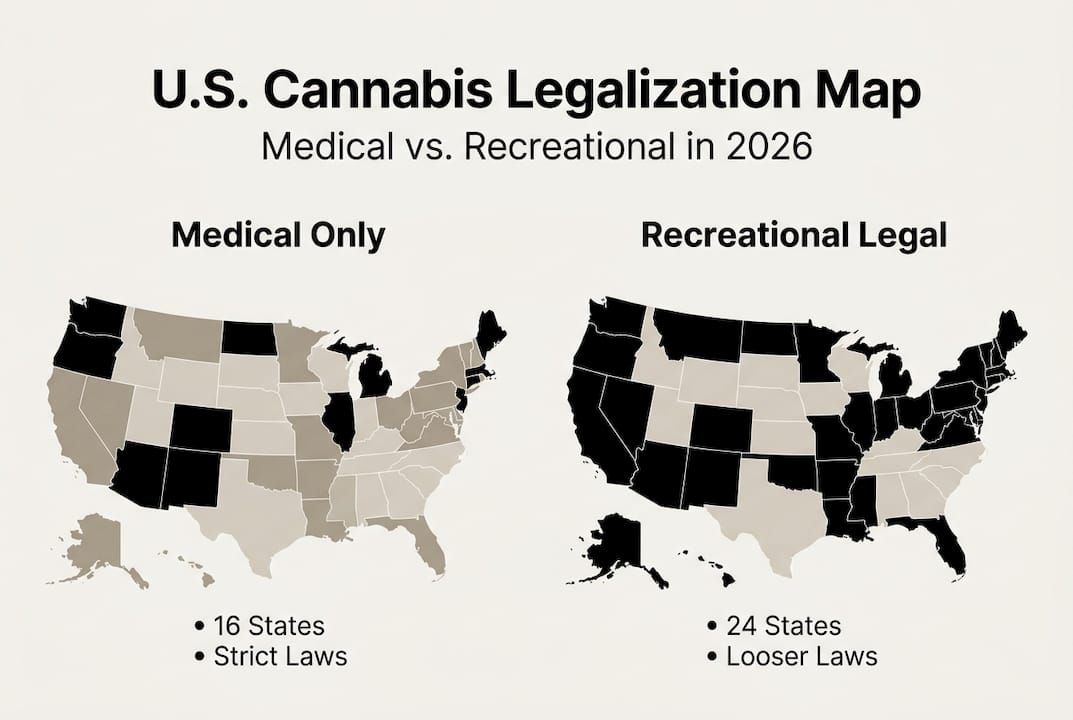
Why the slowdown? Several factors are at play. Some states with strong conservative or rural majorities have repeatedly rejected ballot measures. Others are watching how neighboring states manage tax revenue, public health outcomes, and enforcement before committing. Legalization is not a simple political switch; it requires building regulatory infrastructure, licensing systems, and enforcement frameworks from scratch.
Here’s a quick snapshot of where things stand:
| Legal status | Examples |
|---|---|
| Recreational and medical | California, Colorado, Illinois, New York, Michigan |
| Medical only | Florida, Texas, Georgia, Alabama |
| Fully illegal | Idaho, Wyoming, Kansas, South Carolina |
Key facts to keep in mind:
- Possession limits, purchase caps, and public use rules differ even within recreational states
- Some recreational states still restrict home cultivation
- D.C. allows possession but not retail sales due to federal land restrictions
- Local municipalities can ban dispensaries even in legal states
If you live in or are visiting California, it helps to get familiar with California cannabis laws specifically, since local rules can vary city by city. For those asking about CBD specifically, a CBD legal states guide can clarify what’s accessible without a medical card across the country.
State vs. federal law: Key differences and new developments
Here’s the tension at the heart of U.S. cannabis policy: states can legalize cannabis, but the federal government still classifies marijuana as a Schedule I controlled substance, the same category as heroin. That classification has real consequences for banking, research, taxation, and criminal enforcement.
The biggest federal development in 2025 was movement toward rescheduling marijuana to Schedule III. This is a meaningful shift, but it’s widely misunderstood. Rescheduling to Schedule III acknowledges that cannabis has accepted medical uses, eases restrictions on research and banking, and reduces certain tax burdens on cannabis businesses. What it does not do is legalize recreational use, allow interstate commerce in cannabis, or remove federal criminal penalties for possession.
Think of it this way: Schedule III is the same category as ketamine and anabolic steroids. Those substances are regulated and controlled, not freely available. Rescheduling is a step, not a finish line.
“Rescheduling acknowledges medical use and eases research and banking restrictions, but recreational cannabis remains federally prohibited and interstate commerce is still illegal.” — DLA Piper, 2025
Here’s a side-by-side look at how state and federal law currently compare:
| Issue | State law (legal states) | Federal law |
|---|---|---|
| Recreational possession | Legal with limits | Illegal |
| Medical use | Legal with card | Restricted (Schedule III pending) |
| Banking access | Improving in legal states | Still restricted federally |
| Interstate transport | Illegal regardless | Illegal |
| Research | Allowed in some states | Easing under rescheduling |
Pro Tip: If you run a cannabis-adjacent business or are interested in CBD and THCa products, understanding CBD legality in 2025 at the federal level is essential before making purchasing or business decisions. For the latest on hemp-derived cannabinoids, the CBD and THCa legal updates page is worth bookmarking.
The rescheduling process also benefits wellness consumers indirectly. More research funding means better clinical data on cannabinoids. Better banking access means more legitimate, compliant businesses entering the market. These are slow-moving gains, but they matter.
Navigating legal gray areas and patchwork rules
Even in states where cannabis is fully legal, the rules are not uniform. This is where most consumers get tripped up, and where the real legal risk lives for everyday people.

Take home cultivation. California allows up to six plants per adult for personal use, but other recreational states restrict or outright ban home growing. Some states allow cultivation only for medical patients. If you assume that “legal state” means “same rules everywhere,” you could accidentally break the law in your own backyard.
State-to-state travel is another major gray area. Here’s the rule that never changes regardless of which states are involved: transporting cannabis across state lines is a federal offense. It doesn’t matter if both states have legalized recreational use. The moment you cross a state border with cannabis, you’re in federal jurisdiction, and federal law still treats it as a controlled substance.
Some edge cases that catch consumers off guard:
- Flying with cannabis, even between two legal states, passes through federal airspace and TSA jurisdiction
- Washington, D.C. allows possession and gifting but has no licensed retail sales
- Delivery services operate under state rules, but some counties within legal states ban delivery
- Edibles and concentrates often have separate possession limits from flower
Pro Tip: Before traveling anywhere with cannabis, check both your departure state’s laws and your destination state’s laws. Then check the specific county or city rules. And if you’re flying, leave it at home. Understanding cannabis shipping laws is equally important if you’re ordering products online, since rules around shipping cannabis products vary significantly by product type and state.
The patchwork nature of U.S. cannabis law is not going away anytime soon. Until federal law changes in a fundamental way, these gaps and inconsistencies will continue to create real risk for consumers who assume legality in one place means legality everywhere.
Future outlook: Federal reform, advocacy, and shifting attitudes
If rescheduling to Schedule III is not the finish line, what is? Many advocates argue the only real solution is full federal descheduling, meaning removing cannabis from the Controlled Substances Act entirely. The MORE Act (Marijuana Opportunity Reinvestment and Expungement Act) has been proposed in Congress as a vehicle for exactly that.
Here’s where the debate stands in 2026:
- Reform advocates push for complete descheduling, arguing that prohibition causes more harm than regulated access
- Public health researchers want more clinical data before expanding access, especially regarding youth use
- Law enforcement groups raise concerns about impaired driving detection and cross-border enforcement
- Business interests, particularly in legal states, support federal reform to fix banking and tax inequities
- Wellness consumers and medical patients increasingly drive public opinion toward normalization
“Federal rescheduling benefits medical and wellness communities through better research and banking access, but reform advocates continue pushing for full descheduling while opponents cite youth access and enforcement challenges.” — DLA Piper, 2025
The cannabis stigma around cannabis use is shifting, particularly among wellness-focused consumers who see cannabinoids as part of a broader health toolkit. This cultural shift is real and measurable, and it feeds legislative momentum even when formal reform stalls.
What’s unlikely to change quickly: federal recreational legalization. Even optimistic projections put comprehensive federal reform years away. The more realistic near-term wins are incremental, better banking access, expanded research, expungement programs for prior convictions, and potentially more states moving from medical to recreational frameworks.
A practical perspective: Applying cannabis law knowledge in real life
Most cannabis coverage focuses on the map: which states are green, which are red, what’s moving. That framing misses the point for most consumers. The real question is not whether cannabis is legal somewhere. It’s whether what you’re doing, right now, in your specific location, is legal under both state and local rules.
We’ve seen this play out repeatedly. Someone from a legal state visits a city that has banned dispensaries. A traveler assumes their home state’s card works in another state. A wellness consumer orders a product online without checking whether their county allows delivery. These are not hypothetical risks; they’re common mistakes that carry real consequences.
Even within fully legal states, rules about public consumption, possession limits, and purchase quantities can change at the city or county level. Knowing CBD requirements in California is a good starting point, but it’s only the beginning of what informed consumers need to understand.
Our honest advice: treat every cannabis-related decision as a two-step check. First, confirm state law. Second, confirm local law. Don’t rely on a single news article or a friend’s experience. Laws change, local ordinances vary, and assumptions are the most common source of legal trouble in this space.
Get empowered and stay informed on legal cannabis
Staying current with cannabis law is not a one-time task. Rules shift, new regulations take effect, and federal developments can ripple through state markets faster than most consumers expect.
At California Blendz, we believe informed consumers make better decisions and have better experiences. That’s why we invest in detailed educational content alongside our curated selection of lab-tested, organically grown hemp products. Whether you’re new to cannabinoids or a seasoned consumer tracking federal reform, our CBD legal states guide and ongoing compliance resources are built to keep you grounded in fact, not rumor. Explore our guides, check your state’s current rules, and shop with confidence knowing we prioritize transparency at every step.
Frequently asked questions
Is recreational cannabis federally legal in 2026?
No, recreational cannabis remains federally illegal. Rescheduling to Schedule III does not legalize recreational use or allow interstate commerce, so federal prohibition is still in effect.
How many states legalized recreational cannabis by 2025?
Twenty-four states plus Washington, D.C. have legalized recreational cannabis as of late 2025, with no new states added during that year.
What does federal rescheduling to Schedule III mean for cannabis?
It means cannabis is officially recognized as having medical value, which eases banking restrictions and opens more research pathways. It does not permit recreational use or interstate sales at the federal level.
Can you travel across state lines with legal cannabis?
No. Transporting cannabis across state lines is a federal offense regardless of whether both states have legalized recreational use, because interstate travel falls under federal jurisdiction.


