
Hemp Flower Legal States 2025 Explained: Key Changes
Written by Trevor

Finding safe hemp flower options can feel confusing when federal and state rules keep shifting. American consumers searching for THCa and CBD varieties in 2025 face tough decisions as stricter laws reshape the market. This guide illuminates the evolving legal definitions, compliance challenges, and product distinctions that matter when sourcing hemp flower for wellness. Bold regulatory changes and diverse state interpretations make understanding your choices essential for staying within the law and accessing natural relief.
Table of Contents
- What Is Hemp Flower and Legal Definitions
- Federal vs. State Hemp Laws in 2025
- THCa vs. CBD Hemp Flower: State Variations
- Shipping, Purchasing, and Compliance Requirements
- Risks, Bans, and Market Impacts for Consumers
Key Takeaways
| Point | Details |
|---|---|
| Hemp Flower Definition | Hemp flower consists of the female buds of Cannabis sativa L., containing rich cannabinoids like CBD and THCa, distinct from industrial hemp. |
| Legal Framework Complexity | Federal and state regulations create a patchwork of rules affecting hemp flower cultivation, consumption, and sales; it’s crucial to stay informed about local laws. |
| THCa vs. CBD Variations | THCa and CBD hemp flowers are treated differently; THCa can convert into a psychoactive component under heat, leading to varying regulations by state. |
| Shipping Requirements | Compliance for shipping hemp flower involves acquiring Certificates of Analysis and understanding legal restrictions, which differ across states and carriers. |
What Is Hemp Flower and Legal Definitions
Hemp flower represents the female flowering buds of the Cannabis sativa L. plant, harvested specifically for their rich cannabinoid profile. Unlike industrial hemp cultivated for fiber or seeds, these flowers contain concentrated levels of compounds like CBD and THCa that have attracted significant scientific and consumer interest.
Under current legal frameworks, hemp flower is distinctly categorized based on its chemical composition and intended use. Scientific research focuses on cannabinoid extraction from these flowers, examining potential therapeutic applications such as anti-inflammatory and anxiety-reduction benefits. Key definitional characteristics include:
- Maximum 0.3% Delta-9 THC content
- Derived from legally certified Cannabis sativa L. plant varieties
- Intended for wellness and potential medical research purposes
- Distinct from marijuana through chemical composition
The legal landscape surrounding hemp flower is complex and rapidly evolving. Regulatory bodies typically distinguish between industrial hemp (used for fiber, seeds, and extracts) and hemp flower intended for direct consumption or therapeutic use. This differentiation impacts everything from cultivation permissions to retail sales regulations.
Legal Classifications Matter: Hemp flower is not a uniform category but a nuanced agricultural and regulatory designation with significant implications for producers, researchers, and consumers.
Pro tip: Always verify current state-specific regulations before purchasing or transporting hemp flower, as legal interpretations can vary significantly between jurisdictions.
Federal vs. State Hemp Laws in 2025
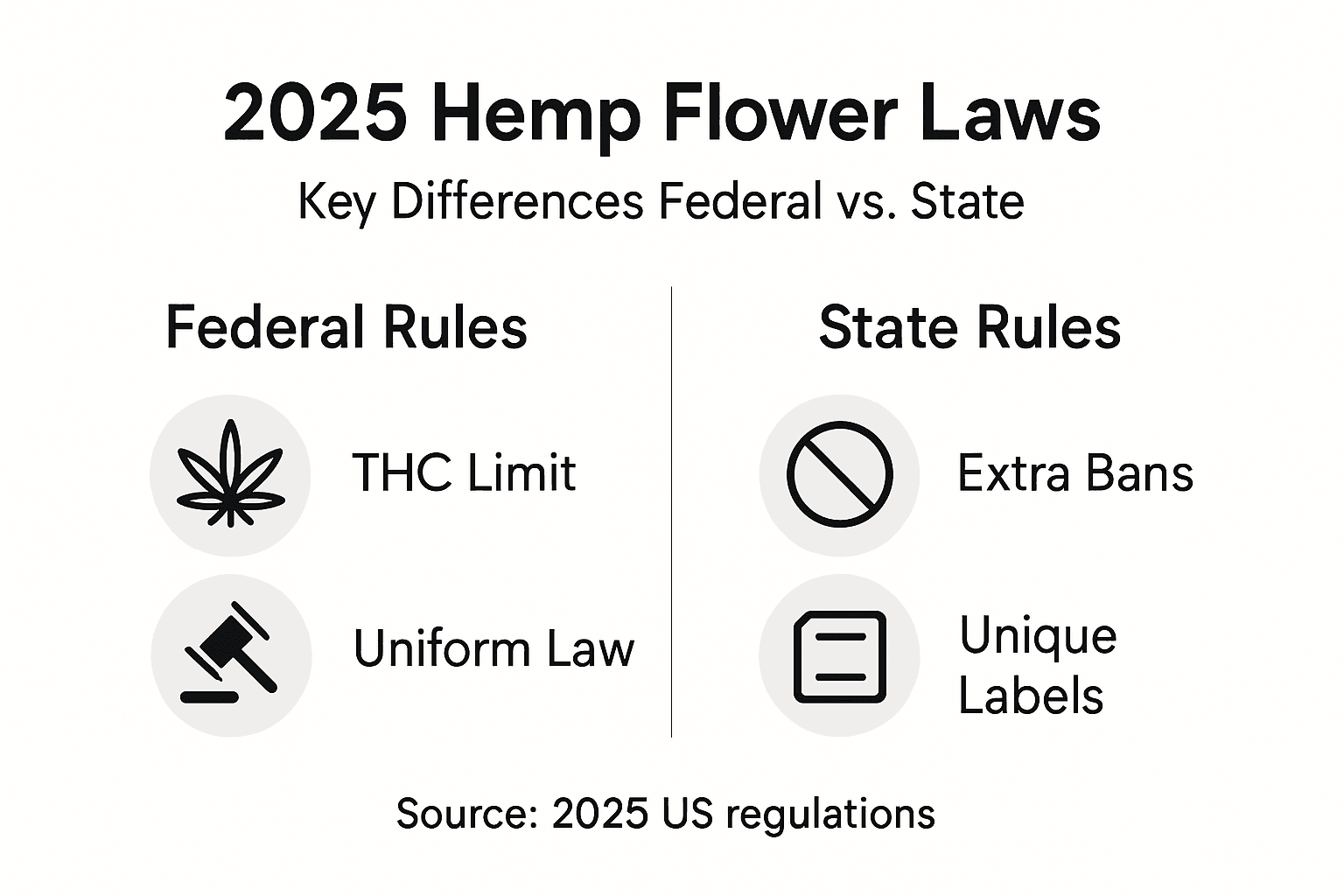
The 2025 hemp regulatory landscape represents a complex battleground of competing federal and state legal frameworks, with significant implications for consumers, producers, and retailers. Federal hemp reform redefines total THC measurement, establishing stricter guidelines that challenge existing state-level interpretations and create unprecedented regulatory complexity.
Key differences between federal and state hemp laws include:
- Federal limit of 0.3% total THC content on dry-weight basis
- State-level variations in cannabinoid restrictions
- Differing enforcement approaches and regulatory interpretations
- Potential conflicts between federal preemption and state autonomy
Under the new federal guidelines, states retain the authority to impose additional restrictions but cannot permit activities that fundamentally contradict federal mandates. This creates a regulatory patchwork where compliance becomes increasingly challenging. State policies continue to diverge from federal standards, with some jurisdictions maintaining more permissive approaches while others adopt even more stringent regulations.
The emerging legal framework significantly impacts hemp businesses, requiring constant vigilance and adaptive strategies to navigate the evolving regulatory environment. Producers and retailers must now carefully monitor both federal guidelines and state-specific nuances to ensure full legal compliance.
Regulatory Complexity Matters: The intersection of federal and state hemp laws represents a dynamic legal landscape with profound implications for the entire hemp industry.
Pro tip: Consult with a legal professional specializing in cannabis regulations to understand the specific compliance requirements in your state, as interpretations can vary dramatically between jurisdictions.
Here’s a comparative overview of how federal and state hemp regulations differ in 2025:
| Aspect | Federal Regulations | State Regulations |
|---|---|---|
| THC Limit | 0.3% total THC, dry weight | Often stricter or varied limits |
| Cannabinoid Scope | Broad, includes all forms | May target specific compounds |
| Enforcement | Overseen by federal agencies | State regulators interpret laws |
| Flexibility | Uniform nationwide | Varies by jurisdiction |
| Compliance Impact | Baseline for all producers | May require separate adaptations |
THCa vs. CBD Hemp Flower: State Variations
The landscape of hemp flower regulations presents a complex tapestry of legal nuances distinguishing THCa and CBD varieties across different states. Understanding THCa flower’s unique legal status becomes crucial for consumers navigating the evolving regulatory environment in 2025.
Key distinctions between THCa and CBD hemp flower include:
- Potential psychoactive conversion of THCa when heated
- Varying state interpretations of legal cannabinoid content
- Different regulatory approaches to intoxication potential
- Distinct molecular structures and therapeutic applications
State regulations demonstrate significant variability in how THCa and CBD hemp flowers are classified and regulated. Some states maintain strict interpretations that effectively ban THCa flower due to its potential to convert to Delta-9 THC when heated, while others adopt more nuanced approaches that consider the flower’s raw, non-intoxicating state.

The legal complexity surrounding these cannabinoids creates a challenging landscape for consumers and producers alike. Jurisdictions differ dramatically in their approach, with some states treating THCa flower as a controlled substance, while others permit its sale under specific conditions.
Legal Interpretation Matters: The distinction between THCa and CBD hemp flower represents a critical legal nuance with profound implications for consumer access and product availability.
Pro tip: Always verify the current legal status of THCa and CBD hemp flower in your specific state, as regulations can change rapidly and vary significantly between jurisdictions.
The following table summarizes key legal and consumer differences between THCa and CBD hemp flower:
| Feature | THCa Hemp Flower | CBD Hemp Flower |
|---|---|---|
| Psychoactive Potential | Converts to Delta-9 with heat | Non-intoxicating under normal use |
| Legal Treatment | Often restricted in states | Widely permitted, but regulated |
| Common Use | Sought for psychoactive effects | Used for wellness and research |
| Market Availability | Limited and varies regionally | Broadly available where legal |
Shipping, Purchasing, and Compliance Requirements
Navigating the complex landscape of hemp flower shipping and purchasing requires a deep understanding of evolving federal and state regulations in 2025. Hemp product shipping regulations have become increasingly intricate, with significant variations across different shipping carriers and jurisdictions.
Key compliance requirements for hemp flower shipping include:
- Obtaining comprehensive Certificates of Analysis (COA)
- Verifying precise THC content documentation
- Ensuring adult-signature verification for shipments
- Tracking state-specific legal restrictions
- Maintaining detailed shipping records
Shipping carriers have developed distinct policies that create substantial challenges for hemp businesses. UPS requires extensive documentation and adult signatures, while FedEx has implemented outright prohibitions on certain hemp-derived THC shipments. The United States Postal Service maintains ambiguous regulations that further complicate interstate transportation of hemp products.
Purchasing hemp flower requires meticulous attention to state-specific legal nuances. Consumers must verify local regulations, understand carrier restrictions, and ensure compliance with both federal and state laws governing cannabinoid products. The variability of legal interpretations means that what is permissible in one state may be strictly prohibited in another.
Regulatory Complexity Matters: Successful hemp flower procurement demands continuous vigilance and a proactive approach to understanding evolving legal frameworks.
Pro tip: Always request and verify the most recent Certificate of Analysis before purchasing hemp flower, and confirm shipping eligibility with both the vendor and your chosen shipping carrier.
Risks, Bans, and Market Impacts for Consumers
The hemp market faces unprecedented challenges in 2025, with federal law changes creating widespread industry disruption. These regulatory shifts threaten consumer access and potentially reshape the entire hemp product landscape across the United States.
Key risks and potential market impacts include:
- Significant reduction in available hemp product varieties
- Potential job losses in hemp-related industries
- Increased likelihood of unregulated black market activity
- Higher prices for remaining legal hemp products
- More restrictive purchasing and consumption requirements
Consumers face multiple challenges as regulatory frameworks tighten around hemp-derived products. The new federal guidelines dramatically restrict intoxicating cannabinoids, effectively eliminating popular products like delta-8 and certain THCa formulations. This regulatory approach creates substantial uncertainty for consumers who have relied on these wellness and recreational alternatives.
The economic consequences extend beyond individual consumer experiences. Small businesses and cultivators in the hemp industry may face existential challenges, with potential widespread market contraction and reduced product innovation. The complex patchwork of state laws further complicates compliance, creating a challenging environment for both producers and consumers.
Regulatory Complexity Matters: The evolving hemp market demands constant vigilance and adaptability from consumers and industry professionals.
Pro tip: Stay informed about local and federal regulations, and maintain flexibility in your hemp product consumption strategies to navigate the rapidly changing legal landscape.
Navigate Hemp Flower Laws with Confidence and Quality Products
Understanding the rapidly changing hemp flower legal landscape in 2025 can be overwhelming, especially with varying federal and state regulations on THCa and CBD products. If you seek trustworthy, lab-tested hemp flowers grown in California’s Emerald Triangle, you deserve a source that prioritizes compliance and product transparency. At California Blendz, we help you bridge the gap between complex legalities and your wellness goals with carefully curated selections in The THCa Prestige Vault and The Founder’s Collection.
Empower your hemp flower experience by choosing products that meet strict legal standards and come with third-party lab results for peace of mind. Act now to stay ahead in this evolving market. Explore our full range and shop confidently at California Blendz where legal compliance meets premium quality.
Frequently Asked Questions
What is hemp flower, and how does it differ from marijuana?
Hemp flower consists of the female flowering buds of the Cannabis sativa L. plant, rich in cannabinoids like CBD and THCa. Unlike marijuana, hemp flower contains a maximum of 0.3% Delta-9 THC, making it non-intoxicating and legally distinct from marijuana.
What are the key legal changes regarding hemp flower in 2025?
In 2025, federal hemp laws introduced stricter guidelines defining total THC content, which impacts the classification and sale of hemp flower. States may impose additional restrictions, resulting in a regulatory patchwork that complicates compliance for producers and consumers alike.
How do THCa and CBD hemp flowers differ legally?
THCa and CBD hemp flowers are treated differently under state regulations. THCa may be restricted due to its potential to convert to psychoactive THC upon heating, while CBD is generally permitted for consumption. Legal interpretations vary significantly between jurisdictions.
What should consumers know about shipping hemp flower in 2025?
Shipping hemp flower requires compliance with federal and state regulations, including obtaining Certificates of Analysis (COA) and verifying THC content. Different shipping carriers have their own policies, making it vital to understand local restrictions and carrier requirements before shipping.
Recommended
- Legal Status Hemp 2025: Complete Global Guide – California Blendz
- Hemp Legality in 2025 – What Changes for Californians – California Blendz
- Is Hemp Legal in 2025? What Consumers Need to Know – California Blendz
- Is Hemp Legal in the US – Key Laws for 2026 – California Blendz
- Die vielseitige Cannabispflanze: Anwendung und Anbau leicht erklärt – Weedforfriends


