
Legal Updates for Hemp 2025 – CBD and THCa Regulation Impact
Written by Trevor

Choosing safe, legally compliant hemp products just became much more complicated for wellness consumers across the United States. With Congress enacting sweeping changes in 2025, the definition of hemp now hinges on total THC limits that include all cannabinoid forms. These updates require both buyers and businesses to closely monitor not only CBD but also THCa content in the products they trust. Staying informed is key for anyone prioritizing wellness within the bounds of the latest American hemp laws.
Table of Contents
- Defining Hemp Laws And Regulatory Landscape
- CBD, THCa, And Hemp: Legal Distinctions
- Key 2025 Legislative Changes And Trends
- Compliance Obligations For Hemp Businesses
- Risks, Penalties, And State Law Variations
Key Takeaways
| Point | Details |
|---|---|
| New Total THC Regulations | The 2025 guidelines mandate total THC calculations, incorporating all variants, requiring businesses to closely monitor cannabinoid content. |
| Stricter Compliance Requirements | Hemp businesses must implement rigorous compliance strategies, including detailed tracking and adherence to new safety standards. |
| Complex Legal Landscape | The regulatory environment now varies significantly by state, necessitating adaptable compliance measures for businesses operating in multiple jurisdictions. |
| Consultation with Legal Experts | Engaging a cannabis regulatory attorney is crucial for ensuring compliance with evolving federal and state laws. |
Defining Hemp Laws and Regulatory Landscape
The federal regulatory landscape for hemp is undergoing significant transformation in 2025, with Congress introducing unprecedented changes that fundamentally redefine legal hemp parameters. Congressional amendments now establish a comprehensive framework that goes far beyond previous delta-9 THC content measurements.
Key shifts in hemp regulation include critical modifications to how cannabinoid content is calculated and controlled:
- Total THC limits now include all tetrahydrocannabinol isomers
- Expanded regulatory oversight of hemp-derived products
- Stricter compliance standards for cultivation and manufacturing
- New dry weight basis calculations for THC concentration
The new federal standards dramatically narrow the definition of legal hemp, effectively reinstating more stringent controls over various hemp products under the Controlled Substances Act. Regulatory compliance now requires manufacturers and cultivators to meticulously track and report total cannabinoid content, not just delta-9 THC levels.
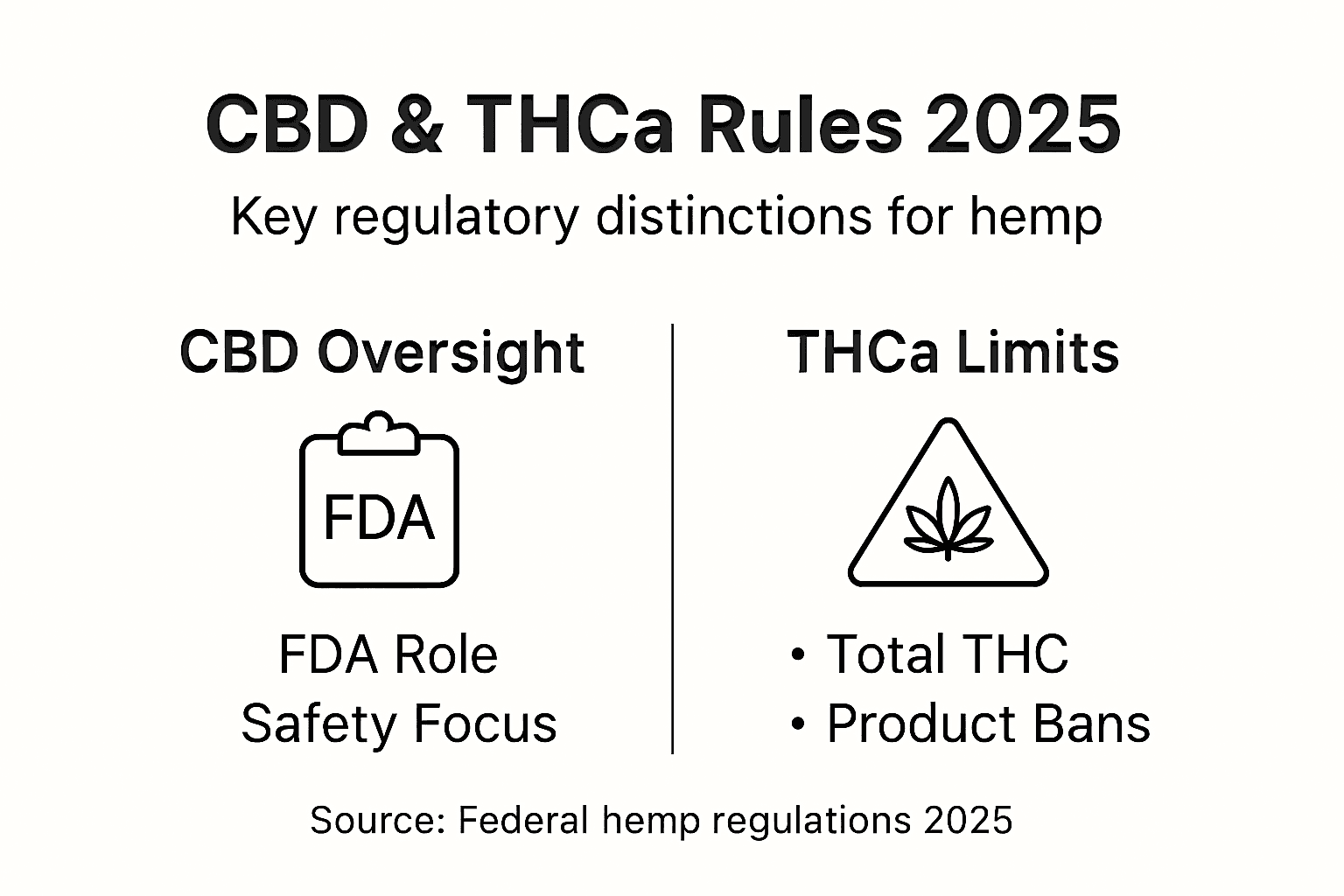
Federal regulatory changes also maintain FDA authority over CBD and related compounds, ensuring continued strict oversight of product safety and marketing claims. This means hemp businesses must adapt quickly to these more complex legal requirements or risk significant penalties.
Pro tip: Consult with a cannabis regulatory attorney to ensure your hemp products remain compliant with the new 2025 federal guidelines.
CBD, THCa, and Hemp: Legal Distinctions
Federal regulations are creating increasingly complex distinctions between cannabinoids, particularly for CBD and THCa derived from hemp. Congressional research reveals nuanced legal classifications that dramatically impact how these compounds are regulated and marketed.
Key legal distinctions between cannabinoids include:
- CBD remains non-intoxicating and subject to FDA pharmaceutical restrictions
- THCa is now classified based on its potential to convert to psychoactive THC
- Hemp product definitions now incorporate total cannabinoid content
- Regulatory focus shifts from origin to psychoactive potential
The 2025 legislative updates fundamentally transform how cannabinoid legal status is determined. Previously, hemp products were evaluated primarily on delta-9 THC levels, but new standards encompass a more comprehensive assessment of potential psychoactive compounds. Federal regulatory changes now treat THCa more stringently, effectively closing previous legal loopholes that allowed broader hemp product distribution.

These regulatory shifts mean businesses must carefully track not just delta-9 THC content, but the total potential for psychoactive transformation across all cannabinoid variants. Manufacturers and retailers now face more complex compliance requirements that demand sophisticated testing and reporting mechanisms.
The following table highlights the differences between CBD and THCa legal treatment in 2025:
| Cannabinoid | Legal Status in 2025 | Primary Regulatory Focus |
|---|---|---|
| CBD | FDA-regulated, non-intoxicating | Safety, pharmaceutical compliance |
| THCa | Treated as potential THC | Psychoactive potential, product limits |
Pro tip: Invest in comprehensive cannabinoid testing that tracks total potential THC content to ensure ongoing regulatory compliance.
Key 2025 Legislative Changes and Trends
Sweeping legislative changes are reshaping the hemp industry’s regulatory landscape in 2025, introducing unprecedented restrictions on cannabinoid production and distribution. These comprehensive reforms represent the most significant overhaul of hemp regulations since the 2018 Farm Bill.
Key legislative modifications include:
- Total THC standard set at 0.3% by dry weight
- Prohibition of synthetic and chemically converted cannabinoids
- Strict product-level THC limits (0.4 milligrams per package)
- Comprehensive ban on most intoxicating hemp-derived products
- Enhanced federal oversight of hemp manufacturing
The new regulatory framework fundamentally transforms hemp product compliance, effectively narrowing the legal market for many existing cannabinoid products. Federal regulatory updates establish more rigorous standards that will significantly impact cultivation, manufacturing, and retail sectors across the United States.
These legislative changes signal a profound shift in how hemp-derived products are conceptualized and regulated. Manufacturers must now navigate an increasingly complex legal environment that prioritizes consumer safety and standardization over the previous more permissive approach to hemp-derived cannabinoids.
Pro tip: Conduct a comprehensive audit of your current product line to ensure compliance with the new 2025 hemp regulations before the November 2026 enforcement deadline.
Compliance Obligations for Hemp Businesses
New regulatory requirements are creating unprecedented challenges for hemp businesses in 2025, demanding comprehensive transformations in product development, testing, and distribution strategies. The regulatory landscape now requires meticulous attention to complex compliance mechanisms that extend far beyond previous legal frameworks.
Key compliance obligations for hemp businesses include:
- Strict total THC threshold of 0.3% by dry weight
- Maximum 0.4 mg total THC per product container
- Comprehensive testing for all THC variants
- Prohibition of synthetic cannabinoid production
- Enhanced documentation and supply chain tracking
- Mandatory FDA-compliant labeling and marketing practices
The new regulatory environment fundamentally reshapes hemp business operations, requiring sophisticated testing protocols and potentially extensive product reformulation. Regulatory amendments introduce stricter licensing requirements that demand proactive compliance strategies and significant investments in quality control infrastructure.
Businesses must now develop robust internal systems to track cannabinoid content, ensure precise manufacturing standards, and maintain comprehensive documentation demonstrating ongoing regulatory adherence. These obligations represent a substantial shift from previous more lenient regulatory approaches, requiring significant operational and strategic adaptations.
Here’s a summary of how the new 2025 hemp regulations impact key business areas:
| Business Area | Main Change | Compliance Impact |
|---|---|---|
| Product Formulation | Total THC content tracking required | Reformulate to meet 0.3% limit |
| Manufacturing | Prohibited synthetic cannabinoids | Revise processes, update SOPs |
| Marketing | Stricter FDA oversight | Adjust claims, review labeling |
| Distribution | Varying state restrictions | Develop state-specific plans |
| Testing | Expanded cannabinoid testing scope | Invest in advanced equipment |
Pro tip: Develop a dedicated compliance team and invest in advanced cannabinoid testing technologies to stay ahead of the new 2025 regulatory requirements.
Risks, Penalties, and State Law Variations
State hemp regulations in 2025 create a complex legal landscape with significant variability across different jurisdictions, presenting unprecedented challenges for hemp businesses nationwide. The dramatic divergence in state-level approaches transforms compliance from a straightforward process into a nuanced strategic challenge.
Key risks and potential penalties include:
- Product seizure in non-compliant jurisdictions
- Financial penalties ranging from $5,000 to $250,000
- Potential license revocation for repeated violations
- Criminal charges for intentional regulatory breaches
- Mandatory product reformulation and testing expenses
- Potential federal and state legal prosecution
The regulatory enforcement landscape varies dramatically between states, with some implementing strict prohibitions while others maintain more permissive frameworks. Some jurisdictions have enacted outright bans on intoxicating hemp products, creating a patchwork of regulations that demand sophisticated legal navigation and comprehensive compliance strategies.
Businesses operating across multiple states must develop robust, adaptable compliance mechanisms that can quickly respond to local regulatory shifts. This requires maintaining detailed documentation, implementing advanced testing protocols, and establishing proactive legal monitoring systems to mitigate potential risks and penalties.
Pro tip: Develop a state-by-state compliance matrix that tracks regulatory variations and updates in real-time to maintain legal operations across different jurisdictions.
Stay Ahead of Hemp Legal Changes with California Blendz
The 2025 hemp regulations bring major challenges including total THC limits, strict compliance, and complex cannabinoid testing requirements. If you want to confidently navigate this evolving landscape, discover premium, lab-tested hemp products crafted to meet the latest standards. Explore our carefully curated selections like The THCa Prestige Vault – California Blendz and The Founder’s Collection – California Blendz featuring organic hemp flower and elite cannabinoid profiles tailored for quality and legal compliance.
Take control of your hemp experience today and shop with confidence at California Blendz. Our transparent sourcing, lab results, and premium product range empower you to meet the new hemp regulations safely while enjoying natural wellness benefits. Visit us now to select compliant, trusted products that meet 2025 standards and keep your hemp journey smooth and legal.
Frequently Asked Questions
What are the key legal changes affecting hemp in 2025?
The 2025 legal changes include a total THC limit of 0.3% by dry weight, a prohibition on synthetic cannabinoids, stricter product-level THC limits, and enhanced federal oversight of hemp manufacturing.
How does the legal status of CBD differ from THCa under new regulations?
CBD remains non-intoxicating and regulated by the FDA, focusing on safety and compliance, while THCa is now treated more strictly due to its potential to convert into psychoactive THC, impacting its distribution and regulation.
What compliance obligations do hemp businesses need to follow in 2025?
Hemp businesses must track total THC content, ensure products do not exceed 0.4 mg of total THC per container, conduct comprehensive cannabinoid testing, and adhere to FDA-compliant labeling and marketing practices.
What are the risks and penalties for non-compliance with hemp regulations?
Risks of non-compliance include product seizure, financial penalties ranging from $5,000 to $250,000, potential license revocation, and mandatory product reformulation. Businesses may also face criminal charges for intentional regulatory breaches.
Recommended
- Hemp Legality in 2025 – What Changes for Californians – California Blendz
- Is Hemp Legal in 2025? What Consumers Need to Know – California Blendz
- Legal Status Hemp 2025: Complete Global Guide – California Blendz
- Is Hemp Legal in the US – Key Laws for 2026 – California Blendz
- Utsikter for CBD i 2026: Hva Helse-Norge Kan Forvente -


