
Hemp Legality in 2025 – What Changes for Californians
Written by Trevor

Finding a truly safe, effective hemp product is about to get even trickier for the average American consumer. New California and federal laws in 2025 introduce a stricter definition of hemp, going far beyond the familiar Delta-9 THC limit. With more rigorous testing and a bold shift to total THC measurements, health-conscious Californians must rethink their approach. This article uncovers important differences and key facts so you can make smart, compliant choices as regulations change.
Table of Contents
- Defining Hemp in 2025: Key Concepts
- Federal and State Laws Shaping Hemp
- Hemp-Derived CBD, THCa, and THC Explained
- California’s 2025 Ban on Intoxicating Hemp
- Compliance, Risks, and Business Impact
Key Takeaways
| Point | Details |
|---|---|
| Evolving Hemp Regulations | The definition and regulation of hemp are changing significantly at both federal and state levels, focusing on total THC content instead of just Delta-9 THC. |
| California’s Legal Landscape | California has implemented strict regulations, including a planned ban on intoxicating hemp products, moving towards integration with broader cannabis laws. |
| Compliance Challenges for Businesses | Companies face increased compliance risks and must adapt their product lines and operational strategies to align with new regulations. |
| Importance of Staying Informed | It’s crucial for consumers and businesses to stay updated on both federal and state regulations to ensure compliance and understand the legal implications of their products. |
Defining Hemp in 2025: Key Concepts
The landscape of hemp regulation is rapidly evolving, with critical changes emerging in how hemp is legally defined across state and federal levels. In 2025, California consumers will encounter a significantly transformed regulatory environment that goes far beyond traditional hemp classifications.
The federal government is implementing a comprehensive redefinition of hemp, moving beyond previous limitations. Federal legislation now considers total tetrahydrocannabinols instead of just Delta-9 THC content. This means the entire cannabinoid profile becomes crucial in determining legal status, not just a single compound. The new standard imposes a strict 0.4 mg total THC limit per finished product, effectively closing what was previously known as the “intoxicating hemp loophole”.
Internationally, regulatory perspectives are also shifting. The European Parliament has advanced a “whole-plant” approach, explicitly including hemp flowers as legitimate agricultural products. This global trend suggests a more holistic understanding of hemp, recognizing its potential across multiple industries. For California consumers, these changes mean more rigorous testing, clearer product labeling, and potentially more restricted access to certain hemp-derived products.
Pro tip: Stay informed about local regulations and always verify the THC content of hemp products through third-party lab testing to ensure compliance with the latest legal standards.
Federal and State Laws Shaping Hemp
In 2025, the hemp regulatory landscape has become increasingly complex, with federal and state governments implementing nuanced approaches to cannabinoid regulation. Federal hemp policy underwent significant transformations that fundamentally reshape how hemp products are classified and controlled across the United States.
The 2025 Agriculture appropriations act represents a pivotal moment in hemp regulation. Whereas the 2018 Farm Bill originally distinguished hemp by Delta-9 THC content, the new legislation takes a more comprehensive approach. The updated framework now considers total THC and THCA levels, dramatically narrowing the legal definition of hemp and imposing stricter controls on hemp-derived products. This shift effectively returns hemp to a more regulated status similar to its pre-2018 classification under the Controlled Substances Act.
State-level regulations add another layer of complexity to the hemp legal landscape. Different states have adopted varying approaches, creating a patchwork of regulations that can be challenging for consumers and producers to navigate. Some states have moved to ban or significantly limit intoxicating hemp products, while others maintain more moderate positions. For California consumers, this means carefully tracking both state and federal guidelines to ensure compliance and understanding the rapidly evolving legal environment surrounding hemp-derived products.
Pro tip: Consult local legal resources and stay updated on both state and federal hemp regulations, as the legal landscape can change quickly and vary significantly between jurisdictions.
Hemp-Derived CBD, THCa, and THC Explained
The world of cannabinoids is complex and rapidly evolving, with legal nuances that can be challenging for consumers to navigate. Cannabis contains multiple cannabinoids with distinct properties that interact differently with the human body, creating a sophisticated landscape of potential effects and legal considerations.
Understanding the key differences between cannabinoids is crucial. THCA (tetrahydrocannabinolic acid) is a non-psychoactive compound found in raw cannabis that transforms into psychoactive Delta-9 THC through a process called decarboxylation - typically triggered by heat. This conversion mechanism creates significant regulatory challenges, as the 2018 Farm Bill’s original language focused solely on Delta-9 THC levels, inadvertently creating loopholes for products containing high THCA content.

Synthetic cannabinoids like Delta-8 THC, chemically converted from CBD, have further complicated the regulatory environment. These compounds exist in a legal gray area, produced outside traditional licensed cannabis markets and offering psychoactive experiences that fall outside original hemp regulation frameworks. Federal proposals are now moving to close these regulatory gaps by comprehensively redefining hemp to include all potentially intoxicating cannabinoids, regardless of their source or method of production.
Pro tip: Always verify the exact cannabinoid composition and legal status of any hemp-derived product, as regulations can change rapidly and vary significantly between jurisdictions.
California’s 2025 Ban on Intoxicating Hemp
California has taken a definitive stance on hemp-derived intoxicants, implementing comprehensive regulations that fundamentally reshape the state’s cannabinoid landscape. Governor Newsom signed Assembly Bill 8 in October 2025, creating a landmark legislation that brings significant changes to hemp product regulations.
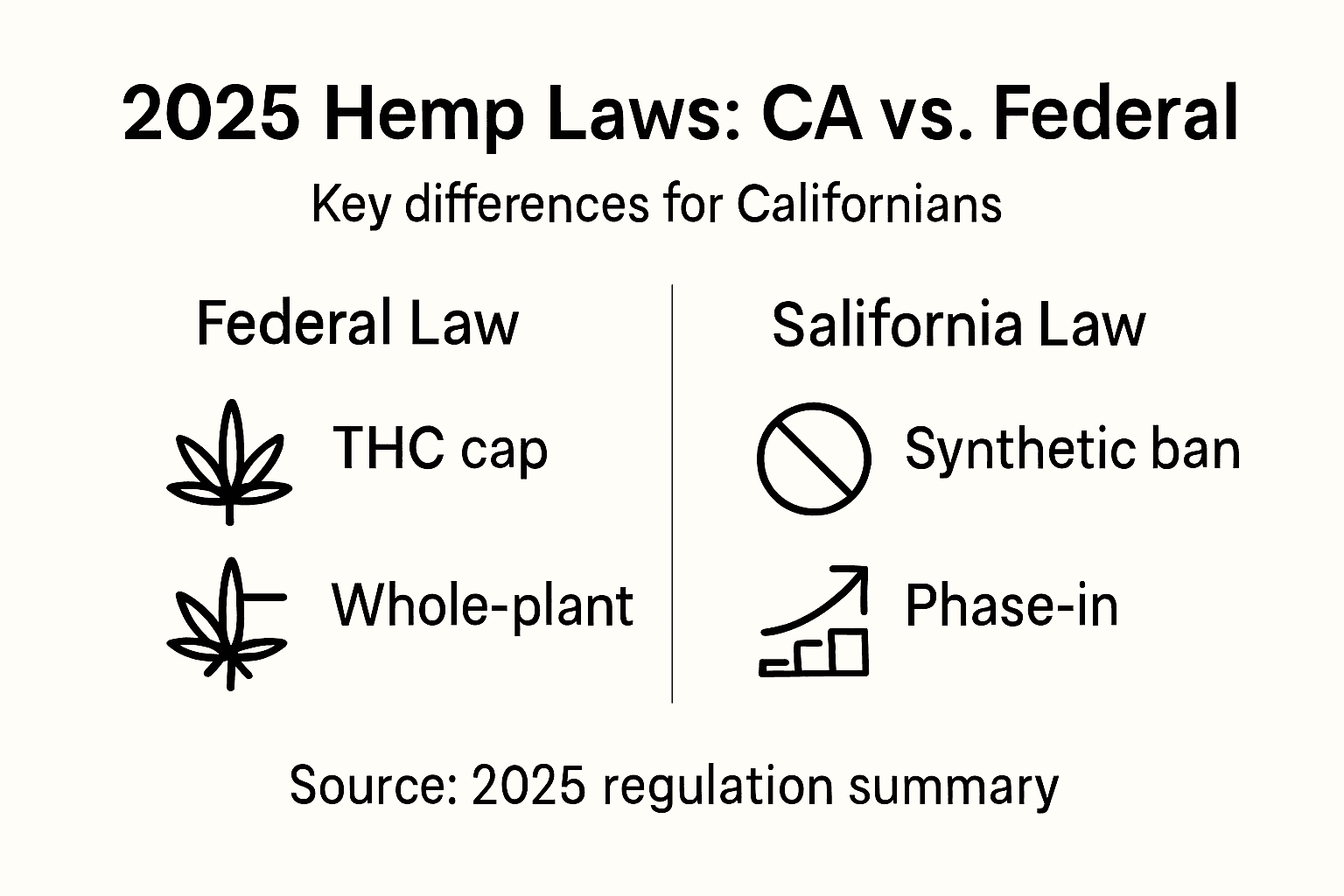
The new law represents a comprehensive approach to controlling hemp-derived products, effectively integrating synthetic cannabinoids like Delta-8 THC into the state’s existing cannabis regulatory framework. Key provisions include strict prohibitions on synthetic cannabinoids, age restrictions set at 21 years, and comprehensive licensing requirements for hemp product manufacturers. These regulations aim to close existing legal loopholes that previously allowed unregulated intoxicating hemp products to proliferate in the market, creating a more controlled and safer consumer environment.
Implementation of the law will occur in phases, with full enforcement expected by January 2028. This strategic timeline allows businesses and consumers to adapt to the new regulatory landscape. The legislation specifically targets inhalable hemp products and synthetic cannabinoids, bringing them under the same rigorous standards applied to traditional cannabis products. For California consumers, this means a significant reduction in available hemp-derived intoxicants and increased oversight to ensure product safety and quality.
Here’s how federal and California hemp product regulations compare in 2025:
| Regulatory Aspect | Federal Law (2025) | California Law (2025) |
|---|---|---|
| THC Measurement | Total THC plus THCA | Total THC plus THCA |
| Product Limit | 0.4 mg THC per product | Often stricter or banned intoxication |
| Synthetic Cannabinoids | Redefined, stricter oversight | Prohibited in consumer products |
| Enforcement Timeline | Immediate upon legislation | Phased, full enforcement by 2028 |
Pro tip: Carefully review the specific details of Assembly Bill 8 and consult local legal resources to understand how these new regulations might impact your current hemp product usage or business operations.
Compliance, Risks, and Business Impact
The evolving hemp regulatory landscape presents substantial challenges for businesses operating in the cannabinoid market. Businesses face heightened compliance risks due to complex and rapidly changing federal and state restrictions on intoxicating hemp products, demanding unprecedented levels of strategic adaptation.
The 2025 federal redefinition fundamentally transforms the hemp industry’s operational framework. Most intoxicating hemp products are now reclassified as Schedule I substances, creating significant legal and financial risks for manufacturers, distributors, and retailers. Companies must immediately reassess their product lines, supply chains, and business models to avoid potential regulatory penalties, contract breaches, and potential legal actions that could result in substantial financial losses.
These regulatory shifts disproportionately impact smaller businesses and social equity entrepreneurs who lack the resources to quickly pivot their operations. The new landscape requires comprehensive risk mitigation strategies, including thorough legal consultations, product reformulation, robust compliance documentation, and potentially complete business model reconstruction. Successful navigation of these changes demands proactive legal counsel, detailed regulatory tracking, and a willingness to fundamentally reimagine product development and market positioning.
This summary table outlines the business challenges resulting from new hemp regulations:
| Challenge | Impact on Businesses | Possible Solutions |
|---|---|---|
| Reclassification of Products | Legal risks, market withdrawal | Product reformulation, legal review |
| Compliance Documentation | Higher administrative costs | Invest in compliance systems |
| Supply Chain Adjustments | Disrupted sourcing, delays | Build new partnerships, diversify sources |
| Social Equity Concerns | Increased barriers for small operations | Targeted support, legal guidance |
Pro tip: Consult specialized cannabis legal experts and conduct a comprehensive audit of your current product portfolio to identify potential compliance vulnerabilities before regulatory enforcement begins.
Stay Ahead of Hemp Legality Changes with Trusted California Blendz
The hemp legal landscape in California is shifting rapidly in 2025, creating challenges for consumers who want to enjoy safe, legal, and high-quality hemp-derived products. Stricter rules on THC limits and bans on intoxicating hemp products mean you must choose trusted sources that prioritize compliance, transparency, and lab-tested quality. Whether you are exploring THCa flower or seeking relaxation with CBD, understanding these evolving regulations is vital to avoid risks and ensure a responsible experience.
Discover our carefully curated selections at The THCa Prestige Vault – California Blendz where every product undergoes rigorous testing and meets California’s strict standards. For those looking for a gentle approach to wellness, explore our CBD Edibles – California Blendz made with organic, sustainably grown hemp. Visit California Blendz now to shop with confidence and stay informed about products that comply with the latest legal requirements. Act today to secure safe, compliant hemp products that fit your lifestyle and values.
Frequently Asked Questions
What is the new definition of hemp in 2025?
The new definition of hemp in 2025 includes a total THC limit of 0.4 mg per finished product, considering the entire cannabinoid profile rather than just Delta-9 THC content.
How will hemp-derived product regulations change in California?
California will implement stricter regulations, including prohibiting synthetic cannabinoids like Delta-8 THC in consumer products, with comprehensive licensing requirements and age restrictions set at 21 years.
What are the potential risks for businesses under the new hemp regulations?
Businesses face significant legal and financial risks due to the reclassification of many hemp products as Schedule I substances, requiring them to reassess their operations and compliance strategies to avoid penalties.
How can consumers ensure they are purchasing compliant hemp products?
Consumers should verify the THC content and cannabinoid composition of hemp products through third-party lab testing and stay informed about the latest state and federal regulations to ensure compliance.


