
Is THCa Legal Federally? 2026 Law Changes Explained
Written by Trevor

Finding reliable answers about THCa can feel confusing for American adults trying to make informed, healthy choices online. With growing interest in organic cannabis and shifting legal rules, understanding the difference between non-psychoactive THCa and traditional THC is crucial. This guide clears up the federal and state regulations, highlights the latest scientific findings, and helps you avoid common mistakes when shopping for hemp or cannabis products in the United States.
Table of Contents
- What Is THCa and Its Key Properties
- The THCa Loophole and Why It Emerged
- Federal Legal Status of THCa in 2026
- New Total THC Rule and Product Limits
- Practical Risks and Enforcement Concerns
- What Remains Legal for Hemp Consumers
Key Takeaways
| Point | Details |
|---|---|
| Understanding THCa | THCa is a non-psychoactive cannabinoid with potential therapeutic benefits being actively researched. |
| Legal Loophole Concerns | The THCa legal loophole, arising from the 2018 Farm Bill, has led to confusion and challenges in cannabis regulations. |
| Total THC Rule Impact | The new total THC rule will require stricter compliance measures for hemp products, impacting market accessibility. |
| Consumer Safety | Consumers should verify the legal status and cannabinoid content of hemp products to ensure safety and compliance. |
What Is THCa and Its Key Properties
THCa, short for Tetrahydrocannabinolic Acid, is a fascinating cannabinoid found naturally in raw, unprocessed cannabis plants. Unlike its more famous cousin THC, THCa is non-psychoactive and exists as the acidic precursor to the compound we commonly associate with cannabis effects. Raw cannabis contains significant THCa concentrations before any heating or processing occurs.
The molecular structure of THCa is quite unique. When cannabis is fresh and unheated, THCa exists in its acidic form, which means it does not produce the intoxicating effects typically associated with cannabis consumption. This occurs because THCa contains an additional molecular group that prevents it from directly interacting with the body’s cannabinoid receptors. However, when exposed to heat through smoking, vaping, or cooking, THCa undergoes a process called decarboxylation, which removes the acidic molecular group and transforms it into THC.
Key properties of THCa include several potential therapeutic benefits that researchers are actively exploring:
- Non-psychoactive in its raw form
- Potential anti-inflammatory properties
- Possible neuroprotective effects
- Appears to interact differently with human biochemistry compared to THC
Scientific interest in THCa has grown significantly, with researchers investigating its potential independent therapeutic applications. Cannabinoid studies suggest THCa may offer unique health benefits without producing the traditional “high” associated with cannabis consumption.
Here’s a quick comparison of THCa and THC in their raw and processed forms:
| Property | THCa (Raw) | THC (Heated/Processed) |
|---|---|---|
| Psychoactivity | Non-psychoactive | Psychoactive, produces “high” |
| Molecular Structure | Contains acidic group | Acidic group removed |
| Therapeutic Potential | Research ongoing, unique benefits | Studied for pain and anxiety relief |
| Legal Status | Often a gray area | Regulated under marijuana laws |
| Conversion Method | No effect without heat | Created from THCa during heating |
Pro tip: Always consult with a healthcare professional before incorporating any new cannabinoid product into your wellness routine, and ensure you understand the legal status of THCa in your specific jurisdiction.
The THCa Loophole and Why It Emerged
The THCa legal loophole emerged as an unexpected consequence of the 2018 Farm Bill, which created a complex regulatory landscape for cannabis products. The bill legalized hemp with less than 0.3% delta-9 THC, but did not explicitly address the nuanced chemistry of cannabinoids like THCa. This oversight created a significant legal gray area that enterprising hemp producers quickly recognized and exploited.
At the heart of this loophole is a critical chemical distinction. While the Farm Bill focused on delta-9 THC content, it overlooked the fact that THCa naturally converts to THC when heated. This means that hemp producers could technically sell high-THCa flower as a legal product, despite its potential to become intoxicating when smoked or processed. Legislative gaps have allowed widespread production of potentially intoxicating hemp products, creating tension between hemp producers and traditional marijuana dispensaries.
The implications of this loophole are significant and multifaceted:
- Bypasses traditional marijuana regulations
- Allows sale of potentially intoxicating products
- Creates confusion in legal cannabis markets
- Challenges existing drug enforcement frameworks
- Raises public health and safety concerns
Public health advocates and regulatory bodies have become increasingly concerned about the potential consequences of this legal ambiguity. The loophole essentially allows the sale of products that can produce intoxicating effects, despite being marketed as hemp, which directly contradicts the original intent of the 2018 Farm Bill.
Pro tip: Always verify the legal status of cannabis products in your specific jurisdiction and consult with local authorities to understand the current regulatory landscape surrounding THCa.
Federal Legal Status of THCa in 2026
The federal legal status of THCa remains complex and ambiguous in 2026, primarily due to the nuanced interpretation of the 2018 Farm Bill. Federal regulations continue to create significant legal uncertainty around cannabis products, particularly those containing THCa. While the bill originally legalized hemp with less than 0.3% delta-9 THC, it did not comprehensively address the intricate chemistry of cannabinoids like THCa.
Key legal considerations for THCa in 2026 revolve around two primary interpretative frameworks. Some federal agencies focus on the delta-9 THC content at the point of measurement, while others advocate for a total THC calculation that includes potential THC conversion. This means that high-THCa products could be considered illegal if the total potential THC content exceeds the 0.3% threshold, even if the initial delta-9 THC levels are low.
The primary legal challenges surrounding THCa include:
- Inconsistent federal and state interpretations
- Lack of explicit regulatory guidance
- Complexity of cannabinoid chemistry
- Potential for rapid THC conversion
- Varying enforcement approaches across jurisdictions
Legal debates continue to center on whether total THC content determines compliance, creating a challenging landscape for producers and consumers. The Drug Enforcement Administration (DEA) and other federal agencies have increasingly emphasized the importance of considering the total potential psychoactive content of cannabis products.
Pro tip: Consult with a legal professional specializing in cannabis regulations to understand the specific legal implications of THCa in your jurisdiction, as the legal landscape continues to evolve rapidly.
New Total THC Rule and Product Limits
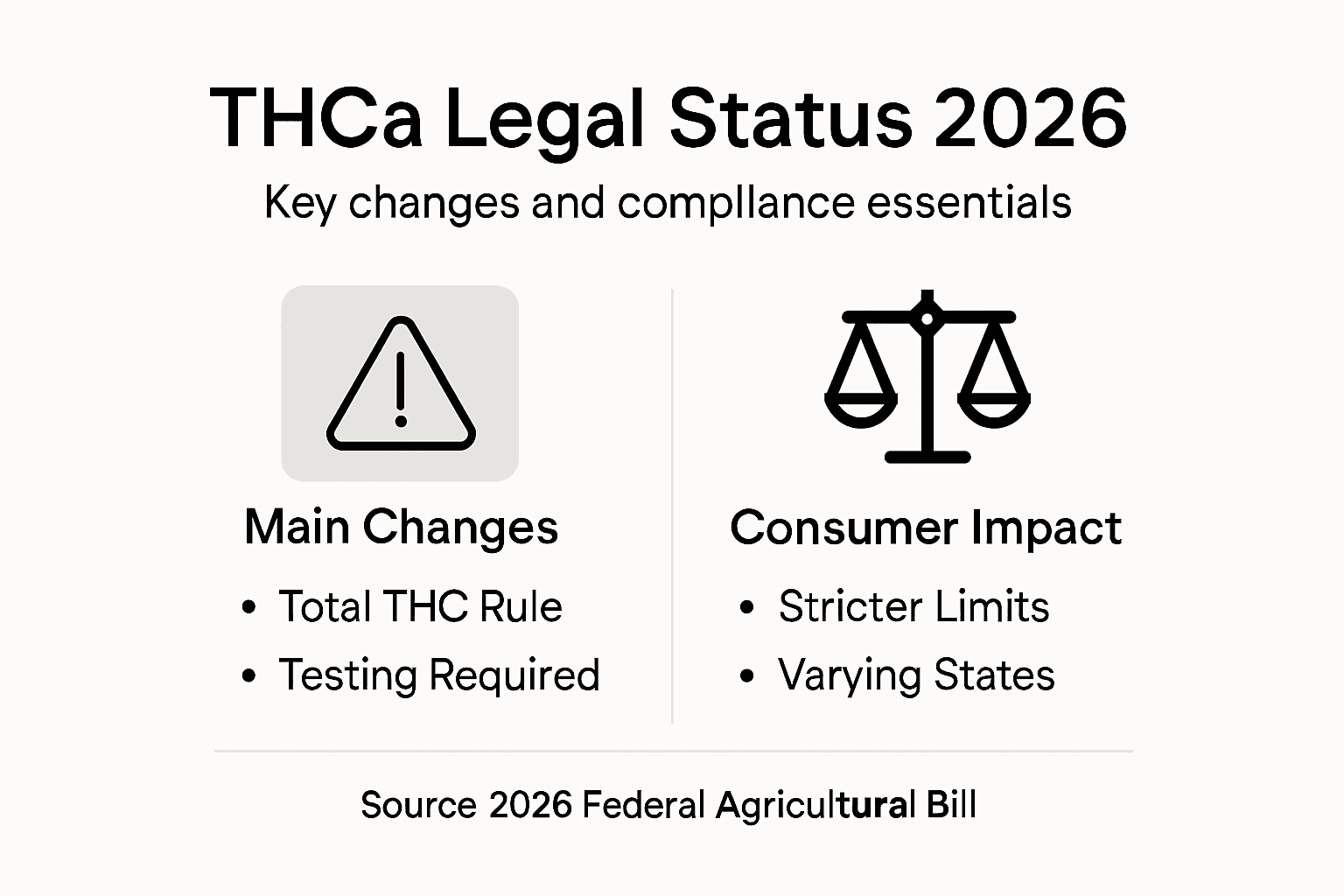
The 2026 federal agricultural appropriations bill represents a significant shift in cannabis regulation, introducing a comprehensive total THC calculation that could dramatically impact hemp and cannabis product markets. The proposed rule fundamentally redefines hemp product standards, focusing on the cumulative psychoactive potential of cannabinoid products rather than isolated THC measurements.
Under the new framework, federal regulators will calculate THC content by summing delta-9 THC and potential THC derived from THCa conversion. This means products will be evaluated based on their total potential psychoactive content, not just the initial delta-9 THC levels. Manufacturers and producers will need to carefully track and report cannabinoid profiles to ensure compliance with the 0.3% total THC threshold.
Key implications of the new total THC rule include:
- Stricter measurement standards for hemp products
- Reduced market accessibility for high-THCa items
- Enhanced consumer protection mechanisms
- More complex product testing requirements
- Potential market consolidation among producers
State-level regulations continue to vary in their approach to THC content measurement, creating an additional layer of complexity for manufacturers and retailers. Some states have already implemented similar total THC calculations, while others maintain more traditional delta-9 THC measurement protocols.
To clarify how new THC regulations affect hemp producers, here’s a summary of testing methods and their consequences:
| Testing Method | What It Measures | Impact on Hemp Products |
|---|---|---|
| Delta-9 THC Only | Active THC at purchase | Allows higher THCa flowers |
| Total THC (Delta-9 + THCa) | All potential psychoactive THC | Limits high-THCa items, stricter compliance |
| State-by-State Approach | Varies by jurisdiction | Creates legal inconsistencies |
Pro tip: Consult with a cannabis regulatory compliance expert to understand how the new total THC rule might specifically impact your product line or business strategy.
Practical Risks and Enforcement Concerns
The landscape of THCa product regulation presents significant challenges for law enforcement and public health officials. Public health concerns surrounding unregulated cannabinoid products continue to mount, creating a complex enforcement environment that spans federal, state, and local jurisdictions. The ambiguous legal status of THCa products has created a regulatory minefield with potential risks to consumer safety.
Enforcement challenges stem from the fundamental complexity of cannabinoid chemistry and varying interpretative frameworks across different regulatory bodies. Law enforcement agencies struggle with inconsistent definitions, making it difficult to determine whether a product is legally compliant. The potential for rapid THC conversion means that products technically meeting legal standards at point of sale could become intoxicating through simple heating or processing.
Key practical risks associated with THCa products include:
- Unregulated product potency
- Inconsistent manufacturing standards
- Potential youth exposure
- Increased risk of cannabis use disorder
- Challenges in product tracking and verification
- Potential cross-state legal complications
The current regulatory landscape creates a patchwork of enforcement priorities, with some states implementing stricter controls while others maintain more permissive approaches. This inconsistency further complicates efforts to develop comprehensive consumer protection strategies and uniform enforcement mechanisms.
Pro tip: Maintain detailed documentation of product composition, sourcing, and potential THC conversion rates to demonstrate compliance and mitigate potential legal risks.
What Remains Legal for Hemp Consumers
The 2026 hemp regulatory landscape continues to provide legal pathways for responsible consumers, despite increasingly complex cannabinoid regulations. Federal legislation maintains clear distinctions for lawful hemp products, ensuring that certain hemp-derived items remain accessible to consumers seeking natural wellness alternatives.
Under the proposed regulatory framework, hemp consumers can expect continued availability of specific product categories. Industrial hemp derivatives, non-cannabinoid hemp products, and items containing minimal psychoactive compounds will remain legal. This means hemp seed products, hemp-derived CBD with controlled concentrations, and raw hemp materials used for textiles, nutrition, and wellness remain viable options for consumers.
Key legal hemp product categories include:
- Hemp seed and hemp seed-based foods
- Non-intoxicating CBD products
- Industrial hemp fiber materials
- Hemp-derived nutritional supplements
- Raw hemp flower with controlled cannabinoid levels
- Hemp-based textiles and construction materials
State and federal regulations increasingly emphasize product testing and transparent labeling to distinguish lawful hemp products from potentially intoxicating alternatives. Consumers can expect more rigorous verification processes, ensuring product safety and regulatory compliance.
Pro tip: Always request third-party lab testing results and verify the specific cannabinoid content before purchasing any hemp-derived product to ensure legal compliance and personal safety.
Navigate the Complex World of THCa Legal Changes with Confidence
Understanding the evolving federal laws around THCa can be confusing and concerning if you want to enjoy hemp-derived products legally and safely. The article highlights key challenges such as the 2026 total THC rule, legal ambiguity, and enforcement risks that make finding trustworthy THCa products a real challenge. If you value transparency, lab-tested quality, and compliance with ever-changing regulations, your search ends here.
Discover peace of mind and premium selection in The THCa Prestige Vault – California Blendz where every product is carefully sourced from California’s Emerald Triangle with full third-party testing.
Ready to explore high-quality, sustainably grown THCa products that honor safety and legality? Visit California Blendz now to browse our expertly curated THCa Bundle – California Blendz and select what fits your wellness journey. Shop confidently with transparent lab results and industry-leading compliance standards at your fingertips.
Frequently Asked Questions
Is THCa legal federally as of 2026?
The federal legal status of THCa is complex and ambiguous in 2026 due to inconsistent interpretations of the 2018 Farm Bill, which legalized hemp under certain THC limits but did not address THCa specifically.
What is the significance of the total THC calculation introduced in 2026?
The total THC calculation sums delta-9 THC and any potential THC from THCa conversion, meaning products must comply with a 0.3% total THC threshold, affecting the legality of high-THCa items.
What challenges do producers face under the new total THC rule?
Producers must ensure compliance with stricter measurement standards and navigate varying state regulations, which can complicate product testing and market accessibility.
What types of hemp products remain legal for consumers in the wake of regulatory changes?
Consumers can still access industrial hemp derivatives, non-intoxicating CBD products, and raw hemp materials used for textiles and nutrition, among other lawful hemp items.
Recommended
- THCa Flower: What is it and How to Find THCa Flower Vendors? – California Blendz
- Debunking 5 Common Myths About THCA Flower – California Blendz
- THCA Flower Explained: What It Is, How It Works, and Why It Matters – California Blendz
- What Is THCa vs THC? Understanding the Key Differences and Benefits – California Blendz
- THCA: Wirkung, Vorteile und wichtige Informationen im Überblick – Weedforfriends


