
Hemp-derived cannabinoids: your 2026 guide to safe use
Written by Trevor

Many consumers believe all hemp cannabinoids are non-intoxicating and federally legal without limits. That’s not true. In 2026, federal law caps total THC at 0.3% dry weight, including THCA, and bans synthetic cannabinoids entirely. This guide explains the legal landscape, cannabinoid effects, and how to choose safe, lab-tested hemp products for relaxation and wellness.
Table of Contents
- Introduction To Hemp-Derived Cannabinoids
- Federal Regulatory Changes Impacting Hemp-Derived Cannabinoids
- Key Hemp-Derived Cannabinoids And Their Effects
- Understanding Synthetic Vs. Naturally Derived Cannabinoids
- Lab Testing And Quality Assurance For Hemp Products
- Common Misconceptions About Hemp-Derived Cannabinoids
- Practical Consumer Tips For Choosing Hemp Cannabinoid Products
- Summary And Next Steps
- Explore Quality Hemp Cannabinoid Products At California Blendz
Key takeaways
| Point | Details |
|---|---|
| Federal hemp definition | Legal hemp contains total THC ≤0.3% dry weight, including delta-9 THC and THCA combined. |
| Synthetic cannabinoid ban | Cannabinoids not naturally found in the hemp plant are federally banned starting in 2026. |
| Psychoactivity varies | CBD is non-intoxicating, while delta-8 THC and THCA produce mild to moderate psychoactive effects. |
| Lab testing is essential | Third-party certificates of analysis verify safety, potency, and regulatory compliance for all hemp products. |
| State laws differ | Some states impose stricter regulations than federal law on hemp cannabinoid sales and possession. |
Introduction to hemp-derived cannabinoids
Hemp-derived cannabinoids are chemical compounds extracted from the Cannabis sativa plant containing 0.3% or less total THC by dry weight. The 2018 Farm Bill federally legalized hemp production, opening the door to a market of cannabinoid products beyond traditional marijuana.
U.S. hemp legalization history traces back to the Agricultural Act of 2014, which permitted pilot programs, and expanded with the 2018 Farm Bill’s removal of hemp from the Controlled Substances Act. By 2026, hemp cannabinoids span recreational and wellness markets. Understanding hemp legality in the U.S. requires recognizing the distinction between hemp and marijuana based solely on THC content.
Cannabinoids beyond CBD now dominate consumer interest. While CBD gained fame for relaxation and wellness benefits, delta-8 THC, THCA, and newer compounds attract users seeking varied effects. These cannabinoids interact with the body’s endocannabinoid system, producing effects ranging from mild euphoria to deep relaxation.
Consumer demand for hemp cannabinoids reflects broader wellness trends. People seek natural alternatives for stress relief, sleep support, and mood enhancement without pharmaceutical side effects. Hemp-derived cannabinoids meet this demand, but understanding their legal status and effects is critical for safe use.
Key reasons consumers choose hemp cannabinoids include:
- Legal accessibility in most states compared to marijuana products
- Variety of effects from non-intoxicating to mildly psychoactive
- Natural origin and perceived safety over synthetic substances
- Growing transparency through lab testing and product labeling
Federal regulatory changes impacting hemp-derived cannabinoids
As of November 12, 2026, the federal hemp definition includes total THC calculated as delta-9 THC plus THCA on a dry weight basis. This redefinition fundamentally changed product legality. Products exceeding 0.3% total THC no longer qualify as legal hemp, regardless of their original classification.

The 2026 law also introduced a 0.4 mg per container cap on total THC, severely limiting intoxicating hemp products like gummies, vapes, and beverages. This cap applies to any single serving or container, effectively banning high-potency hemp products marketed for recreational use.
Synthetic cannabinoids face an outright federal ban. Any cannabinoid not naturally occurring in the cannabis plant, even if chemically similar to natural compounds, is illegal. This targets lab-created substances like synthetic delta-8 or HHC produced through chemical conversion processes not found in nature.
State regulations add complexity. While federal law sets a baseline, states retain authority to impose stricter rules. California’s hemp legality changes illustrate how state enforcement can diverge from federal policy, creating a patchwork of compliance requirements.
| Regulation Type | Federal Standard | State Variability |
|---|---|---|
| Total THC limit | ≤0.3% dry weight (delta-9 + THCA) | Some states ban THCA products entirely |
| THC per container | ≤0.4 mg total THC | States may set lower limits or ban intoxicating hemp |
| Synthetic cannabinoids | Federally banned | State enforcement varies widely |
| Lab testing requirements | Not federally mandated for all products | Many states require third-party testing |
Pro Tip: Always verify your state’s specific hemp laws before purchasing or traveling with cannabinoid products. Federal compliance doesn’t guarantee state legality.
Key regulatory impacts include:
- Many THCA flower products now exceed legal total THC limits
- Delta-8 THC beverages and high-dose edibles face container cap restrictions
- Chemically derived cannabinoids, even from hemp precursors, may be classified as synthetic
- Retailers and consumers face increased scrutiny and potential legal risks
Key hemp-derived cannabinoids and their effects
CBD lacks intoxicating effects and dominates the wellness market. Users report relaxation, stress reduction, and improved sleep without the high associated with THC. CBD interacts with CB1 and CB2 receptors indirectly, modulating pain perception and inflammation.
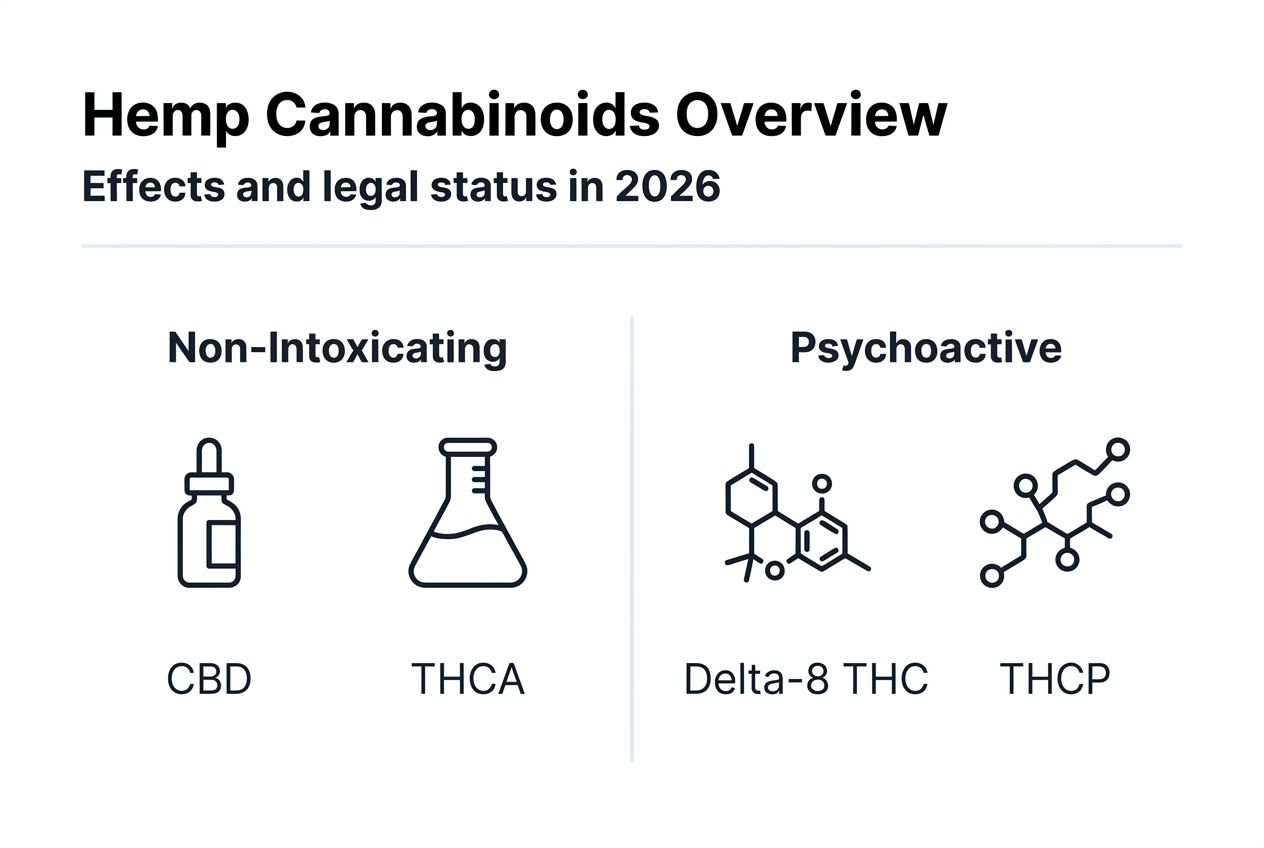
Delta-8 THC occupies a middle ground. It’s partially psychoactive and derived from CBD through chemical conversion, producing milder euphoria than delta-9 THC. However, 2026 regulations restrict delta-8 products due to synthetic classification concerns and THC content limits.
THCA is the acidic precursor to delta-9 THC found in raw cannabis. When heated through smoking or vaping, THCA converts to delta-9 THC, producing psychoactive effects. Many THCA flower products test below 0.3% delta-9 THC but exceed total THC limits once THCA is included in calculations.
Emerging cannabinoids like THCP and HHC attract attention for potency and novelty. THCP occurs naturally in trace amounts and binds more strongly to cannabinoid receptors than delta-9 THC. HHC, a hydrogenated form of THC, offers similar effects with claimed legal advantages, though its synthetic production often triggers federal bans.
| Cannabinoid | Psychoactive? | Legal Status 2026 | Common Effects |
|---|---|---|---|
| CBD | No | Federally legal | Relaxation, stress relief, non-intoxicating |
| Delta-8 THC | Mild | Restricted (often synthetic) | Mild euphoria, relaxation, legal gray area |
| THCA | Yes (when heated) | Limited by total THC | Converts to delta-9 THC, psychoactive effects |
| THCP | Yes (potent) | Varies by source/synthesis | Strong euphoria, limited availability |
| HHC | Yes | Often banned (synthetic) | Similar to delta-9 THC, legal uncertainty |
Pro Tip: If you’re new to psychoactive cannabinoids, start with low doses of CBD or low-potency delta-8 products to gauge your tolerance before exploring stronger options.
Consumer examples for relaxation and mild psychoactivity:
- CBD tinctures or capsules for daily stress management without intoxication
- Low-dose delta-8 gummies for evening relaxation with gentle mood lift
- THCA flower for experienced users seeking traditional cannabis effects legally
- Blended products combining CBD and minor cannabinoids for balanced wellness
Understanding CBD legality and checking hemp legal updates helps you stay informed as regulations evolve.
Understanding synthetic vs. naturally derived cannabinoids
Synthetic cannabinoids are lab-created compounds that mimic natural cannabinoids but aren’t found in the cannabis plant. Federal law bans synthetic cannabinoids starting in 2026, closing loopholes that allowed chemically converted hemp derivatives to enter the market.
Naturally derived cannabinoids come directly from hemp or cannabis plants through extraction processes like CO2 or ethanol extraction. These compounds exist in the plant’s natural state, making them federally compliant under the 2018 Farm Bill’s hemp provisions.
The ban targets cannabinoids synthesized outside the plant, including those created by chemically converting CBD into delta-8 THC or other analogs. Even if the starting material is natural hemp-derived CBD, the conversion process renders the final product synthetic under 2026 rules.
Examples comparing synthetic to natural cannabinoids:
- Natural CBD extracted from hemp flowers vs. synthetic CBD created in a lab from non-cannabis precursors
- Naturally occurring delta-8 THC in trace plant amounts vs. delta-8 THC mass-produced through CBD isomerization
- THCA found in raw cannabis vs. chemically synthesized THCA from non-plant sources
- Plant-derived terpenes vs. artificial terpenes added to enhance flavor or effects
Safety and legal implications are significant. Synthetic cannabinoids often lack safety testing and may contain harmful byproducts from chemical reactions. Natural cannabinoids benefit from the plant’s entourage effect, where multiple compounds work synergistically.
Legal risks include federal prosecution, state penalties, and product seizures. Consumers unknowingly purchasing synthetic cannabinoids face potential legal jeopardy, especially when traveling across state lines. Retailers selling banned synthetics risk fines and business closure.
For more context on hemp legal status, check state-specific resources before making purchases.
Lab testing and quality assurance for hemp products
Third-party lab testing verifies that hemp products meet safety standards, contain accurate cannabinoid levels, and comply with THC limits. Independent labs eliminate conflicts of interest, ensuring honest reporting of product contents.
Certificates of analysis (COAs) provide detailed breakdowns of cannabinoid profiles, terpene content, and contaminants like heavy metals, pesticides, and residual solvents. Reading COAs empowers consumers to make informed choices and avoid unsafe products.
How to read a certificate of analysis:
- Check the lab name and accreditation to confirm third-party independence.
- Review cannabinoid potency, including total THC calculations (delta-9 + THCA).
- Verify the product stays within the 0.3% total THC legal limit.
- Look for pass/fail results on contaminant testing (pesticides, heavy metals, mold).
- Confirm the batch number on the COA matches the product label.
Key metrics for safety and compliance:
- Potency: Accurate cannabinoid concentrations in mg/g or percentage
- Total THC: Combined delta-9 THC and THCA to ensure federal compliance
- Contaminants: Absence of harmful pesticides, solvents, and heavy metals like lead or arsenic
- Microbial testing: No dangerous bacteria, mold, or yeast
Transparency practices build consumer trust. Reputable brands publish COAs on their websites, link them directly on product pages, and update testing regularly as new batches arrive. Lab reports for hemp flower exemplify this commitment to quality.
Pro Tip: If a brand doesn’t provide accessible lab reports or refuses to share them upon request, consider it a red flag and shop elsewhere.
Common misconceptions about hemp-derived cannabinoids
Myth: All hemp cannabinoids are non-intoxicating. Many consumers incorrectly believe this, but cannabinoids like delta-8 THC and THCA produce psychoactive effects. Only CBD and a few minor cannabinoids like CBG lack intoxicating properties.
Distinction between delta-9 THC and total THC confuses buyers. Delta-9 THC is the primary psychoactive compound, but total THC includes THCA, which converts to delta-9 when heated. Federal limits apply to total THC, not just delta-9, meaning many THCA products exceed legal thresholds.
False belief: Synthetic cannabinoids are safe and legal. Some consumers assume lab-created cannabinoids are simply purified or enhanced versions of natural compounds. In reality, synthetic cannabinoids carry unknown health risks and are federally banned in 2026.
Clarification of federal limits: The 0.3% total THC limit applies at harvest and in final products. THCA counts toward this limit, catching many consumers off guard when purchasing flower or concentrates labeled as “legal hemp.”
Additional misconceptions:
- Assuming all hemp products sold in stores are automatically legal and safe
- Believing higher prices guarantee better quality or legal compliance
- Thinking hemp cannabinoids can’t cause failed drug tests (THC metabolites trigger positives)
- Expecting consistent effects across brands without checking lab reports
Practical consumer tips for choosing hemp cannabinoid products
Verify third-party lab testing before purchasing any hemp product. Reputable brands display COAs prominently on product pages or provide batch-specific reports upon request. Avoid products lacking transparent testing.
How to choose quality hemp cannabinoid products:
- Check for third-party lab reports showing cannabinoid potency and contaminant screening.
- Read product labels carefully to understand cannabinoid content and serving sizes.
- Confirm total THC stays within the 0.3% dry weight federal limit.
- Research the brand’s reputation, sourcing practices, and customer reviews.
- Align your product choice with personal wellness goals, whether relaxation, sleep, or mild psychoactivity.
Understanding labels prevents confusion. Look for milligrams of cannabinoids per serving, not just percentages. A 10mg CBD gummy is straightforward, but a “15% CBD” tincture requires calculating total cannabinoid content based on bottle volume.
Compliance with 2026 federal THC limits protects you legally. When traveling, verify traveling with hemp products regulations to avoid state or federal violations.
Pro Tip: Start with small doses of any new cannabinoid product, especially psychoactive ones like delta-8 or THCA. Effects vary widely based on individual tolerance, metabolism, and product potency.
Align products with your goals:
- For non-intoxicating relaxation: Choose pure CBD tinctures, capsules, or topicals
- For mild psychoactivity: Try low-dose delta-8 gummies or THCA flower in small amounts
- For sleep support: Look for CBD combined with CBN or melatonin
- For targeted relief: Consider topical CBD creams or balms for localized application
Stay informed by reviewing CBD legality guides and hemp legal tips regularly as laws evolve.
Summary and next steps
Legal hemp cannabinoids in 2026 must contain total THC ≤0.3% dry weight, including delta-9 THC and THCA combined. This federal limit significantly restricts product availability, especially for THCA flower and high-potency edibles previously sold as legal hemp.
Distinguishing cannabinoids by psychoactivity and origin is essential. CBD offers non-intoxicating wellness benefits, while delta-8 THC and THCA provide mild to moderate psychoactive effects. Synthetic cannabinoids face federal bans, making naturally derived compounds the only legal option.
Lab testing ensures safety and compliance. Third-party certificates of analysis verify cannabinoid content, confirm legal THC limits, and screen for contaminants. Never purchase hemp products without accessible lab reports.
Responsible, informed use maximizes wellness benefits while minimizing legal and health risks. Key action steps:
- Verify third-party lab testing before every purchase
- Understand your state’s specific hemp regulations beyond federal law
- Start with low doses of psychoactive cannabinoids to assess tolerance
- Choose products aligned with your wellness goals, whether relaxation or mild psychoactivity
- Stay updated on evolving hemp laws and product availability
By applying the knowledge from this guide, you can confidently navigate the 2026 hemp cannabinoid market and select safe, effective products for your wellness journey.
Explore quality hemp cannabinoid products at California Blendz
Ready to experience premium hemp cannabinoids with full transparency and legal compliance? California Blendz offers lab-tested hemp flower, pre-rolls, and wellness products sourced from California’s Emerald Triangle.
Every product meets 2026 federal regulations, with accessible third-party lab reports confirming safety, potency, and total THC limits. Whether you seek non-intoxicating CBD for daily relaxation or carefully cultivated THCA flower for experienced users, California Blendz delivers quality you can trust. Our curated selection supports your wellness goals with organic, sustainably grown hemp that honors both plant and planet. Explore our collection today and discover hemp cannabinoids backed by science, transparency, and care.
FAQ
Are all hemp-derived cannabinoids legal under federal law in 2026?
No. Only cannabinoids from hemp with total THC ≤0.3% dry weight qualify as legal. This includes delta-9 THC and THCA combined, restricting many products. Synthetic cannabinoids not naturally found in hemp are federally banned, regardless of THC content.
How can I tell if a hemp product is safe and compliant?
Look for third-party lab reports showing cannabinoid profiles, total THC levels, and contaminant screening. Reputable brands publish certificates of analysis on product pages. Verify the batch number matches your product and confirm total THC stays within legal limits.
What’s the difference between delta-8 THC and CBD?
CBD is non-intoxicating and widely legal for wellness use without psychoactive effects. Delta-8 THC produces mild euphoria and relaxation but faces 2026 legal restrictions due to synthetic production methods and THC content. Both interact with the endocannabinoid system differently.
Can hemp cannabinoids cause me to fail a drug test?
Yes. Products containing THC, including delta-8, delta-9, and THCA, produce metabolites detectable in standard drug screenings. Even trace THC in CBD products can accumulate and trigger positive results. If drug testing is a concern, choose broad-spectrum CBD or CBD isolate products.
Why are THCA products controversial under 2026 law?
THCA converts to delta-9 THC when heated, and federal law now counts THCA toward total THC limits. Many THCA flower products exceed the 0.3% total THC threshold, making them illegal hemp despite low delta-9 THC levels before heating. This creates confusion and legal risk for consumers and retailers.


