
Is Hemp Legal in the US – Key Laws for 2026
Written by Trevor

Most American consumers looking for relaxation and wellness are surprised to learn that industrial hemp contains less than 0.3 percent THC, making it non-intoxicating and legally distinct from marijuana. With California’s booming interest in legal CBD options, understanding how hemp differs from its psychoactive cousin is essential. This article clears up common misconceptions about hemp, highlights the latest U.S. laws, and explains why its natural compounds offer unique wellness benefits for California residents.
Table of Contents
- Defining Hemp And Addressing Misconceptions
- Types Of Hemp Products And Key Differences
- Federal Laws Shaping Hemp Legality
- New Restrictions For Thc And Cannabinoids
- State-Level Variations And Consumer Impacts
- Risks, Compliance, And What To Avoid
Key Takeaways
| Point | Details |
|---|---|
| Understanding Hemp | Hemp is a distinct variety of Cannabis sativa L. with less than 0.3% THC, making it non-intoxicating and beneficial for various industries. |
| Legal Changes | The 2018 Farm Bill legalized hemp cultivation in the U.S., paving the way for expanded agricultural and commercial opportunities. |
| Upcoming Regulations | The 2026 federal guidelines will introduce stricter THC limits and testing requirements, significantly impacting hemp product formulations. |
| State Variations | Consumers must be aware of differing state regulations regarding hemp products, which may lead to variations in availability and compliance. |
Defining Hemp and Addressing Misconceptions
Hemp is a versatile agricultural crop with significant potential, often misunderstood due to its botanical relationship with marijuana. Despite common misconceptions, hemp is a distinct variety of Cannabis sativa L. plant characterized by its extremely low tetrahydrocannabinol (THC) content, which distinguishes it from its psychoactive cousin. Industrial hemp’s global characteristics reveal a plant with remarkable environmental and industrial applications.
Understanding hemp requires recognizing its chemical composition. Unlike marijuana, industrial hemp contains less than 0.3% THC, making it non-intoxicating and legally differentiated. This minimal THC level means hemp cannot produce the psychoactive effects associated with cannabis consumption. The plant instead offers tremendous value through its fibers, seeds, and potential for sustainable production across multiple industries including textiles, construction materials, nutrition, and wellness products.
The legal landscape surrounding hemp has dramatically transformed in recent years, particularly with the 2018 Farm Bill in the United States, which federally legalized hemp cultivation. This legislative change acknowledged hemp’s potential as an agricultural commodity, removing it from the controlled substances list and enabling widespread commercial and research opportunities. Hemp’s sustainable agricultural profile further supports its emerging economic significance, demonstrating low environmental impact and versatile cultivation possibilities.
Pro tip: When purchasing hemp products, always verify the THC content and request third-party lab testing to ensure legal compliance and product quality.
Types of Hemp Products and Key Differences
Hemp’s versatility enables the production of diverse product categories, each with unique characteristics and applications. Hemp product types span multiple industries, ranging from industrial materials to wellness and nutritional supplements. These categories are typically classified into three primary segments: fiber hemp, grain hemp, and cannabinoid-rich hemp, each serving distinct market needs and regulatory frameworks.
Fiber hemp represents the traditional industrial application, utilized extensively in textiles, construction materials, and sustainable packaging. Grain hemp focuses on nutritional products, including protein powders, hempseed oil, and food ingredients rich in essential fatty acids. Cannabinoid-rich hemp has emerged as a significant wellness category, producing CBD and other non-intoxicating compounds used in health supplements, topical treatments, and therapeutic formulations. Unlike marijuana-derived products, these hemp varieties contain less than 0.3% THC, ensuring legal compliance and non-psychoactive properties.
Global hemp product manufacturing continues to evolve, with increasing sophistication in processing technologies and product development. The market demonstrates growing consumer interest in sustainable, plant-based alternatives across multiple sectors. Each hemp product type requires specialized cultivation techniques, extraction methods, and quality control processes to meet regulatory standards and consumer expectations. The differentiation between these product categories lies not just in their end-use, but in their genetic profiles, cultivation practices, and intended commercial applications.
Pro tip: When exploring hemp products, always verify the specific product type, THC content, and third-party lab testing to ensure quality and legal compliance.
Here is a comparison of the three main types of hemp products and their typical uses:
| Product Type | Key Uses | Distinct Regulatory Focus |
|---|---|---|
| Fiber Hemp | Textiles, construction, packaging | Industrial processing standards |
| Grain Hemp | Protein, oil, food supplements | Food safety and labeling laws |
| Cannabinoid-Rich | CBD oils, supplements, topicals | THC limits, health claims review |
Federal Laws Shaping Hemp Legality
Federal hemp regulations have undergone dramatic transformations since the landmark 2018 Farm Bill, which initially distinguished hemp from marijuana based on THC concentration. This pivotal legislation removed hemp with less than 0.3% delta-9 THC from the Controlled Substances Act, creating a revolutionary pathway for legal hemp cultivation and commercial development across the United States. The legal landscape continues to evolve, with increasingly sophisticated regulatory frameworks designed to address emerging market complexities and potential industry abuse.
The upcoming 2026 federal guidelines represent a significant shift in hemp regulation, moving beyond the simple THC concentration metric to implement more comprehensive control mechanisms. New legislation is expected to introduce stricter total THC content calculations, more rigorous testing requirements, and enhanced enforcement protocols. These changes aim to close existing legal loopholes that have allowed the proliferation of potentially intoxicating hemp-derived products, signaling a more nuanced approach to cannabinoid regulation by federal authorities.

New federal hemp enforcement strategies will likely involve increased collaboration between agencies like the FDA, DEA, and USDA. The regulatory framework is anticipated to implement more stringent requirements for product testing, labeling, and distribution. Manufacturers and retailers will face more complex compliance standards, with potential restrictions on synthesized cannabinoids and more precise definitions of legal hemp products. These changes reflect an ongoing effort to balance consumer safety, market innovation, and regulatory oversight in the rapidly evolving hemp industry.
Pro tip: Stay informed about changing hemp regulations by regularly consulting official government sources and maintaining detailed documentation of product testing and compliance.
New Restrictions for THC and Cannabinoids
Federal hemp regulations have introduced unprecedented restrictions on THC and cannabinoid products, marking a significant shift in the legal landscape. The upcoming November 2026 guidelines establish a strict maximum of 0.4 milligrams total THC per consumer product container, effectively eliminating most current hemp-derived cannabinoid offerings. This comprehensive approach moves beyond previous delta-9 THC concentration metrics to consider total THC content, signaling a more rigorous regulatory framework.
The new federal law specifically targets synthesized cannabinoids, effectively banning popular variants like delta-8 and delta-10 THC. These restrictions aim to close existing legal loopholes and address concerns about potentially intoxicating hemp-derived products. Manufacturers and retailers will need to completely redesign their product formulations, testing protocols, and compliance strategies to align with these stringent new requirements. The legislation represents a fundamental restructuring of the hemp product market, prioritizing consumer safety and standardization.
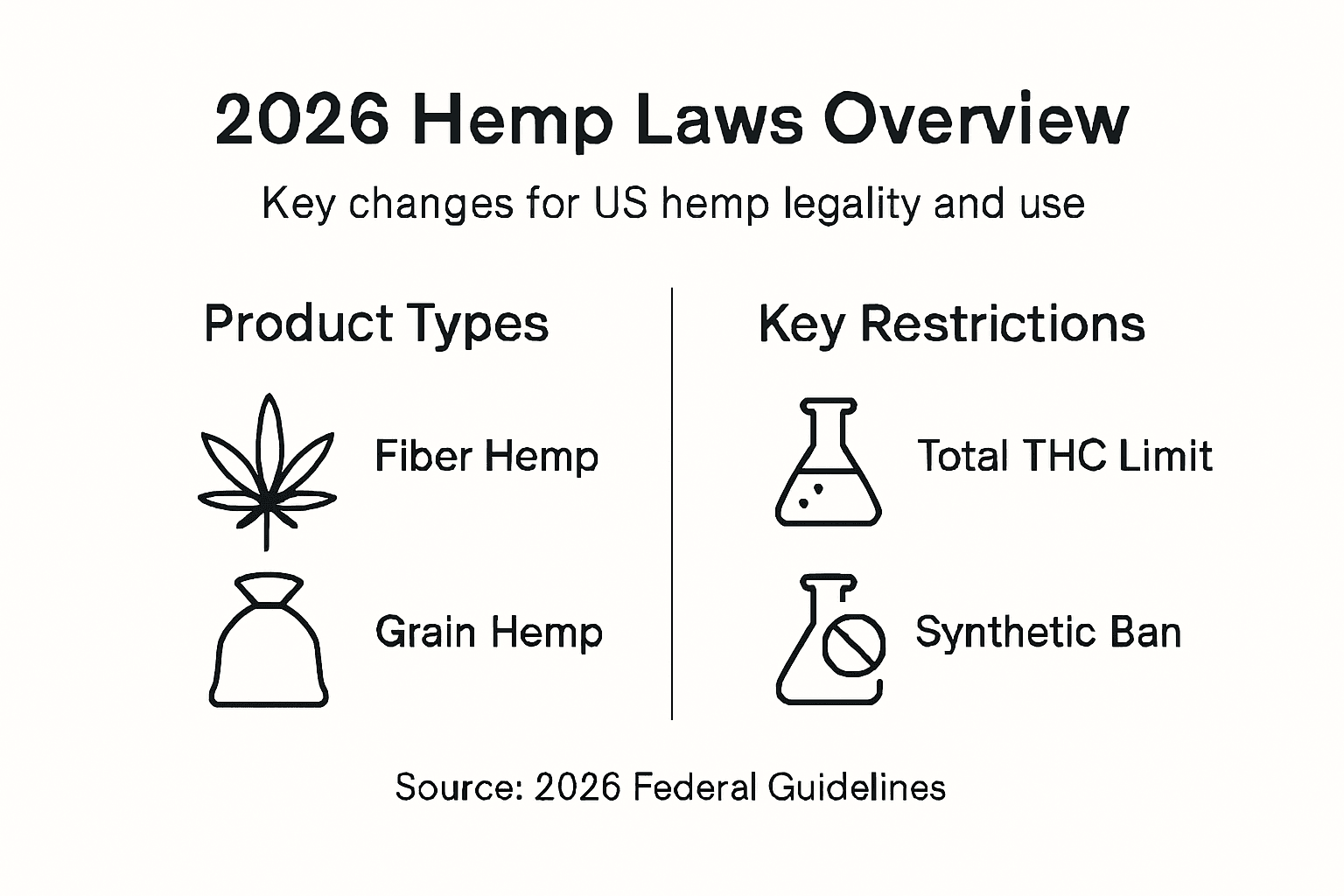
Congressional hemp product restrictions will require businesses to conduct comprehensive reviews of their current product lines. The law’s precise language excludes intermediate products sold directly to consumers and imposes significant limitations on cannabinoid concentrations. These changes will likely trigger a massive transformation in the hemp industry, forcing companies to invest in research, reformulation, and compliance infrastructure to meet the new federal standards.
Pro tip: Consult with legal and regulatory experts specializing in hemp legislation to ensure your products remain compliant with the upcoming 2026 federal restrictions.
The table below summarizes recent and upcoming changes in federal hemp regulation:
| Regulatory Stage | Key Change | Impact on Industry |
|---|---|---|
| 2018 Farm Bill | Legalized hemp below 0.3% THC | Opened national hemp market |
| 2026 Federal Guidelines | 0.4mg total THC per product; ban synthetics | Forces reformulation, limits products |
| Future State Rules | Additional state-specific restrictions | Regional market differences |
State-Level Variations and Consumer Impacts
State hemp regulation dynamics reveal a complex legal landscape where individual states maintain significant autonomy in interpreting and implementing federal hemp guidelines. Some states, like Oregon, have already proactively banned certain intoxicating hemp cannabinoids, creating a patchwork of regulations that will become increasingly complicated with the 2026 federal restrictions. Consumers can expect substantial variations in product availability and legal interpretations across different states, potentially leading to significant market disruptions.
The emerging regulatory environment will create substantial challenges for hemp businesses operating across multiple state jurisdictions. States with existing cannabis frameworks will likely experience more nuanced implementation challenges, as they attempt to reconcile their current legal structures with the new federal mandates. This complexity could result in uneven enforcement, creating potential legal uncertainties for manufacturers, retailers, and consumers seeking hemp-derived products.
Hemp regulatory landscape transformation suggests that consumers will need to become increasingly sophisticated in understanding local and federal regulations. The potential for significant market changes includes reduced product diversity, increased testing requirements, and potentially higher prices as companies invest in compliance infrastructure. Consumers in states with more restrictive interpretations may find themselves with substantially fewer hemp product options compared to those in more permissive jurisdictions.
Pro tip: Always verify the specific hemp product regulations in your state, as local laws may differ significantly from federal guidelines.
Risks, Compliance, and What to Avoid
Hemp business compliance strategies are becoming increasingly complex with the 2026 federal hemp law changes. Businesses must navigate a challenging regulatory landscape that introduces significant uncertainty around product classification, enforcement, and legal risk. The potential for products to be reclassified as marijuana creates substantial operational challenges, requiring companies to develop flexible and proactive compliance frameworks that can adapt to rapidly changing regulatory environments.
The emerging legal framework introduces multiple critical risks for hemp businesses and consumers. Banking institutions remain hesitant to work with hemp-related businesses, creating financial infrastructure challenges. Licensing requirements are becoming more stringent, with potential for unexpected regulatory interpretations that could abruptly disrupt existing business models. Manufacturers must carefully monitor both federal and state agency actions, maintaining meticulous documentation and preparing for potential enforcement scenarios that could emerge under the new regulatory guidelines.
Hemp farmer regulatory challenges extend beyond business compliance, impacting agricultural producers directly. Ongoing regulatory confusion creates significant economic uncertainty, with potential social stigma and local licensing challenges threatening the sustainability of hemp cultivation. Farmers must now contend with more complex regulatory requirements, increased testing mandates, and the potential for sudden changes in product legality that could render existing crops unmarketable.
Pro tip: Maintain comprehensive documentation of product sourcing, testing, and compliance to protect your business against potential regulatory scrutiny.
Stay Ahead of Hemp Legal Changes with Trusted Quality from California Blendz
Navigating the shifting legal landscape around hemp and cannabinoids can feel overwhelming, especially with the 2026 federal restrictions introducing strict limits on THC content and banning synthetic cannabinoids. If you are looking for premium hemp-derived products that prioritize legal compliance, transparency, and consistent quality, California Blendz offers a curated selection designed to meet your needs. Explore our The Founder’s Collection – California Blendz featuring organically grown, lab-tested hemp flower that aligns with evolving laws and consumer safety standards.
Don’t risk uncertainty with unverified products when you can shop confidently today at California Blendz. Benefit from verified cannabinoid profiles, third-party lab results, and clear product information tailored for both newcomers and seasoned users seeking safe, legal hemp alternatives. Start your journey to relaxation and relief within the framework of current laws now by visiting our CBD Edibles – California Blendz and discover trustworthy options designed for wellness. Act now to secure products aligned with the latest legal standards and enjoy peace of mind in your hemp experience.
Frequently Asked Questions
Is hemp legal in the US?
Yes, hemp is legal in the US as long as it contains less than 0.3% THC, following the 2018 Farm Bill which removed it from the Controlled Substances Act.
What are the different types of hemp products?
There are three primary types of hemp products: fiber hemp (used in textiles and construction), grain hemp (used for nutrition like seeds and oils), and cannabinoid-rich hemp (which includes CBD and other non-intoxicating compounds).
What changes are expected in hemp regulation by 2026?
The 2026 federal guidelines are expected to impose stricter total THC content calculations, more rigorous testing requirements, and enhanced enforcement protocols to address potential intoxicating hemp-derived products.
How should businesses prepare for upcoming hemp regulations?
Businesses should maintain comprehensive documentation of product sourcing and testing, develop flexible compliance frameworks, and stay informed on both federal and state regulations to navigate the evolving legal landscape.
Recommended
- Legal Status Hemp 2025: Complete Global Guide – California Blendz
- Is Hemp Legal in 2025? What Consumers Need to Know – California Blendz
- Understanding the Legalities of Getting Pulled Over with Legal Hemp: W – California Blendz
- Understanding Hemp Legality by State: A Comprehensive Guide – California Blendz


