
How to filter hemp CBD & THCa products by effects in 2026
Written by Trevor

Finding the right hemp-derived product can feel overwhelming when you’re searching for specific effects like relaxation or pain relief. Many consumers end up disappointed because they overlook critical factors like terpene profiles and cannabinoid synergy. This guide teaches you how to filter CBD and THCa products effectively using chemical profiles, lab reports, and smart ecommerce tools to match your wellness goals with precision.
Table of Contents
- Prerequisites: What You Need Before Filtering Products By Effects
- Understanding Cannabinoids And Terpenes For Desired Effects
- How To Use Lab Test Results To Filter Products Effectively
- Setting Up Filtering Steps On Ecommerce Platforms
- Common Mistakes And Troubleshooting In Effect-Based Filtering
- Expected Results, Timelines, And Cost Considerations
- Safety Warnings And Legal Considerations
- Alternative Filtering Approaches And Their Tradeoffs
- Explore Trusted Hemp-Derived Products With California Blendz
- Frequently Asked Questions
Key takeaways
| Point | Details |
|---|---|
| Cannabinoid and terpene knowledge drives filtering success | Understanding how CBD, THCa, and terpenes like myrcene create effects enables targeted product selection. |
| Lab reports verify potency and legal compliance | Third-party tests confirm cannabinoid percentages, terpene profiles, and THC stays under 0.3% dry weight. |
| Ecommerce filters combining chemistry and effects improve choices | Platforms with metadata filtering by cannabinoid potency, terpene content, and effect tags refine results. |
| Common errors include ignoring terpenes and misreading reports | Skipping terpene analysis or overlooking THC limits reduces effectiveness and risks legal issues. |
| Safety checks prevent compliance risks and ensure purity | Verifying lab results for contaminants and THC content protects health and legal standing. |
Prerequisites: what you need before filtering products by effects
Before diving into effect-based filtering, you need foundational knowledge and reliable tools. Start by learning key cannabinoids like CBD and THCa, which produce distinct effects. CBD offers non-intoxicating relaxation and relief, while THCa is non-psychoactive until heated into THC.
Terpenes are equally important. These aromatic compounds found in hemp influence effects significantly. For example, myrcene promotes sedation, while limonene can uplift mood. Understanding terpenes in hemp flower helps you recognize which profiles align with your goals.
Access to third-party lab reports is non-negotiable. These documents detail cannabinoid potency and terpene content, giving you objective data to filter products accurately. Without lab results, you’re guessing based on marketing claims.
You also need to know U.S. legal limits. Hemp products must contain less than 0.3% THC by dry weight to comply with federal law. Exceeding this threshold puts you at legal risk and violates regulations. Always verify THC content in lab reports before purchasing.
Finally, use an ecommerce platform with robust filtering capabilities. Look for sites that let you search by cannabinoid percentages, terpene profiles, and effect metadata like “relaxation” or “pain relief.” Platforms without these features make precise filtering nearly impossible.
- Basic cannabinoid and terpene knowledge
- Access to third-party lab reports
- Awareness of 0.3% THC legal limit
- Ecommerce platform with chemical profile filters
Understanding cannabinoids and terpenes for desired effects
Cannabinoids and terpenes work together to create the effects you experience. THC is the intoxicating compound responsible for the “high,” but THCa, its raw precursor, remains non-psychoactive until you apply heat. This makes THCa flower a legal option in many states, as it stays under the 0.3% THC limit until decarboxylation.
CBD provides calming effects without intoxication. It interacts with your endocannabinoid system to reduce anxiety and inflammation. When combined with specific terpenes, CBD’s effects amplify through what scientists call the entourage effect in CBD flower.
Filtering hemp-derived products by specific effects is best achieved by analyzing both cannabinoid and terpene profiles, since terpenes significantly modulate the overall experience. Myrcene, found in many indica strains, produces sedative effects ideal for sleep. Linalool offers floral notes and calming properties similar to lavender. Beta-caryophyllene targets inflammation and pain through unique receptor interactions.
Research shows full-spectrum extracts demonstrated 30% higher efficacy for anxiety relief compared to isolates in clinical trials. This happens because isolate products strip away terpenes and minor cannabinoids, losing the synergistic benefits. When you filter for effects, prioritize full-spectrum or broad-spectrum products that preserve the complete chemical profile.
Pro Tip: Check if the product lists specific terpene percentages, not just “contains terpenes.” Quantitative data lets you compare products objectively and predict effects more accurately.
Understanding the role of terpenes in hemp flower transforms how you shop. Instead of choosing products randomly, you can match chemical profiles to your needs. A product high in myrcene and CBD works well for evening relaxation, while one with limonene and moderate THCa might suit daytime relief.
- THCa converts to THC when heated but stays non-intoxicating in raw form
- Myrcene and linalool support relaxation and sleep
- Beta-caryophyllene targets inflammation and pain
- Full-spectrum products outperform isolates by 30% for anxiety
- Chemical synergy creates stronger, more reliable effects
The THCa legal status remains complex but generally permissible under federal law when THC content stays below 0.3%. This knowledge helps you filter confidently within legal boundaries while accessing potent cannabinoid profiles.
How to use lab test results to filter products effectively
Lab reports contain the objective data you need to filter products by effects. Start by locating the cannabinoid potency section. This shows percentages of CBD, THCa, THC, and other compounds. High CBD percentages (15-20%) typically deliver stronger relaxation effects, while THCa levels indicate potential potency after heating.

Next, examine the terpene profile. Quality reports list individual terpenes with their concentrations in milligrams per gram or percentages. Look for the specific terpenes linked to your desired effects. If you want relaxation, search for products with myrcene above 0.5% or linalool above 0.3%.
THC content verification is critical for legal compliance. Hemp-derived products must contain less than 0.3% THC by dry weight in the U.S. to comply with federal law. Check both the “Total THC” line, which includes THCa converted to THC equivalent, and the “Delta-9 THC” line for actual THC present.
Contaminant screening protects your health. Scan for pesticide, heavy metal, and microbial tests. Any detectable levels of dangerous pesticides or metals like lead should be a dealbreaker. Reputable products pass all safety screens with “ND” (not detected) results.
Lab tested cannabis provides transparency that marketing claims cannot match. Always verify the lab report is recent (within 6 months) and comes from an accredited third-party facility, not an in-house lab.
Pro Tip: Screenshot or save lab reports for products you love. This creates a reference library of chemical profiles that work for you, making future filtering faster and more accurate.
| Lab Report Element | Significance for Filtering | What to Look For |
|---|---|---|
| Cannabinoid Potency | Determines effect strength and legality | CBD 15-20%, THCa levels, Total THC under 0.3% |
| Terpene Profile | Predicts specific effects like relaxation | Myrcene >0.5%, linalool >0.3%, quantitative data |
| THC Content | Ensures legal compliance | Total THC and Delta-9 THC both under 0.3% |
| Contaminants | Confirms safety and purity | All pesticides, heavy metals showing “ND” |
| Lab Certification | Validates report reliability | ISO accreditation, third-party status |
Understanding how cannabis is tested demystifies these reports and builds your confidence in interpreting data. The more familiar you become with reading lab results, the faster you can filter products during shopping sessions.
- Identify cannabinoid percentages for potency
- Analyze terpene quantities for effect prediction
- Verify THC stays under 0.3% for compliance
- Check contaminant screens for safety
- Confirm third-party lab accreditation
Setting up filtering steps on ecommerce platforms
Most quality hemp ecommerce sites offer filtering tools that combine multiple data points. Start by navigating to the product category you want, such as flower or pre-rolls. Look for filter options in the sidebar or top menu.
Step one: Select your desired effect from available tags. Common options include “relaxation,” “pain relief,” “sleep,” or “focus.” These tags are based on the product’s cannabinoid and terpene profiles, giving you a starting point.
Step two: Add cannabinoid filters if available. Set minimum CBD percentages (try 15%+) or filter for THCa products specifically. Some platforms let you exclude high-THC products automatically, ensuring legal compliance.
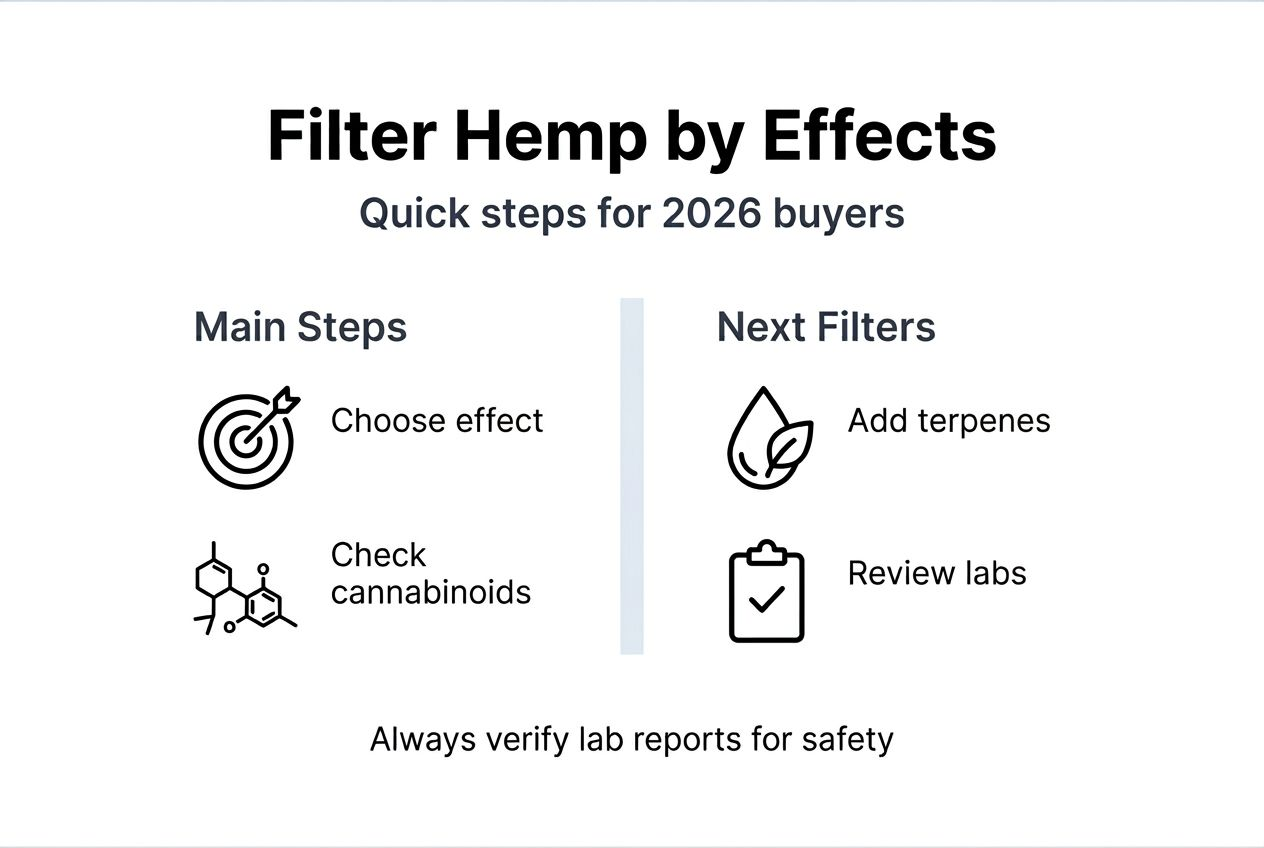
Step three: Apply terpene filters when offered. Advanced platforms let you select products containing specific terpenes like myrcene or beta-caryophyllene. If this option isn’t available, you’ll need to check individual product descriptions.
Step four: Choose your product form. Flower provides the most complete terpene and cannabinoid profile but requires inhalation or heating. Tinctures offer precise dosing but may have slower onset times. Pre-rolls provide convenience with full-spectrum effects.
Step five: Review lab reports for your filtered results. Click through to verify the chemical profiles match your needs and confirm THC compliance. Don’t trust the filter alone; always validate with lab data.
Never rely on a single filtering metric. A product tagged “relaxation” with high CBD but lacking sedative terpenes like myrcene won’t deliver the effects you expect. Layer multiple filters to narrow results effectively.
Cannabis product labeling guide explains what information should appear on compliant products. Use this knowledge to spot incomplete or misleading labels during filtering.
For deeper guidance, explore effect-based cannabis selection steps that walk through matching chemical profiles to specific wellness goals. This resource complements ecommerce filtering with strategic selection principles.
Common mistakes and troubleshooting in effect-based filtering
Many consumers make the same filtering errors repeatedly. The biggest mistake is ignoring terpene profiles completely. Focusing only on CBD or THCa percentages misses half the equation. Two products with identical 18% CBD can produce vastly different effects based on their terpene content.
Another common error is misreading lab reports. Some shoppers confuse “Total THC” with “Delta-9 THC,” leading to incorrect assumptions about legality or potency. Always read both values carefully and understand that Total THC includes THCa converted to THC equivalent.
Relying solely on effect tags without verifying lab data creates disappointment. Marketing teams sometimes assign tags based on strain genetics rather than actual tested chemical profiles. A product labeled “relaxing” might lack sufficient myrcene or linalool to deliver that effect.
Overlooking the legal THC limit is risky. Some consumers assume all hemp products are automatically compliant, but processing methods or testing inaccuracies can push THC above 0.3%. Always check lab results yourself rather than trusting product listings alone.
When filtering results seem wrong, troubleshoot by double-checking your filter selections. Make sure you haven’t accidentally excluded categories you wanted or set ranges too narrow. Clear all filters and start fresh if results don’t make sense.
If lab reports are missing or outdated, contact customer service before purchasing. Reputable vendors provide current third-party tests readily. Missing lab data is a red flag indicating possible quality or compliance issues.
- Ignoring terpenes reduces effectiveness
- Misreading Total THC vs Delta-9 THC causes confusion
- Trusting tags without lab verification leads to poor choices
- Overlooking THC limits creates legal risk
- Not verifying filter accuracy wastes time
Following the 7 steps to effect-based cannabis selection prevents these mistakes systematically. Additionally, understanding safe dosing of THCa helps you avoid overconsumption that can muddy your assessment of product effects.
Expected results, timelines, and cost considerations
Effect onset varies dramatically by consumption method. Inhaled products like flower or pre-rolls typically produce effects within 20-45 minutes as cannabinoids enter your bloodstream through the lungs. This makes inhalation ideal when you need fast relief or quick-onset relaxation.
Oral products such as tinctures or edibles take longer, often 60-90 minutes, because they must pass through your digestive system. However, oral consumption produces longer-lasting effects, sometimes 4-6 hours compared to 2-3 hours for inhalation.
Full-spectrum products with preserved terpene profiles cost 20-30% more than isolates or distillates. This premium reflects the careful extraction and processing required to maintain chemical complexity. The higher price delivers better effect reliability and typically stronger results per milligram.
| Product Type | Cannabinoid Content | Terpene Profile | Effect Reliability | Typical Cost | Best For |
|---|---|---|---|---|---|
| CBD Isolate | 99% CBD, no other compounds | None | Low (no entourage effect) | $20-30/gram | Budget-conscious, specific needs |
| Full-Spectrum Flower | 15-20% CBD, 0.1-0.3% THC, minor cannabinoids | Rich, 2-4% total terpenes | High (complete synergy) | $35-50/eighth | Targeted effects, reliability |
| THCa Flower | 15-25% THCa, minor cannabinoids | Rich, 2-4% total terpenes | High (full profile) | $40-60/eighth | Potency, effect precision |
| Broad-Spectrum Tincture | 20-30mg CBD/mL, minor cannabinoids | Moderate, 0.5-1% terpenes | Moderate-High | $40-70/bottle | Convenience, precise dosing |
Budget-conscious filtering should prioritize value per milligram while maintaining quality standards. A moderately priced full-spectrum product often delivers better results than a cheap isolate, making it more cost-effective long-term.
Goal-based filtering changes your approach. If you need consistent sleep support, invest in products with proven high myrcene content even if they cost more. For occasional stress relief, a mid-range CBD product might suffice.
Effect reliability improves when you follow chemical profile filtering consistently. Track which combinations work best for you and recreate those profiles in future purchases. This personalized approach maximizes both satisfaction and cost efficiency.
- Inhaled products: 20-45 minute onset
- Oral products: 60-90 minute onset, longer duration
- Full-spectrum products cost 20-30% more but deliver 30% better efficacy
- Budget filtering should prioritize value per milligram
- Goal-based selection justifies premium products for critical needs
Safety warnings and legal considerations
CBD can interact with common medications by affecting liver enzymes that metabolize drugs. If you take blood thinners, antidepressants, or other prescription medications, consult your doctor before adding CBD products to your routine. These interactions can increase or decrease medication effectiveness unpredictably.
The federal THC limit is firm and non-negotiable. Products exceeding 0.3% THC by dry weight are classified as marijuana, not hemp, creating legal complications in states without adult-use cannabis laws. Always verify lab-tested THC content before purchase and never assume compliance.
Federal law requires hemp-derived products to contain less than 0.3% THC by dry weight. Filtering must ensure you never inadvertently select products above this threshold. Verify THC content in third-party lab reports for every purchase to avoid regulatory risk and potential legal consequences.
Avoid products making unverified health claims. Statements like “cures anxiety” or “treats chronic pain” violate FDA regulations and signal unreliable vendors. Legitimate hemp companies describe potential effects based on cannabinoid and terpene profiles without making medical claims.
Source products exclusively from vendors providing current third-party lab results. In-house testing lacks independence and accountability. Reputable brands display lab reports prominently on product pages or make them available upon request.
Contaminant risks include pesticides, heavy metals, and residual solvents from extraction. These substances can cause serious health problems with regular exposure. Lab reports should show all contaminants at non-detectable levels for safe consumption.
Legal requirements for CBD in California illustrate how state regulations can add requirements beyond federal law. Research your state’s specific rules to ensure complete compliance when filtering and purchasing products.
Alternative filtering approaches and their tradeoffs
Consumer reviews offer social proof and real-world effect reports that lab data cannot capture. Reading how others experienced a product provides valuable context, especially regarding subjective factors like taste or ease of use. However, individual body chemistry varies dramatically, making reviews inconsistent predictors of your personal experience.
Crowdsourced effect ratings aggregate many users’ experiences into average scores. These systems work well for identifying products that consistently deliver intended effects across diverse users. The weakness is that ratings often lack the specificity of chemical profiles, leaving you uncertain which cannabinoids or terpenes drove the results.
Lab-based chemical profiling provides objective, reproducible data you can compare across products and vendors. This approach eliminates marketing bias and subjective opinions. The tradeoff is the learning curve required to interpret reports and understand cannabinoid-terpene interactions.
Combining both methods delivers optimal results. Use lab reports to filter for appropriate chemical profiles, then check reviews to confirm those profiles translate to satisfying real-world effects. This dual validation catches products that look good on paper but underperform in practice.
Novice users should start with review-based filtering to build familiarity with product types and effects. As you gain experience, gradually incorporate lab data analysis to refine your selections and understand why certain products work better for you.
Advanced users benefit from leading with chemical profiling since they understand how different compounds affect them personally. Reviews then serve as quality checks rather than primary filtering criteria.
| Filtering Method | Reliability | Ease of Use | Learning Curve | Risk Level | Best For |
|---|---|---|---|---|---|
| Consumer Reviews | Moderate (subjective variation) | High (read and decide) | Low | Moderate (inconsistent results) | Novice users, qualitative insights |
| Lab Chemical Profiling | High (objective data) | Moderate (requires interpretation) | Moderate-High | Low (verifiable facts) | Experienced users, precise targeting |
| Combined Approach | Very High (dual validation) | Moderate | Moderate | Very Low (catches outliers) | All users seeking best outcomes |
| Effect Tags Only | Low-Moderate (depends on vendor accuracy) | Very High (one-click filtering) | Very Low | Moderate-High (potential mismatches) | Quick browsing, preliminary filtering |
Situational recommendations change based on your priorities. When trying a new product category, lean on reviews for guidance. When you know exactly what chemical profile you need, prioritize lab data. For regular reorders of proven products, effect tags and quick filtering suffice.
Explore trusted hemp-derived products with California Blendz
Now that you understand how to filter hemp-derived CBD and THCa products by effects, put that knowledge to work with California Blendz’s curated selection. Every product comes with detailed third-party lab reports verifying cannabinoid potency, terpene profiles, and legal THC compliance under 0.3%.
Explore flowers, pre-rolls, and bundles specifically selected for relaxation, pain relief, and other targeted effects. The platform’s filtering tools let you search by chemical profiles and effect metadata, exactly as described in this guide. Detailed product pages display the cannabis product labeling information you need for informed decisions.
Access educational resources that deepen your understanding of lab tested cannabis and help you optimize future purchases. California Blendz sources exclusively from California’s Emerald Triangle, ensuring organic cultivation practices and sustainable growing methods. Trust in quality, safety, and effect-based filtering support with California Blendz.
Frequently asked questions
How do terpenes influence the effects of hemp-derived products?
Terpenes interact with cannabinoids to enhance or modify effects like relaxation or pain relief, contributing significantly beyond cannabinoid content alone. Key terpenes such as myrcene and linalool are known for their calming properties, while beta-caryophyllene targets inflammation. This synergy, called the entourage effect, explains why full-spectrum products outperform isolates despite similar cannabinoid percentages.
What legal limits should I check when selecting hemp products by effects?
Ensure product THC does not exceed 0.3% dry weight as mandated by federal law to avoid legal issues. Verify lab reports confirm both Delta-9 THC and Total THC (including THCa conversion) stay within this limit. State regulations may impose additional requirements, so research local laws before purchasing to ensure complete compliance.
How quickly can I expect effects after using filtered hemp products?
Inhaled products typically take 20-45 minutes for effects onset, providing fast relief ideal for acute needs. Oral products can take 60-90 minutes but deliver longer-lasting effects, often 4-6 hours compared to 2-3 hours for inhalation. Effect duration and intensity vary by product type, chemical profile, and your individual metabolism.
Can I rely on consumer reviews to filter products by effects?
Consumer reviews offer helpful insights but can be subjective and inconsistent due to individual body chemistry variations. Combining reviews with lab test data ensures more reliable effect-based selection by validating chemical profiles with real-world experiences. Use reviews for qualitative context but verify with objective cannabinoid and terpene analysis for best results.
Recommended
- Is THCa Legal Federally? 2026 Law Changes Explained – California Blendz
- Hemp Legality in 2025 – What Changes for Californians – California Blendz
- 7 Steps to Effect-Based Cannabis Selection for Wellness – California Blendz
- CBD Legality in 2025: Complete Guide for Users – California Blendz
- CBD vs THC: KEY DIFFERENCES YOU NEED TO KNOW IN 2025 – SMOKO CBD


