
Full Spectrum Hemp: Unlocking Natural Wellness Benefits
Written by Trevor

Searching for a natural way to support relaxation and wellness can bring up more confusion than clarity, especially with so much misinformation about hemp-based products. For many in California, understanding the difference between full spectrum hemp and other extracts matters for both peace of mind and results. Learn how full spectrum hemp preserves the plant’s complete chemical profile, why legal standards are changing, and how lab testing protects your health.
Table of Contents
- Defining Full Spectrum Hemp and Common Myths
- Types of Hemp Extracts and Their Differences
- How Full Spectrum Hemp Delivers Effects
- Legal Status and Safety Standards in 2026
- Choosing Quality Full Spectrum Hemp Products
Key Takeaways
| Point | Details |
|---|---|
| Full Spectrum Hemp | Retains the plant’s complete chemical profile, including cannabinoids, terpenes, and flavonoids, with THC levels under 0.3%. |
| Common Myths | Full spectrum hemp is non-psychoactive and differs significantly from marijuana; it ensures legal compliance and wellness benefits. |
| Extraction Matters | The extraction method affects the final product’s quality; prefer CO2 or ethanol extraction techniques for best results. |
| Product Evaluation | Prioritize transparency, third-party lab testing, and ingredient integrity when choosing full spectrum hemp products. |
Defining Full Spectrum Hemp and Common Myths
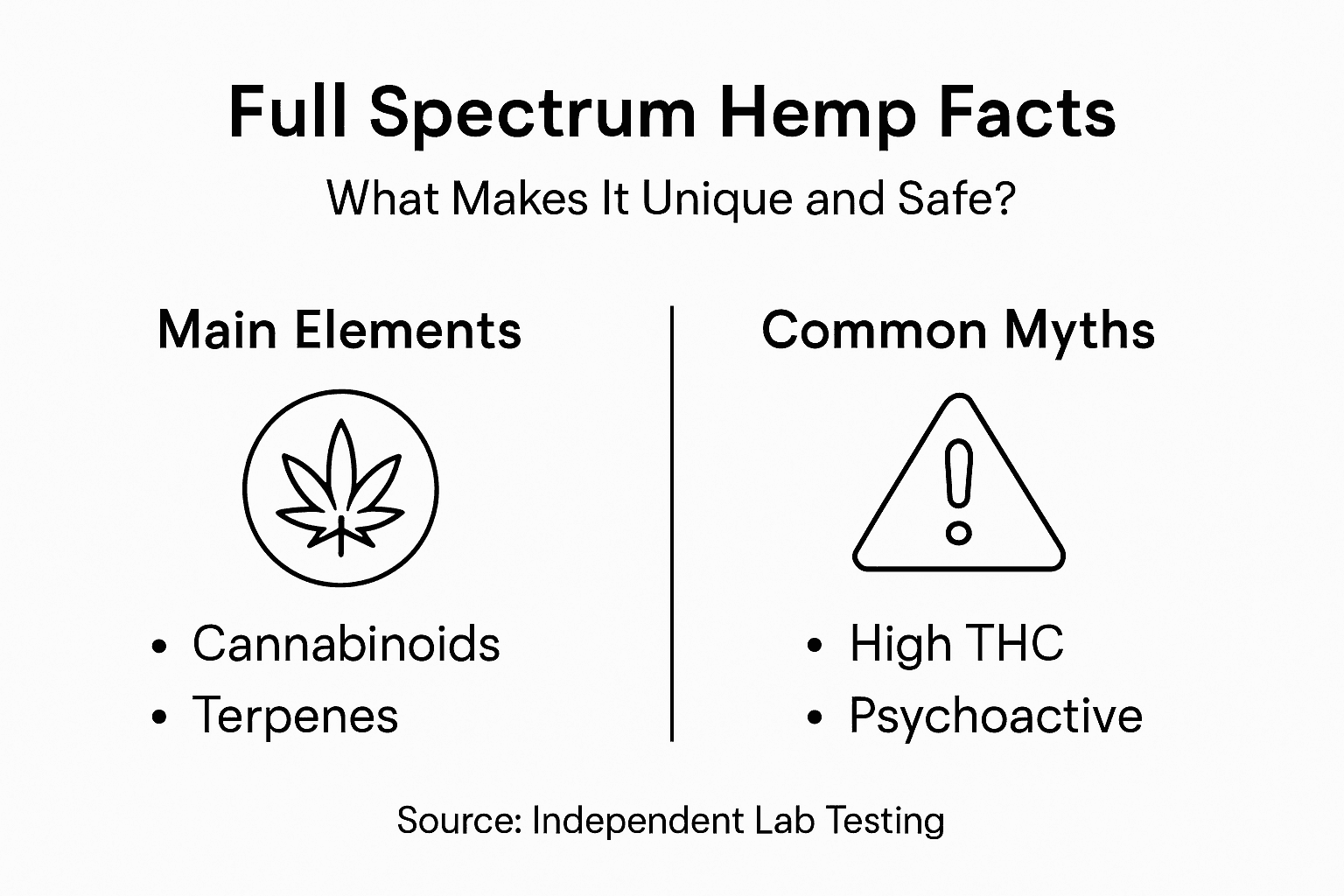
Full spectrum hemp represents a comprehensive approach to extracting and preserving the natural chemical complexity of the hemp plant. Unlike isolated cannabinoid extracts, full spectrum products retain the maximum amount of the plant’s original chemical constituents, including major and minor cannabinoids, terpenes, and flavonoids.
The fundamental distinction of full spectrum hemp lies in its holistic composition. Full spectrum hemp extract contains trace amounts of THC (not exceeding 0.3%), which differentiates it from other cannabis extracts. This nuanced profile means the product captures the plant’s entire chemical ecosystem, not just a single compound. Federal regulations have specifically defined hemp as cannabis containing less than 0.3% delta-9 THC, enabling legal cultivation and distribution.
Common myths about full spectrum hemp often stem from misunderstandings about its nature and legal status:
- Myth 1: Full spectrum hemp is the same as marijuana
- Myth 2: These products will produce a “high” sensation
- Myth 3: All hemp extracts are identical
- Myth 4: Full spectrum hemp is not scientifically validated
The reality is that full spectrum hemp products are non-psychoactive and contain minimal THC. They represent a nuanced approach to plant-based wellness, leveraging the complex interactions between different cannabinoids and plant compounds.
Pro tip: Always verify the third-party lab testing results for full spectrum hemp products to understand their exact cannabinoid profile and ensure legal compliance.
Types of Hemp Extracts and Their Differences
Hemp extraction is a complex process that yields various types of extracts, each with unique chemical compositions and potential therapeutic benefits. Different extraction methods produce dramatically different cannabinoid profiles, making the selection of extraction technique crucial for the final product’s effectiveness.
The primary types of hemp extracts include:
- Full Spectrum Extract: Contains the complete range of cannabinoids, including trace THC, terpenes, and flavonoids
- Broad Spectrum Extract: Similar to full spectrum but with THC completely removed
- CBD Isolate: Pure cannabidiol with all other compounds eliminated
- Whole Plant Extract: Captures the entire plant’s chemical profile
Extraction techniques significantly impact the final extract’s quality and therapeutic potential. Common methods include:
- Supercritical CO2 Extraction: Yields high-cannabinoid extracts with minimal solvent residue
- Ethanol Extraction: Preserves more plant compounds and acidic cannabinoids
- Hydrodistillation: Excellent for extracting terpenes but less effective for cannabinoids
The entourage effect plays a critical role in understanding extract differences. This phenomenon suggests that cannabinoids work synergistically, meaning full spectrum extracts might offer more comprehensive wellness benefits compared to isolated compounds.

Here’s a concise comparison of popular hemp extract types and their distinctive features:
| Extract Type | THC Content | Main Benefit | Typical Use Case |
|---|---|---|---|
| Full Spectrum | Up to 0.3% (legal) | Maximum plant synergy | General wellness support |
| Broad Spectrum | None | Broad plant compound profile | Sensitive to THC exposure |
| CBD Isolate | None | Pure cannabidiol, no other actives | Precise dosing, purity |
| Whole Plant Extract | Varies | Most complete cannabinoid mix | Traditional herbal uses |
The complexity of hemp extracts demonstrates that not all products are created equal - extraction method and chemical composition matter significantly.
Pro tip: Always request third-party lab testing results to understand the exact cannabinoid and terpene profile of your hemp extract.
How Full Spectrum Hemp Delivers Effects
Therapeutic research demonstrates full spectrum hemp’s remarkable potential for addressing various wellness challenges through its complex biochemical interactions. The extract’s effectiveness stems from its comprehensive chemical profile, which includes multiple cannabinoids, terpenes, and other plant compounds working synergistically.
The key mechanisms of full spectrum hemp’s effects include:
- Endocannabinoid System Interaction: Directly engages with the body’s natural regulatory network
- Receptor Modulation: Influences CB1 and CB2 receptors throughout the nervous system
- Inflammation Reduction: Helps mitigate cellular stress and inflammatory responses
- Neurological Support: Promotes balanced neural communication
The entourage effect is crucial in understanding how full spectrum hemp delivers its benefits. This phenomenon occurs when multiple cannabinoids and terpenes work together, creating a more powerful therapeutic response than any single compound could produce independently.
The complexity of full spectrum hemp means that its effects are not about a single active ingredient, but the intricate dance of multiple plant compounds.
Specific therapeutic potentials include:
- Pain management support
- Anxiety and stress reduction
- Sleep cycle regulation
- Neurological function enhancement
Pro tip: Start with low dosages and gradually increase to understand how your individual body responds to full spectrum hemp extracts.
Legal Status and Safety Standards in 2026
Federal legislation has dramatically reshaped hemp regulatory frameworks in the United States, introducing comprehensive changes that impact hemp product availability and compliance. The new regulations represent a significant shift in how hemp products are defined, manufactured, and distributed across the country.
Key legal developments in 2026 include:
- THC Redefinition: Total THC now includes THCA, not just delta-9 THC
- Product Restrictions: Stricter limits on intoxicating hemp-derived products
- Synthetic Cannabinoid Exclusion: Explicit prohibition of synthetic cannabinoid formulations
- Enhanced Testing Requirements: More rigorous laboratory verification protocols
The global landscape of hemp regulation remains complex:
- United States: Most restrictive framework with comprehensive federal oversight
- European Union: Stable cultivation rules with varying product acceptance
- Canada: Maintaining consistent regulatory approach
- United Kingdom: Continuing to refine hemp product standards
Compliance Challenges will be significant for industry stakeholders. Manufacturers must adapt quickly to new testing, labeling, and production standards to remain legally compliant.
Regulatory evolution in 2026 signals a mature approach to hemp product safety, prioritizing consumer protection and product transparency.
Pro tip: Consult legal and regulatory experts to ensure your hemp products meet the latest federal and state compliance requirements.
Choosing Quality Full Spectrum Hemp Products
Selecting high-quality full spectrum hemp products requires careful consideration of multiple critical factors to ensure safety, potency, and effectiveness. Consumers must look beyond marketing claims and develop a discerning approach to product selection.
Key criteria for evaluating full spectrum hemp products include:
- Source Transparency: Hemp grown in regulated agricultural environments
- Extraction Method: Clean, solvent-free extraction techniques
- Cannabinoid Profile: Comprehensive range of cannabinoids and terpenes
- Third-Party Lab Testing: Independent verification of potency and purity
The most critical aspects of product selection involve:
- Verifying detailed laboratory testing results
- Understanding the complete cannabinoid composition
- Checking for organic cultivation practices
- Examining the product’s complete ingredient list
Potency Verification remains crucial for consumer safety. Products should provide comprehensive lab reports showing exact cannabinoid concentrations, potential contaminants, and precise chemical profiles.
Below is a summary of key aspects for evaluating high-quality full spectrum hemp products:
| Evaluation Factor | Why It Matters | What to Look For |
|---|---|---|
| Source Transparency | Ensures safe, regulated supply | Verified farm location |
| Extraction Method | Impacts purity and effect | CO2 or ethanol extraction |
| Lab Testing | Confirms potency and safety | Accessible, up-to-date reports |
| Ingredient List | Reveals added substances | Clean, minimal, organic ingredients |
Not all full spectrum hemp products are created equal - rigorous testing and transparency separate exceptional products from mediocre alternatives.
Pro tip: Request and thoroughly review the complete certificate of analysis before purchasing any full spectrum hemp product, paying special attention to cannabinoid percentages and potential contaminant screenings.
Discover the True Power of Full Spectrum Hemp with California Blendz
Unlock the natural wellness benefits of full spectrum hemp by choosing products that harness the full chemical complexity of the plant including cannabinoids, terpenes, and flavonoids. If you want to experience the entourage effect and enjoy balanced relief, relaxation, or enhanced wellbeing, trust California Blendz for organic, sustainably grown, and lab-tested hemp products sourced directly from California’s Emerald Triangle.
Explore our premium selection in the CBD Sun Grown – California Blendz collection where transparency and quality meet. Now is the perfect time to take control of your wellness journey with products designed to deliver authentic full spectrum benefits. Visit California Blendz to browse, learn more about cannabinoid profiles, and find your ideal hemp solution today. For exclusive offers, also check out our New Deals – California Blendz and elevate your full spectrum experience.
Frequently Asked Questions
What is full spectrum hemp?
Full spectrum hemp refers to a type of extract that retains the complete range of cannabinoids, terpenes, and flavonoids from the hemp plant, including trace amounts of THC (not exceeding 0.3%).
How does full spectrum hemp deliver its effects?
Full spectrum hemp works by interacting with the body’s endocannabinoid system and influencing various receptors, which helps reduce inflammation and promote overall wellness due to a synergistic effect known as the entourage effect.
What are the differences between full spectrum, broad spectrum, and CBD isolate?
Full spectrum contains all cannabinoids including a small amount of THC, broad spectrum includes cannabinoids without THC, and CBD isolate is pure cannabidiol with no other active compounds.
Why is third-party lab testing important for full spectrum hemp products?
Third-party lab testing ensures the accuracy of the product’s cannabinoid profile, verifies its potency, and confirms the absence of contaminants, providing consumers with confidence in safety and quality.


