
Overcoming Cannabis Stigma: Building Social Acceptance
Written by Trevor

Nearly one in three American adults still feel hesitant discussing cannabis use with friends or healthcare professionals. For wellness-focused Californians, outdated attitudes often clash with a growing interest in natural remedies like CBD and THCa. Recognizing the roots of cannabis stigma provides clarity and opens new possibilities for personal relaxation and relief. Unpacking misconceptions helps you make confident, informed choices about organically grown products tailored to your health.
Table of Contents
- Understanding Cannabis Stigma and Misconceptions
- Types of Cannabis Stigma and Its Origins
- Current Legal Landscape and Changing Norms
- Impacts on Wellness, Disclosure, and Relational Trust
- Effective Strategies for Education and Advocacy
Key Takeaways
| Point | Details |
|---|---|
| Cannabis Stigma | Cannabis stigma encompasses structural, social, and personal dimensions that significantly affect individuals’ wellness and access to resources. |
| Evolving Legal Landscape | The legal status of cannabis is shifting globally, with varying regulations from prohibition to legalization, reflecting changing societal perceptions. |
| Importance of Education | Addressing cannabis stigma requires evidence-based education and compassionate advocacy that focuses on factual information and personal experiences. |
| Strategic Disclosure | Individuals should navigate personal relationships thoughtfully, assessing when to disclose cannabis use to foster trust while protecting privacy. |
Understanding Cannabis Stigma and Misconceptions
Cannabis has long been shrouded in misunderstanding, with deeply rooted societal misconceptions that have prevented meaningful dialogue about its potential benefits. These stigmas, often stemming from decades of misinformation and political propaganda, have created significant barriers for individuals seeking natural wellness alternatives. Shifting public perceptions about medical cannabis requires a comprehensive approach that addresses historical biases and challenges long-standing stereotypes.
The origins of cannabis stigma can be traced back to deliberate campaigns of fear and misinformation, particularly during the 1930s Reefer Madness era. These campaigns systematically portrayed cannabis users as dangerous and deviant, creating a lasting cultural narrative that has been challenging to dismantle. Social conditioning played a significant role in transforming cannabis from a commonly used medicinal plant to a demonized substance, effectively criminalizing its use and restricting scientific research.
Modern perspectives are gradually evolving, with increasing scientific evidence challenging previous misconceptions. Many people now recognize cannabis not as a dangerous drug, but as a complex plant with potential therapeutic applications. Research continues to demonstrate its effectiveness in managing conditions like chronic pain, anxiety, and sleep disorders. By understanding the complex myths surrounding cannabis, we can begin to deconstruct harmful stereotypes and approach the topic with nuance and empathy.
Pro Tip: Start conversations about cannabis with openness and curiosity, focusing on factual information and personal wellness experiences rather than repeating outdated stereotypes.
Types of Cannabis Stigma and Its Origins
Cannabis stigma is a multifaceted phenomenon that manifests across different social levels, creating complex barriers for individuals seeking to understand and utilize this plant. Comprehensive research on cannabis stigmatization reveals a nuanced landscape of prejudice that extends far beyond simple misconceptions.
Three primary types of cannabis stigma emerge from societal structures: structural stigma, social stigma, and personal stigma. Structural stigma operates at the institutional level, embedded in legal systems and policy frameworks that historically criminalized cannabis use. These systemic barriers create profound challenges for individuals, restricting access to medical treatment, employment opportunities, and social acceptance. The origins of cannabis stigmatization can be traced to moral panic, legislative control, and deep-rooted cultural narratives that positioned cannabis as a dangerous substance.
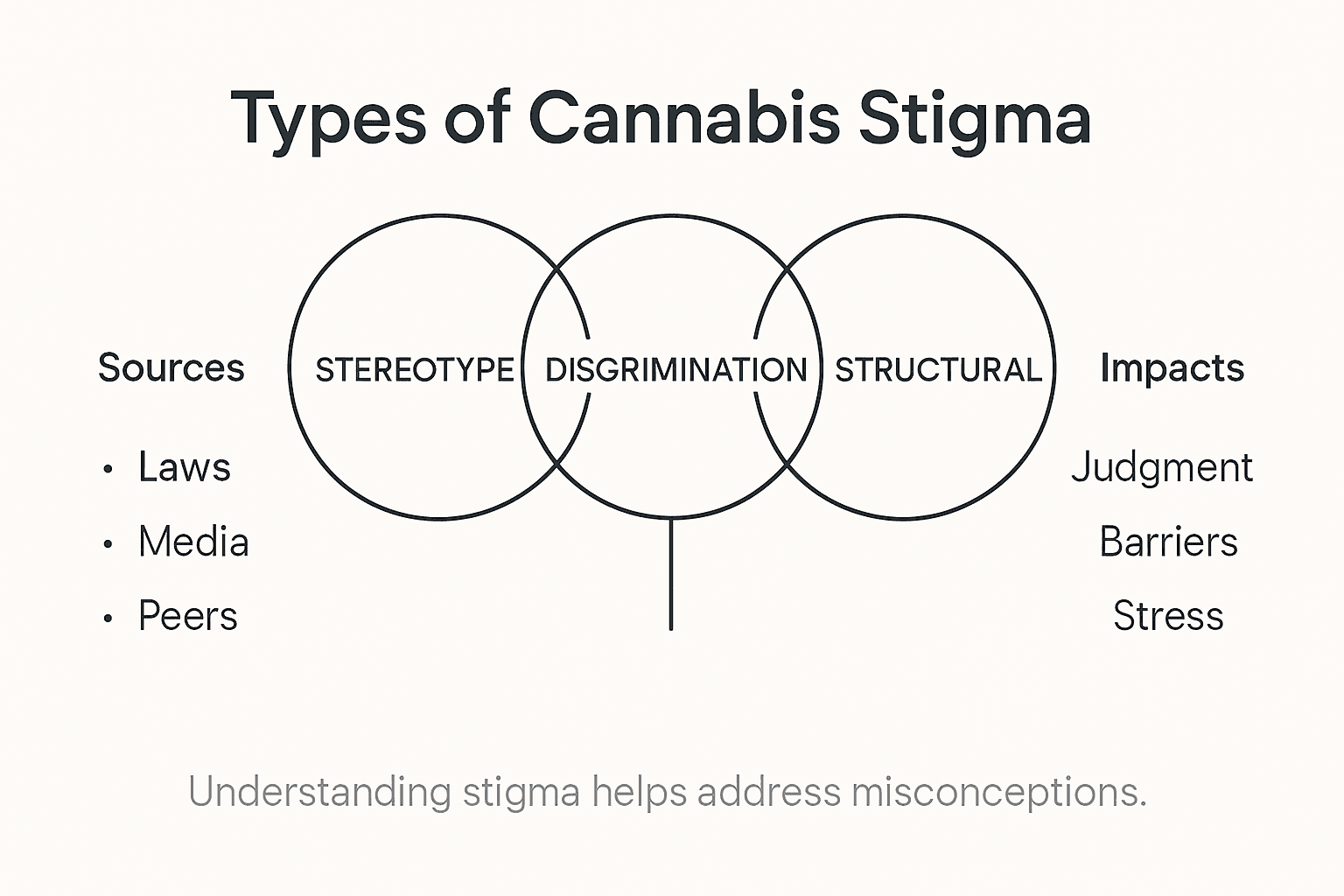
Social stigma manifests through interpersonal interactions, where cannabis users frequently encounter judgment, stereotyping, and marginalization. Friends, family members, and professional networks often perpetuate harmful narratives that paint cannabis consumers as irresponsible or deviant. This social conditioning creates psychological barriers that discourage open dialogue and personal exploration of cannabis’s potential therapeutic benefits. The evolving landscape of cannabis perception suggests a gradual shift toward more nuanced, scientifically informed understanding.
Pro Tip: Challenge cannabis stigma by engaging in informed, compassionate conversations that prioritize factual information and personal wellness experiences over outdated stereotypes.
Below is an at-a-glance summary of how the three main types of cannabis stigma differ across society:
| Type of Stigma | Source of Stigma | Main Impact on Individuals | Addressing Strategies |
|---|---|---|---|
| Structural | Laws, policies, institutions | Limits access to healthcare, jobs | Policy reform, advocacy campaigns |
| Social | Family, friends, networks | Judgment, isolation, social stress | Education, open dialogue |
| Personal | Internal beliefs, self-shame | Anxiety, concealment, low wellness | Counseling, peer support groups |
Current Legal Landscape and Changing Norms
The cannabis legal landscape has undergone profound transformations, reflecting a complex interplay of social attitudes, scientific research, and policy reforms. Emerging cannabis policy research demonstrates a significant shift from strict prohibition to more nuanced, evidence-based regulatory approaches across the United States and internationally.
Legal frameworks surrounding cannabis now encompass multiple regulatory models, ranging from complete prohibition to full legalization. Depenalization, decriminalization, and legalization represent distinct approaches that different jurisdictions have adopted. International cannabis policy variations reveal a diverse spectrum of legal strategies, with some regions focusing on medical use while others embrace broader recreational frameworks. These evolving policies reflect changing societal perspectives and increasing recognition of cannabis’s potential therapeutic and economic benefits.
California stands at the forefront of progressive cannabis legislation, with a comprehensive legal framework that balances consumer access, public health considerations, and responsible regulation. The state’s approach includes robust medical cannabis programs, carefully structured recreational use guidelines, and stringent quality control measures. Exploring cannabis policy transformations reveals a complex narrative of social change, scientific understanding, and legal innovation that continues to reshape perceptions and practices.
Pro Tip: Stay informed about local cannabis laws by regularly checking official state resources and understanding the specific legal nuances in your jurisdiction.
Here is a quick comparison of cannabis legal models and their real-world effects:
| Regulatory Model | Legal Status | Access to Cannabis | Social Acceptance |
|---|---|---|---|
| Prohibition | Fully illegal | No legal access | High stigma, strong taboo |
| Depenalization | Minor offense | Limited access, fines | Moderate stigma, less taboo |
| Decriminalization | Not criminal | Personal use allowed | Reduced stigma, more dialogue |
| Legalization | Fully legal | Regulated, open access | Low stigma, normalized usage |
Impacts on Wellness, Disclosure, and Relational Trust
Cannabis stigma creates profound psychological barriers that extend far beyond social perceptions, deeply impacting individual wellness, healthcare interactions, and personal relationships. Research on cannabis-related stigma in healthcare settings reveals the complex ways anticipated judgment can prevent individuals from seeking appropriate medical support and maintaining open communication with healthcare providers.

The psychological toll of cannabis stigma manifests through internalized shame and anticipatory discrimination, which significantly obstruct wellness journeys. Systematic investigations of stigma’s impact demonstrate how pervasive social stigmatization leads to reduced treatment-seeking behaviors and diminished trust in professional relationships. Users frequently experience anxiety about potential negative consequences, causing many to conceal their cannabis use even in medical contexts where transparent communication is crucial for comprehensive care.
Relational trust becomes particularly complex when cannabis use intersects with personal and professional networks. Individuals often navigate delicate social dynamics, weighing the potential risks of disclosure against the benefits of authenticity. Understanding user privacy considerations becomes essential in managing these intricate social interactions, allowing individuals to protect their personal information while maintaining genuine connections.
Pro Tip: Practice strategic disclosure by assessing individual relationships and creating safe spaces for honest, judgment-free conversations about your wellness choices.
Effective Strategies for Education and Advocacy
Addressing cannabis stigma requires a multifaceted approach that combines evidence-based education, strategic communication, and intentional cultural transformation. Comprehensive research on stigma reduction demonstrates that targeted educational interventions can fundamentally reshape public understanding and attitudes toward cannabis use, particularly when focusing on factual, nuanced information about medical applications and wellness potential.
Successful advocacy strategies incorporate several key elements: narrative storytelling, lived experience representation, and institutional training. Multi-level stigma reduction approaches emphasize the importance of creating holistic, intersectional educational frameworks that address misconceptions across interpersonal, professional, and societal levels. By humanizing cannabis users and providing context-rich, scientifically grounded information, advocates can gradually dismantle long-standing prejudices and promote more empathetic, informed perspectives.
Communication tactics play a crucial role in shifting perceptions. Effective advocates focus on creating safe, judgment-free spaces for dialogue, utilizing evidence-based messaging that highlights the potential therapeutic benefits and responsible use practices. Exploring cannabis education strategies reveals the power of personal narratives and scientific communication in challenging existing stereotypes and building more nuanced societal understanding.
Pro Tip: Approach cannabis discussions with curiosity and openness, prioritizing factual information and personal wellness experiences over defensive or confrontational communication.
Break Free From Cannabis Stigma With Trusted Quality and Transparency
Overcoming cannabis stigma requires more than conversations it demands access to products you can trust and feel confident about. If you have faced social judgment or internalized doubt about cannabis use for wellness discovering clean and responsibly sourced options can empower your journey toward natural relief and relaxation. California Blendz offers lab-tested, organic hemp-derived CBD and THCa flower curated from California’s Emerald Triangle—all selected to support your well-being with transparency and care.
Explore The Founder’s Collection – California Blendz for premium products that reflect a commitment to quality and responsible cultivation. By choosing products that align with your wellness goals you reinforce informed self-care and help build social acceptance. Take control of your cannabis experience today by visiting California Blendz to browse trusted selections or check out our thoughtful THCa Bundle – California Blendz designed for those seeking effective natural solutions. Start your journey with confidence now.
Frequently Asked Questions
What are the main types of cannabis stigma?
Cannabis stigma can be categorized into three main types: structural stigma, which involves legal and institutional barriers; social stigma, which arises from interpersonal interactions and societal perceptions; and personal stigma, which includes internal beliefs and shame about cannabis use.
How does cannabis stigma affect individual wellness?
Cannabis stigma can lead to internalized shame and anticipatory discrimination, which may prevent individuals from seeking appropriate medical support, thereby impacting their overall wellness journey and trust in healthcare providers.
What strategies can be used to combat cannabis stigma?
Effective strategies include education through narrative storytelling, representation of lived experiences, and institutional training. Creating safe spaces for dialogue and providing evidence-based information can help shift public attitudes toward cannabis use.
Why is open dialogue important in overcoming cannabis stigma?
Open dialogue allows for sharing factual information and personal wellness experiences, which is essential for challenging misconceptions and fostering a more empathetic understanding of cannabis use. This approach helps reduce social barriers and promotes acceptance.
Recommended
- Green Revolution: The Destigmatization of Cannabis Revolt – California Blendz
- Cannabis Wellness Without the High: Navigating the Safe & Sober Path – California Blendz
- Unveiling the Effects of Smoking Cannabis Out of Papers on Flavor Prof – California Blendz
- 1930’s Reefer Madness and Its Impact on Society – California Blendz


